A single SUAVE model predicts long-horizon video and acts as a policy, competitive with dedicated world models and specialized action policies on static and dynamic manipulation tasks and shows that masked diffusion is a practical and versatile foundation for unified video-action modeling.
Abstract
Vision-language-action models (VLAs) inherit strong semantic grounding from pretrained vision-language backbones but are typically optimized for predicting actions rather than future observations. They can see and act, but they do not imagine the future before acting. World action models (WAMs) built on video diffusion backbones can imagine but treat language as frozen conditioning on a continuous latent space. Unified models bring these modalities into one architecture, but they either decode autoregressively, one token at a time, or keep video continuous with an auxiliary action head. In this work, we present SUAVE, a Single vocabulary Unified Action-Video modEl in which a masked diffusion transformer generates video and actions conditioned on language, with all three modalities represented as discrete tokens in a shared sequence. Choosing which tokens to mask at inference turns the same network into a world model, a robot policy, or a video-action model. For action-free co-training, the action positions of unlabeled video are filled with mask tokens and excluded from the loss. Simulation and real-world experiments demonstrate two findings. First, a single SUAVE model predicts long-horizon video and acts as a policy, competitive with dedicated world models and specialized action policies on static and dynamic manipulation tasks. On a real robot, our model generates subgoal images and an action chunk spanning one second of motion in 1,030 ms on an RTX 5090 GPU, sustaining closed-loop control at 2.5 actions per second. Second, pretraining on robot video and co-training on human video substantially improves policy performance and zero-shot robustness to distribution shift. Together, these results show that masked diffusion is a practical and versatile foundation for unified video-action modeling.

Vision-language-action models benefit from the understanding and reasoning capabilities of pretrained vision-language models, but action-only supervision provides limited grounding in world dynamics. Conversely, world-action models inherit spatiotemporal priors from video generation models, yet remain limited in semant...
Wen-Xuan Song, Jia-Yi Chen, Jing-Bo Wang et al.· 3 citations
LD4WAM is presented, which pairs a Latent Dynamics Model trained with semantic reconstruction and real motion alignment with a World Dynamics Action Model built as a mixture-of-transformers (MoT), which preserves full future-video generation and uses learnable queries to distill these latent dynamics from generated fut...
Zhen Shen, Jia-Qi Liang, Jasper Lu et al.· 3 citations
Vision Language Action (VLA) models condition actions directly on current visual and language context, without an explicit account of how the scene evolves under candidate actions. World Action Models (WAM) attempt to address this limitation by predicting future states, but existing designs keep prediction and policy l...
Hong-Yi Cai, Yi Herng Ong, Ting-Ting Wu et al.· 0 citations
Intention Distillation (INDI) is proposed, which distills behavior-level intent into the action decoder and organizes downstream predictions in an objective-dependent manner, and shows that action decoders benefit from explicitly modeling the semantic objective of the behavior they generate.
Vision-Language-Action (VLA) models have recently incorporated world models to provide richer dynamic supervision beyond sparse action labels. However, explicitly predicting future images or videos may include control-irrelevant appearance, while guidance derived from holistic future visual representations and shared g...
Vision-Language-Action (VLA) models have become a central paradigm for robot policy learning, which predict actions in three forms: raw action chunks, discrete action tokens, or continuous action latents. However, existing action representations primarily model action trajectories, with limited consideration of the vis...
Yuan Xu, Yi-Xiang Chen, Qi-Sen Ma et al.· 0 citations
Exploring how generative AI could make machine vision more accessible to businesses. The post GenEye in a Box: Making Machine Vision Something You Can Just Ask For appeared first on GPT-Lab.
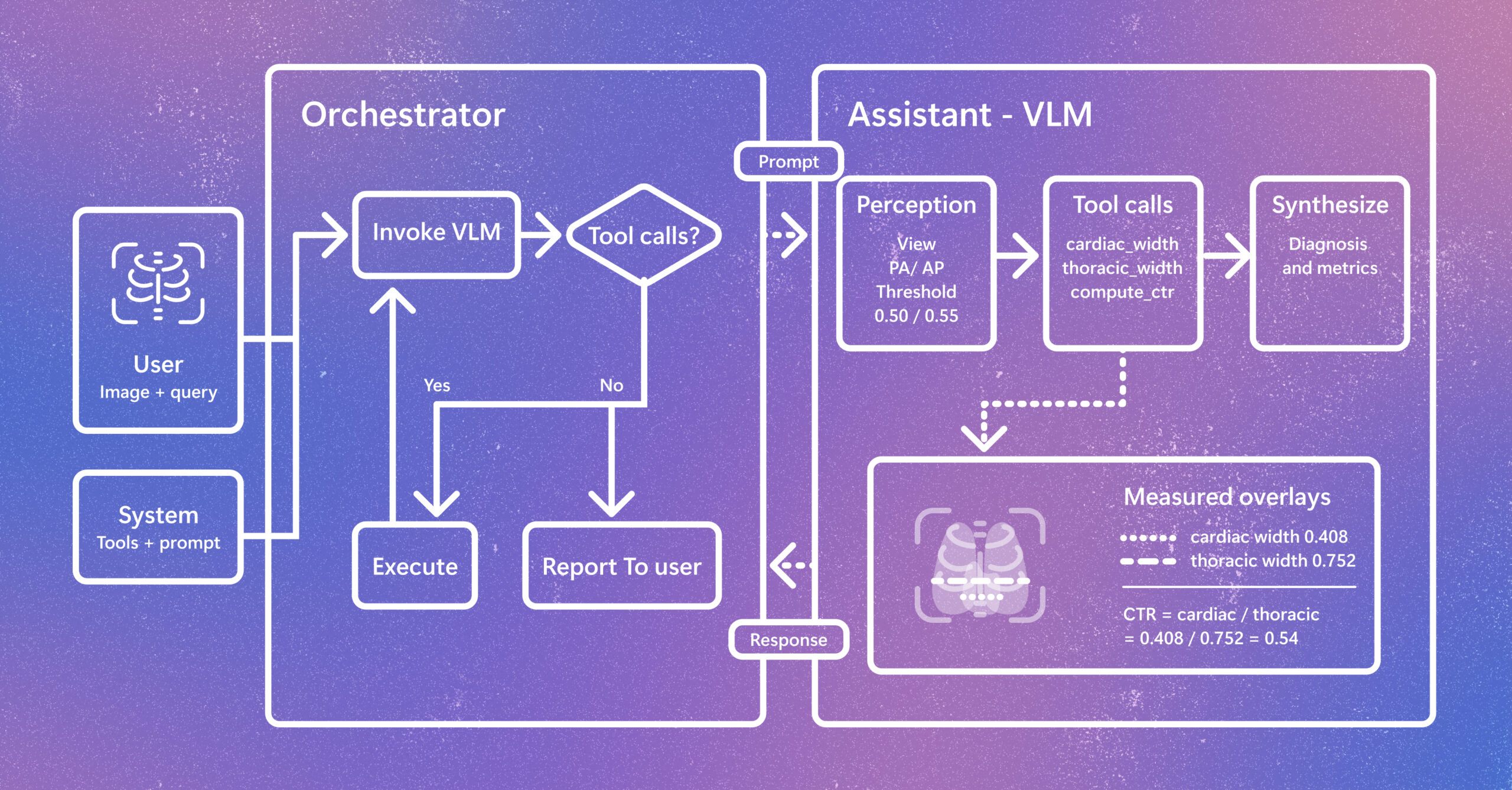
Radiology AI is evolving beyond report generation. CARE-X explores a unified approach that combines flexible reasoning, calibrated predictions, and measurement-based tools for chest X-ray interpretation. The post Introducing CARE-X: Towards Clinically Useful Radiology VLMs with Auxiliary Supervision, Reward-Aligned Learning, and Tool-Augmented Measurement appeared first on Microsoft Research.