Skip to content

Distilling Graph Geometry: Knowledge Gap from GNNs to MLPs

Oct 2026 · 0 citations · 42 references
Computer Science

Abstract

GNN-to-MLP distillation aims to retain the predictive accuracy of a message-passing teacher while deploying a graph-free MLP at inference. Existing methods mainly transfer node-wise predictions or use confidence-based reweighting, but they do not specify where the student should preserve the teacher's graph-induced geometry. We show that this omission leads to two spectral failure modes in the student's representation space. On sparse graphs, the student suffers from spectral underfit, missing high-energy teacher directions induced by aggregation. On dense graphs, it suffers from spectral overfit, retaining spurious directions that the teacher has collapsed through aggregation. Motivated by an energy-weighted teacher-student alignment objective, we propose Graph Geometry-aware MLP (G^2MLP), a training-time distillation framework guided by Ollivier-Ricci curvature. Curvature acts as a local proxy for allocating supervision between prediction-level and representation-level alignment. The deployed model is a standard MLP with no graph access at inference. Across node-classification benchmarks, G^2MLP improves over graph-free distillation baselines in most settings, reduces the teacher-student rank gap in both regimes, and transfers to Graph Transformer teachers and link prediction.
View source

Similar papers

#artificial intelligence Preprint Jul 2024

The Llama 3 Herd of Models

It is found that Llama 3 delivers comparable quality to leading language models such as GPT-4 on a plethora of tasks, and performs competitively with the state-of-the-art on image, video, and speech recognition tasks.

Aaron Grattafiori, Abhimanyu Dubey, Abhinav Jauhri et al. · 21,082 citations · ⚡3,832
#artificial intelligence Conference Open access Jun 2018

Gibson Env: Real-World Perception for Embodied Agents

This paper investigates developing real-world perception for active agents, proposes Gibson Environment for this purpose, and showcases a set of perceptual tasks learned therein.

F. Xia, Amir Zamir, Zhi-Yang He et al. · 1,069 citations · ⚡112
#machine learning Review Open access Oct 2014

Software development in startup companies: A systematic mapping study

The results indicate that software engineering work practices are chosen opportunistically, adapted and configured to provide value under the constrains imposed by the startup context.

Nicolò Paternoster, Carmine Giardino, M. Unterkalmsteiner et al. · 394 citations · ⚡54

Diffusion models as plug-and-play priors

The possibility of inferring high-dimensional data inference in a model that consists of a prior and an auxiliary differentiable constraint given some additional information is considered, thereby allowing a range of potential applications in adapting models to new domains and tasks.

Alexandros Graikos, Esmeralda S. Whitammer, N. Jojic et al. · 316 citations · ⚡15

Trajectory Balance: Improved Credit Assignment in GFlowNets

It is proved that any global minimizer of the trajectory balance objective can define a policy that samples exactly from the target distribution, and empirically demonstrate the benefits of the trajectories balance objective for GFlowNet convergence, diversity of generated samples, and robustness to long action sequenc...

Esmeralda S. Whitammer, Moksh Jain, Emmanuel Bengio et al. · 302 citations · ⚡60

Related blog posts

Microsoft Research Blog Nov 16, 2026

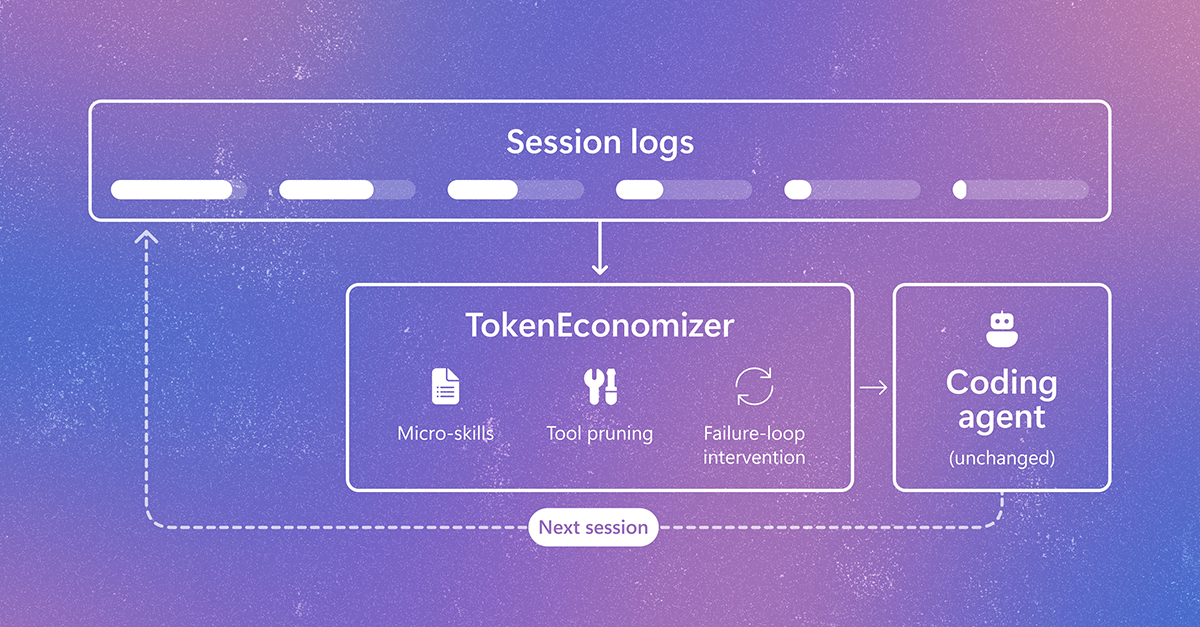
TokenEconomizer: Learning from Experience to Make AI Coding Agents More Efficient

AI coding agents are increasingly help developers fix bugs and build features largely on their own, but every interaction with their models consumes tokens. In each session, an agent sends instructions, tool descriptions, and session history to its model. Most efforts to reduce this cost focus on individual tasks. Yet developers return to the same […] The post TokenEconomizer: Learning from Experience to Make AI Coding Agents More Efficient appeared first on Microsoft Research.

We use cookies to run the site and, with your consent, for analytics and to show ads. See our Cookie Policy.