AI Networking Cookbook: Practical recipes for AI-assisted network automation and development
Similar papers
New directions on agile methods: a comparative analysis
Agile Software Development Methods: Review and Analysis
This publication proposes a definition and a classification of agile software development approaches and analyses ten software development methods that can be characterized as being "agile" against the defined criterion.
The impact of agile practices on communication in software development
The study shows that agile practices improve both informal and formal communication, but indicates that, in larger development situations involving multiple external stakeholders, a mismatch of adequate communication mechanisms can sometimes even hinder the communication.
Software development in startup companies: A systematic mapping study
The results indicate that software engineering work practices are chosen opportunistically, adapted and configured to provide value under the constrains imposed by the startup context.
Diffusion models as plug-and-play priors
The possibility of inferring high-dimensional data inference in a model that consists of a prior and an auxiliary differentiable constraint given some additional information is considered, thereby allowing a range of potential applications in adapting models to new domains and tasks.
Trajectory Balance: Improved Credit Assignment in GFlowNets
It is proved that any global minimizer of the trajectory balance objective can define a policy that samples exactly from the target distribution, and empirically demonstrate the benefits of the trajectories balance objective for GFlowNet convergence, diversity of generated samples, and robustness to long action sequenc...
Related blog posts
What AI gets wrong and what failure teaches us
Jennifer Neville did not want to go into computer science—but that’s exactly where she landed. Neville discusses the starts and stops that led to her professional sweet spot and her work identifying “surprising failures” making it hard for AI to handle complexity. The post What AI gets wrong and what failure teaches us appeared first on Microsoft Research.
Echoverse: Deep, evolving environments for computer-use agents
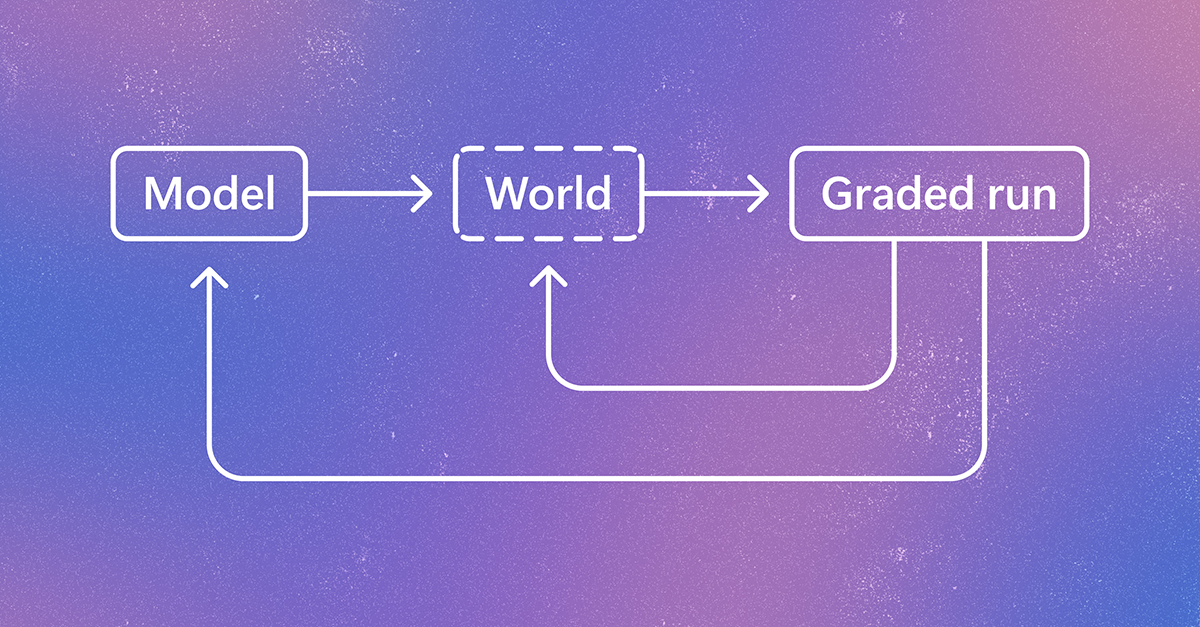
Computer-use AI agents struggle with multi-step workflows like email and customer support. Echoverse trains agents in realistic environments rather than simply providing more training tasks, helping them improve as the tasks, tests, and environments evolve. The post Echoverse: Deep, evolving environments for computer-use agents appeared first on Microsoft Research.
Beyond one-on-one: Authoring, simulating, and testing dynamic human-AI group conversations
Human-Computer Interaction and Visualization
Solving a 31-year-old grand challenge in mathematics – the KLS conjecture
For decades, a fundamental question about the difficulty of computing in high-dimensional spaces has resisted proof. New research resolves this question, removing a major theoretical obstacle to understanding the efficiency of randomized algorithms used across science and computing. The Kannan–Lovász–Simonovits (KLS) conjecture was proposed in 1995. It asks whether, for a broad class of high-dimensional […] The post Solving a 31-year-old grand challenge in mathematics – the KLS conjecture appear…