FACET proposes an efficient replay-free task-conditioned feature consistency loss, aiming to mitigate catastrophic forgetting of the learned mixture distribution in the adapter's feature space, and demonstrates robust scalability.
Abstract
Class-incremental learning (CIL) requires a model to incrementally learn tasks that contain new classes without accessing earlier training data while preserving the ability to recognize all seen classes. Recently, pretrained-model-based approaches have become prevalent by adapting a frozen backbone with additional lightweight trainable modules. Existing methods, however, exhibit limitations: task-specific adapters learn explicit per-task representations but are parameter- and computation-inefficient, while LoRA-based merging methods combine per-task LoRA parameters into a single model whose static aggregated weights cause representation interference during inference. To address these problems, we present \textbf{FACET}: task-conditioned \textbf{F}e\textbf{A}ture transformation with \textbf{C}ondition\textbf{E}d feature consis\textbf{T}ency, achieving excellent parameter efficiency while producing highly discriminative features during inference. When continually trained on a task sequence, FACET learns a single shared adapter that employs a dynamic task-conditioned feature transformation, shaping the overall feature distribution of the adapter into a mixture of overlap-reduced task-specific components. On the other hand, we propose an efficient replay-free task-conditioned feature consistency loss, aiming to mitigate catastrophic forgetting of the learned mixture distribution in the adapter's feature space. Even when maintaining only a single adapter, FACET demonstrates robust scalability. On both very long task sequences (e.g., 200 tasks) and standard short task sequences (e.g., 20 tasks), our method achieves superior performance while using significantly fewer trainable parameters and GFLOPs. The code will be made open source upon acceptance.

Parameter-efficient adaptation enables continual learners to acquire task-specific knowledge through compact model updates while maintaining strong within-task performance. However, class-incremental inference requires each input to be classified among all classes seen so far without access to its task identity. For le...
Long-Huan Xu, Zhi-Peng Zhou, Wei-Liang Ji et al.· 0 citations
Experiments show that FiUni can effectively infer latent batch-level task affiliations and achieve competitive performance against advanced task-aware CL methods with fewer trainable parameters.
Dezheng Han, Anlan Zhang, Zhiwu Zhu et al.· 0 citations
Self-evolving language models improve by generating tasks and learning from their own feedback, but adapting the task generator often requires a separate challenger-training loop. Can we generate tasks adapted to the current solver without explicitly training a challenger? We introduce \textbf{D}irect Self-\textbf{E}vo...
MemMTL, a multi-task dense prediction framework that estimates a compact task state from global visual context and refines it through a learnable task-state prototype memory, is proposed.
Yang-Yang Xu, Haobo Yuan, Yu-Zhu Wang et al.· 0 citations
TAILS resolves cross-task ambiguity at the representation level, while leaving the original PTM, method-specific modules, and classifier unchanged, and can improve classification and task-inference performance with modest parameter overhead and negligible inference cost.
Zhiming Xu, Huiyu Yi, Zheng-He Xie et al.· 0 citations
RaMod, a Representation-Aware Modularity framework, is proposed, a Representation-Aware Modularity framework to extend the ReFT paradigm to CTG through two novel components: Dual-Modular Representation & Parameter Fine-tuning, which manipulates only a strategically chosen subset of hidden representations with modular i...
Zheng Gong, Ying Sun, Chao Wang et al.· Proceedings of the Thirty-Fi...· 0 citations
Exploring how generative AI could make machine vision more accessible to businesses. The post GenEye in a Box: Making Machine Vision Something You Can Just Ask For appeared first on GPT-Lab.
Microsoft Research Blog· microsoft.comAug 11, 2026
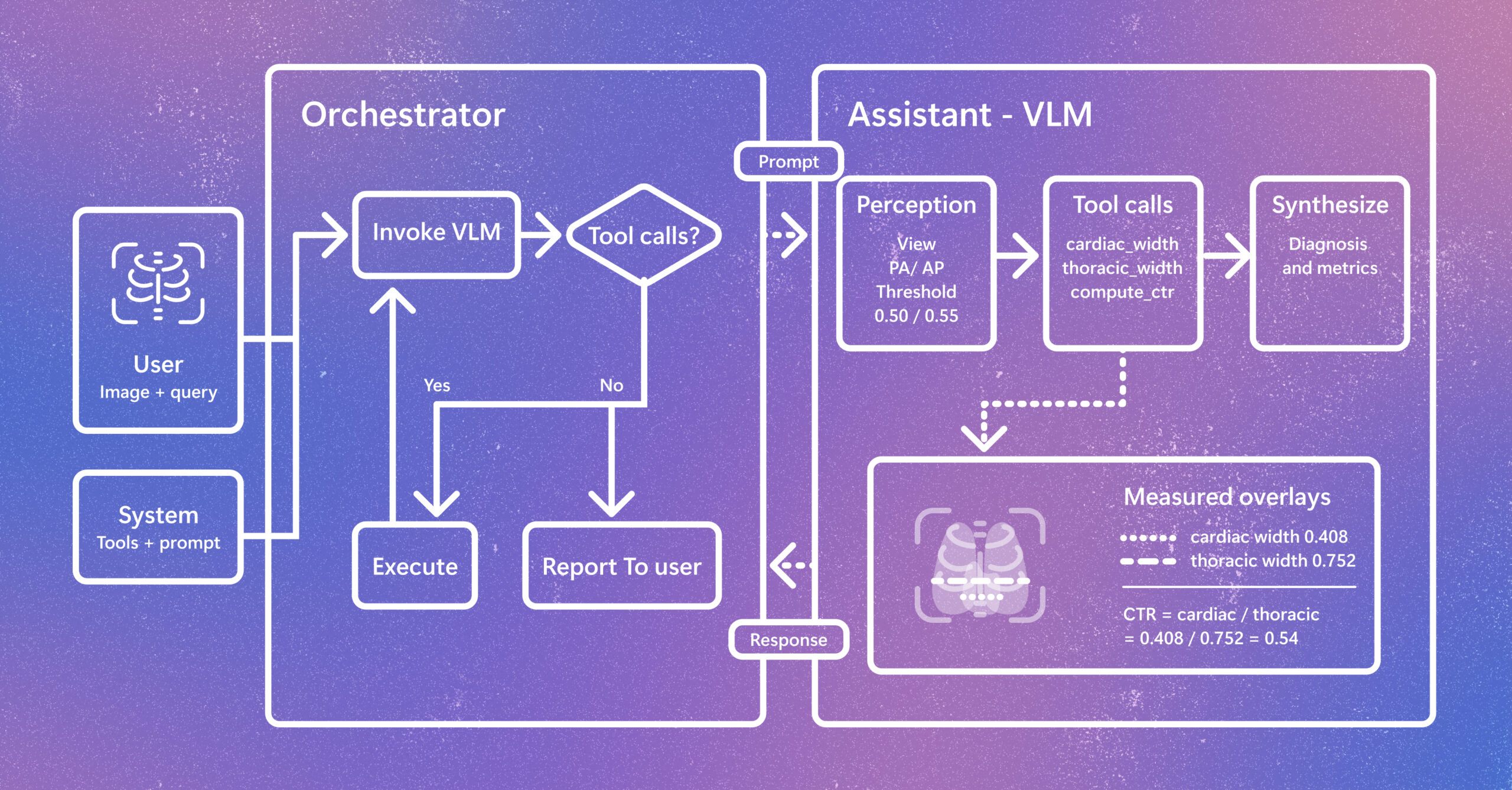
Radiology AI is evolving beyond report generation. CARE-X explores a unified approach that combines flexible reasoning, calibrated predictions, and measurement-based tools for chest X-ray interpretation. The post Introducing CARE-X: Towards Clinically Useful Radiology VLMs with Auxiliary Supervision, Reward-Aligned Learning, and Tool-Augmented Measurement appeared first on Microsoft Research.