Skip to content

Managing the Noise: Harnessing the Power of Graph Neural Networks to Detect Subsurface Damage under Noisy Experimental Settings

Jan 2027 · Journal of computing in civil engineering · 0 citations · 47 references
Structural Health Monitoring Techniques

Abstract

Aging infrastructure with limited budgets has driven stakeholders to explore new methods for monitoring structural health. Structural health monitoring represents a strategy to address this challenge using physical measurements to characterize performance. This approach has often leveraged various sensing modalities to describe operational response to loading environment, with most strategies relying on continuous measurement. In recent years, the complexity and economic constraints associated with continuous monitoring have motivated alternatives. The digital twin framework offers a model-first approach, where real-world data informs virtual models (the “twin”), enables dynamic updates based on measurements and further offers enhanced assessment and predictive capabilities. This work formulates a graph neural network-powered prototype digital twin of a structural system that can identify unseen damage through updating intact finite element models of small-scale representations of structural elements based on full-field measurements. Within this study, MeshGraphNet is trained on noisy strain and displacement data using noise statistics characterized from a physical digital image correlation experimental setup, which differs from most existing methods that rely on idealized or synthetically generated noise. Three models were trained on noise-free data, data with noise, and data with improved signal-to-noise ratios. Results demonstrate that model performance correlates positively with damage severity, achieving an F1 score of 43.79% for the damaged class across the data set. Performance improved substantially when evaluated on specific damage severity ranges, reaching 78.75% for instances with 45%–50% damage, as shear strain exceeds the noise floor at higher damage severities. When compared to robust principal component analysis and denoising autoencoders, the proposed mixed data training strategy outperforms these preprocessing methods. Validation on a physical dogbone specimen demonstrates consistent performance across simulated and experimental data, indicating potential for real-world implementation. Future work aims to extend the framework to more extensive experimental data and assess the scalability of the trained model for larger and more complex structural systems.
View source

Similar papers

#computer vision Conference Aug 2008

Scrum in a Multiproject Environment: An Ethnographically-Inspired Case Study on the Adoption Challenges

Agile methods continue to gain popularity. In particular, the Scrum method appears to be on the verge of becoming a de-facto standard in the industry, leading the so called Agile movement. While there are success stories and recommendations, there is little scientifically valid evidence of the challenges in the adoptio...

A. Marchenko, P. Abrahamsson · 59 citations · ⚡11
#computer vision Open access Sep 2012

Making the leap to a software platform strategy: Issues and challenges

A comprehensive taxonomy of the challenges faced when a medium-scale organization decided to adopt software platforms is provided, namely: business challenges, organizational challenges, technical challenges, and people challenges.

Yaser Ghanam, F. Maurer, P. Abrahamsson · 41 citations · ⚡3
#machine learning Open access Mar 2024

Integration of molecular coarse-grained model into geometric representation learning framework for protein-protein complex property prediction

MCGLPPI, a novel geometric representation learning framework that combines graph neural networks (GNNs) with the MARTINI molecular coarse-grained (CG) model to predict overall PPI properties accurately and efficiently, offers an effective and efficient solution for PPI overall property predictions.

Yang Yue, Shu Li, Yihua Cheng et al. · 15 citations

PepPCBench is a Comprehensive Benchmarking Framework for Protein-Peptide Complex Structure Prediction

PepPCBench enables a robust evaluation of PFNN-based methods and supports their continued development for peptide-protein structure prediction, and highlights the influence of peptide length, conformational flexibility, and training set similarity on prediction accuracy.

Si-Long Zhai, Huifeng Zhao, Ji-Ke Wang et al. · 13 citations · ⚡1
#data science Open access Oct 2026

Less can be more for predicting properties with large language models

Abstract Predicting properties from coordinate–category data—sets of vectors paired with categorical information—is fundamental to computational science, manifesting in materials science as predicting formation energies or elastic moduli from crystal structures. While large language models (LLMs) have increasingly been...

Nawaf Alampara, Santiago Miret, Kevin Maik Jablonka · 13 citations

Related blog posts

Microsoft Research Blog Jul 13, 2026

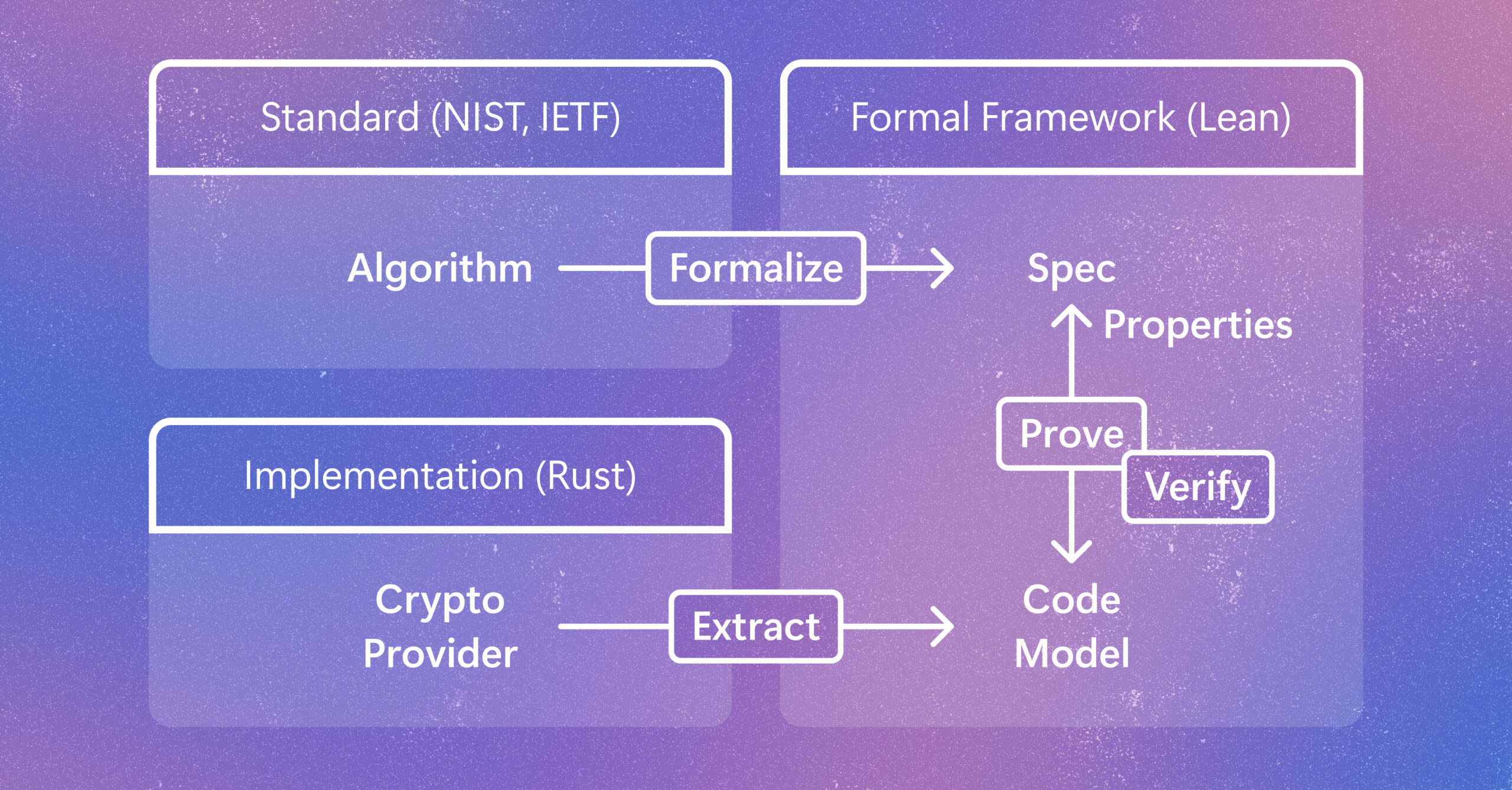
Verifying Rust cryptography in SymCrypt, from standards to code

Cryptographic code supports vital protections in modern computing systems. Learn how a new method helps verify code as developers write it while preserving speed and adaptability as it gets implemented and evolves. The post Verifying Rust cryptography in SymCrypt, from standards to code appeared first on Microsoft Research.

We use cookies to run the site and, with your consent, for analytics and to show ads. See our Cookie Policy.