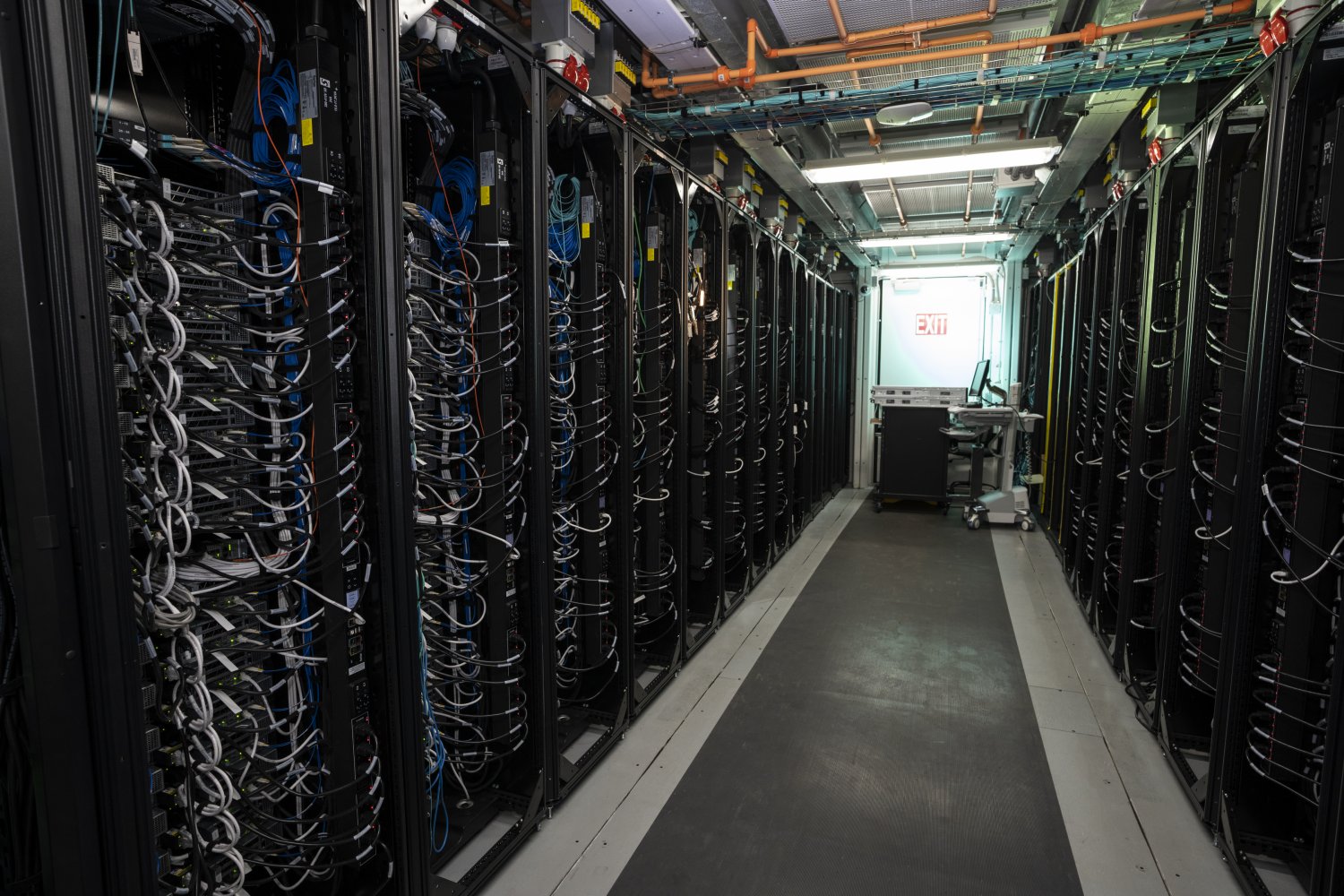
Determinizm Termo-Algorytmiczny w Hyperscale AI: Modelowanie i proaktywna kontrola nieliniowej propagacji anomalii hydrodynamicznych obiegów mCDU do warstwy wykonawczej obliczeń rozproszonych.
Abstract
Determinizm Termo-Algorytmiczny w Hyperscale AI: Modelowanie i proaktywna kontrola nieliniowej propagacji anomalii hydrodynamicznych obiegów mCDU do warstwy wykonawczej obliczeń rozproszonych Streszczenie: Wraz ze skalowaniem klastrów obliczeniowych sztucznej inteligencji (AI/HPC) powyżej gęstości mocy 100 kW na szafę rackową, dotychczasowy paradygmat ścisłej separacji infrastruktury mechaniczno-hydraulicznej (HVAC/mCDU) od warstwy wykonawczej oprogramowania ulega całkowitemu załamaniu. Niniejsza rozprawa doktorska wprowadza i formalizuje pojęcie Determinizmu Termo-Algorytmicznego – teorii stanowiącej, że w architekturach wielkowęzłowych proces obliczeniowy jest zdarzeniem ściśle termodynamicznym, w którym fizyka płynu bezpośrednio modyfikuje czas trwania cyklu zegara procesora oraz determinuje łączny czas egzekucji algorytmu (t_exec). Głównym celem badawczym pracy jest sformułowanie, numeryczne rozwiązanie oraz empiryczna walidacja modelu nieliniowej propagacji zaburzeń hydraulicznych ze skali makroinstalacji obiegów wtórnych mCDU do skali mikro (mikrokanały zimnych płyt GPU o wymiarach 100–200 µm), a ostatecznie do logiki sterowania częstotliwością taktowania krzemu w trybie DVFS i orkiestracji barier synchronizacji klastrowej (NCCL Ring-AllReduce). W ramach pracy wyprowadzono Sprzężony Układ Równań Stanu (0D Lumped-Parameter DAE System), wiążący w jedną pętlę sprzężenia zwrotnego: Kinematykę taktowania zegara PMIC w dziedzinie cykli obliczeniowych: dC(t) / dt = f(T_j(t)) Bilans cieplny złącza krzemowego (T_j) uwzględniający dodatnie sprzężenie zwrotne z wykładniczo rosnącymi prądami upływu I_leak(T_j) oraz załamanie konwekcyjnego współczynnika przejmowania ciepła h_conv na skutek uwięzionej fazy gazowej alpha_void: C_th * (dT_j(t) / dt) = P_total(f(t), V(t), T_j(t)) * S(t) - h(alpha_void(t)) * A * (T_j(t) - T_fluid(t)) gdzie P_total(f, V, T_j) = P_dyn(f, V) + V * I_leak(T_j), a S(t) = 1 / [1 + exp(k * (t - t_exec))] stanowi gładką sigmoidalną funkcja przejścia w stany spoczynku C-state. Stochastyczną inercję hydrodynamiki dwufazowej, opisującą desorpcję gazów obcych z płynu zgodnie z Prawem Henry’ego oraz lokalne mikro-wrzenie (flash evaporation) wywołane zapaścią ciśnienia statycznego np. (P_stat < 30 PSIG / 2.07 bar g): tau_void * (d alpha_void(t) / dt) = G_eq(Q_dot(t), m_dot(t), Delta P_micro(t)) - alpha_void(t) W odpowiedzi na zidentyfikowany problem opóźnienia klasycznych czujników (1–10 Hz) opracowano cyber-fizyczny algorytm kontroli TACE-Alg, wykorzystujący telemetrię piezoelektryczną 100 Hz. Pomiary ruchomej wariancji szumu ciśnienia różnicowego sigma^2_DeltaP pozwalają na estymację ułamka fazy gazowej alpha_void(t) = min(0.05, gamma * sqrt(sigma^2_DeltaP(t))) oraz proaktywną modyfikację pracy pomp VFD lub zaworów bypass na 300–800 ms przed krytycznym skokiem temperatury krzemu T_j, trwale eliminując powstawanie lokalnych maruderów (Straggler Effect) w synchronicznych operacjach rozproszonych. Rozprawa rozszerza uniwersalny model teoretyczny na dwie zaawansowane domeny technologiczne: Obliczenia Post-CMOS (Part V): Zastosowanie predykcyjnych materiałów zmiennofazowych (PCM), falowodów fononowych oraz ciekłych metali sterowanych magnetohydrodynamicznie (MHD) w stykach gęstości mocy przekraczających 500 W/cm². Autonomiczne Systemy Kosmiczne (Part VI): Załamanie konwekcji swobodnej w warunkach mikrograwitacji (g -> 0), potęgowanie zjawiska przywierania pęcherzy (alpha_void > 0), dysypacja radiacyjna Stefana-Boltzmanna w próżni kosmicznej oraz kointegracja ciepła odpadowego z układami podtrzymywania życia załogi (ECLSS). Opracowanie wieńczy zestaw rygorystycznych procedur odbiorowych QA/QC (dwuetapowa deaeracja próżniowa, kalibracja poduszki azotu np. 25 PSIG przy bezwzględnie wyzerowanym przyłączu cieczowym 0.0 PSIG oraz „Test Neodymowy”), stanowiący bezpośrednie wdrożenie inżynieryjne wyników badań do praktyki komisjonowania najnowocześniejszych centrów danych Hyperscale AI. Title: Thermo-Algorithmic Determinism in Hyperscale AI: Modeling and Proactive Control of Non-Linear Hydrodynamic Anomaly Propagation from mCDU Loops to the Execution Layer of Distributed Computing Abstract: With artificial intelligence and high-performance computing (AI/HPC) clusters scaling beyond power densities of 100 kW per rack, the traditional paradigm of strictly isolating mechanical-hydraulic facility infrastructure (HVAC/mCDU) from the software execution layer completely collapses. This doctoral dissertation introduces and formalizes the concept of Thermo-Algorithmic Determinism—a theory establishing that in multi-node architectures, the computational process is fundamentally a thermodynamic event wherein fluid physics directly modulates the CPU clock cycle duration and determines total algorithm execution time (t_exec). The primary research objective of this work is to formulate, numerically solve, and empirically validate a model describing the non-linear propagation of hydraulic disturbances from the macro-scale of secondary mCDU cooling loops down to the micro-scale (microchannels of GPU cold plates measuring 100–200 µm), and ultimately to the silicon clock frequency control logic in DVFS mode and cluster synchronization barrier orchestration (NCCL Ring-AllReduce). As part of this research, a Coupled Lumped-Parameter Differential-Algebraic System of Equations (0D DAE System) was derived, binding into a closed feedback loop: PMIC Clock Kinematics in the computational cycle domain: dC(t) / dt = f(T_j(t)) Silicon Junction Thermal Balance (T_j) incorporating positive feedback from exponentially growing leakage currents I_leak(T_j) and the collapse of the convective heat transfer coefficient h_conv caused by trapped gas void fraction alpha_void: C_th * (dT_j(t) / dt) = P_total(f(t), V(t), T_j(t)) * S(t) - h(alpha_void(t)) * A * (T_j(t) - T_fluid(t)) where P_total(f, V, T_j) = P_dyn(f, V) + V * I_leak(T_j), and S(t) = 1 / [1 + exp(k * (t - t_exec))] represents a smooth C-state transition function. Stochastic Two-Phase Hydrodynamic Inertia, describing foreign gas desorption from the coolant under Henry's Law and localized flash evaporation caused by static pressure collapse e.g. (P_stat < 30 PSIG / 2.07 bar g): tau_void * (d alpha_void(t) / dt) = G_eq(Q_dot(t), m_dot(t), Delta P_micro(t)) - alpha_void(t) To address the response latency inherent in conventional temperature and pressure sensors (1–10 Hz), a cyber-physical control algorithm (TACE-Alg) was developed utilizing 100 Hz piezoelectric telemetry. Real-time measurements of the moving variance of differential pressure noise sigma^2_DeltaP enable estimation of the void fraction alpha_void(t) = min(0.05, gamma * sqrt(sigma^2_DeltaP(t))) and proactive adjustment of VFD pumps or bypass valves 300–800 ms prior to critical silicon junction temperature spikes (T_j), permanently mitigating local straggler generation (Straggler Effect) in synchronous distributed operations. The dissertation extends the theoretical framework across two advanced technical frontiers: Post-CMOS Computing (Part V): Integration of predictive Phase Change Materials (PCM), phononic waveguides, and magnetohydrodynamic (MHD) liquid metal loops for extreme heat fluxes exceeding 500 W/cm². Autonomous Deep-Space AI (Part VI): Breakdown of buoyancy-driven convection in microgravity (g -> 0), amplification of bubble pinning (alpha_void > 0), Stefan-Boltzmann radiative vacuum dissipation, and enthalpy harvesting for Environmental Control and Life Support Systems (ECLSS). The work concludes with a comprehensive suite of QA/QC commissioning protocols (including two-stage oil-free vacuum degassing, nitrogen precharge calibration at e.g. 25 PSIG exclusively with a zeroed 0.0 PSIG liquid connection, and the "Neodymium Test"), providing direct engineering implementation of the research findings into Hyperscale AI data center commissioning practices.