Oct 2026· Journal of Aerospace Information Systems· 0 citations· 6 references
Reinforcement Learning in Robotics
Abstract
An open simulation environment is presented for training multiple reinforcement-learning agents in beyond-visual-range air combat while balancing physical fidelity against rollout speed. The objective is to provide a reproducible testbed that retains the sensing, tracking, weapon, and cooperative-information effects governing long-range engagements without the computational cost of a full mission simulator. Aircraft and missiles use geodetic four-degree-of-freedom kinematics and energy-based aerodynamics; probabilistic radar detections, electronic-warfare effects, shared-track fusion, seeker-constrained missile guidance, and distance-dependent terminal lethality are represented explicitly. Fixed-shape observations and safety-gated actions support parallel self-play. End-to-end experiments with a memoryless policy learned boundary compliance, survival, and progressively more effective weapon employment, while subsystem profiling measured approximately ten seconds of wall-clock time for a 300-step two-versus-two episode on the reported hardware. These results establish internal training readiness and reproducible computational scaling and form a platform for reproducible research on learned tactics and fair benchmarking in this domain.

The results indicate that software engineering work practices are chosen opportunistically, adapted and configured to provide value under the constrains imposed by the startup context.
Nicolò Paternoster, Carmine Giardino, M. Unterkalmsteiner et al.· Information and Software Tec...· 394 citations· ⚡54
This state-of-practice investigation was performed using a literature review followed by a multiple-case study approach and presents how inconsistency between managerial strategies and execution can lead to failure by means of a behavioral framework.
Carmine Giardino, Xiaofeng Wang, P. Abrahamsson· International Conference on...· 175 citations· ⚡19
This study conducts a case survey study based on the secondary data of the major pivots happened in 49 software startups, and demonstrates that customer need pivot is the most common among all pivot types.
Sohaib Shahid Bajwa, Xiaofeng Wang, Anh Nguyen-Duc et al.· Empirical Software Engineeri...· 127 citations· ⚡15
It is found that roles of MVPs in startups were not fully aware by entrepreneurs, and entrepreneurs should consider a systematic approach to fully explore the value of MVP, as a multiple facet product (MFP).
Anh Nguyen-Duc, P. Abrahamsson· International Conference on...· 93 citations· ⚡9
It is found that what perceived as biggest challenges by software startups do vary across different life cycle stages, even though its significance decreases when the learning focuses of the startups move from problem to solution and their products mature.
Xiaofeng Wang, Henry Edison, Sohaib Shahid Bajwa et al.· International Conference on...· 62 citations· ⚡6
A comprehensive overview of how enhanced sampling methods are reshaping the field, with a particular focus on the data-driven construction of collective variables, is provided.
Kai Zhu, Enrico Trizio, Jintu Zhang et al.· Chemical Reviews· 58 citations
Related blog posts
MIT News · Artificial Intelligence· news.mit.eduNov 17, 2026
By studying the computational foundations of language learning, Associate Professor Jacob Andreas builds intelligent systems that can communicate effectively with humans.
MIT News · Artificial Intelligence· news.mit.eduNov 17, 2026
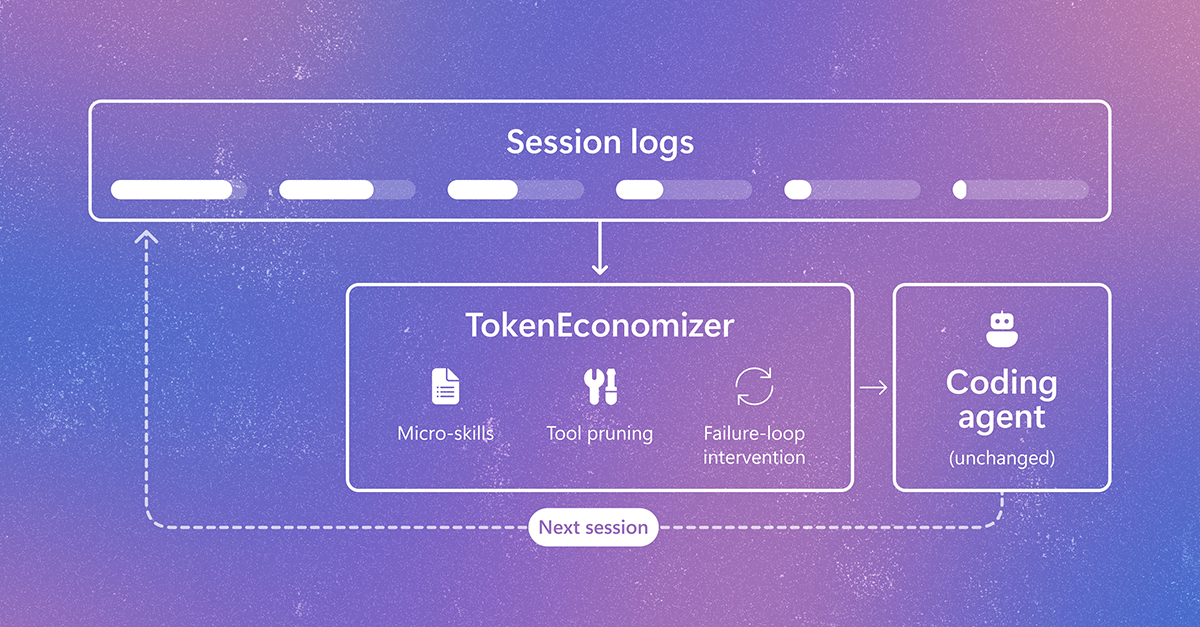
AI coding agents are increasingly help developers fix bugs and build features largely on their own, but every interaction with their models consumes tokens. In each session, an agent sends instructions, tool descriptions, and session history to its model. Most efforts to reduce this cost focus on individual tasks. Yet developers return to the same […] The post TokenEconomizer: Learning from Experience to Make AI Coding Agents More Efficient appeared first on Microsoft Research.
MIT News · Artificial Intelligence· news.mit.eduNov 9, 2026