Nov 2026· IEEE Internet of Things Journal· Vol 13, pp. 51192-51206· 0 citations· 39 references
TL;DR
A novel dual-task learning-driven and prototype-guided federated open-set domain generalization (FedOSDG) method for intelligent fault diagnosis (FD) is proposed, which aggregates local models by measuring the discrepancies between the local and global class prototypes to effectively alleviate the negative transfer problem caused by model aggregation.
Abstract
The existing domain generalization-based fault diagnosis (DGFD) methods typically rely on the assumption that the label spaces of the source domains (SDs) and the unseen target domain (TD) are consistent, and they aggregate data from different SDs for unified model training. However, in real-world industrial scenarios, the fault classes that are not covered in the SDs may appear in the TD, and the data privacy constraints prevent the direct aggregation of data from several SDs for model training. Therefore, a novel dual-task learning-driven and prototype-guided federated open-set domain generalization (FedOSDG) method for intelligent fault diagnosis (FD) is proposed. First, a feature distribution-based dual-task learning strategy is designed, which enables local models of different clients to learn domain-invariant features through feature compression based on the information bottleneck (IB) principle and adversarial learning. Second, a prototype-guided dynamic decision boundary construction (PGDDBC) strategy is proposed, which utilizes the local data from source clients to construct the local class prototypes and uses them as guidance to dynamically construct the optimal decision boundaries between different fault classes, aiming to effectively identify known and unknown fault classes. Third, a prototype discrepancy-based dynamic aggregation (PDDA) strategy is designed, which aggregates local models by measuring the discrepancies between the local and global class prototypes to effectively alleviate the negative transfer problem caused by model aggregation. Finally, the extensive experiments demonstrate that the proposed method exhibits excellent cross-domain FD performance on unseen TD under open-set scenarios while ensuring data privacy.
Federated domain generalization (FDG) aims to learn models that generalize reliably to out-of-distribution (OOD) environments without centralizing client's data. However, existing FDG methods assume that all source clients have labeled data, limiting their ability to leverage the abundant unlabeled client data availabl...
Jun-Yu Ren, Wen-Sheng Gan, Philip S. Yu· 0 citations
It is concluded that Conformal Prediction combined with wavelet-structured representations offers a principled path toward bounded, interpretable fault diagnosis under realistic industrial constraints.
Vladimir Stojanović, Hong-Feng Tao, Xiao-Di Li· Conference proceedings· 0 citations
The proposed Joint Domain-Class Federated Learning (JDFL), a lightweight, optimizer-agnostic extension that makes this latent domain variation usable without sharing raw data, and introduces two complementary supervision strategies based on simple intuitions.
Sina Najafi, Mostafa Tavassolipour, S. P. Shariatpanahi· arXiv.org· 0 citations
Pattern recognition systems are essential for ensuring safety and efficiency in intelligent manufacturing, yet they rely heavily on labeled data. However, datasets collected across factories exhibit significantly different distributions due to variations in production environments and schedules. More critically, discre...
Ke-Ke Huang, Pei-Jing Zhang, Ze-Yi Liu et al.· IEEE Transactions on Automat...· 0 citations
Existing multi-source domain methods tend to directly map raw data into a shared subspace, while neglecting explicit decoupling between fault-related and non-related information. Moreover, these methods primarily enforce domain-level alignment without introducing class-level constraints, which leads to blurred inter-cl...
Zheng-Hong Wu, Shu-Ze Wang, Chao-Bing Wang et al.· Journal of Vibration and Con...· 0 citations
Related blog posts
Microsoft Research Blog· microsoft.comNov 16, 2026
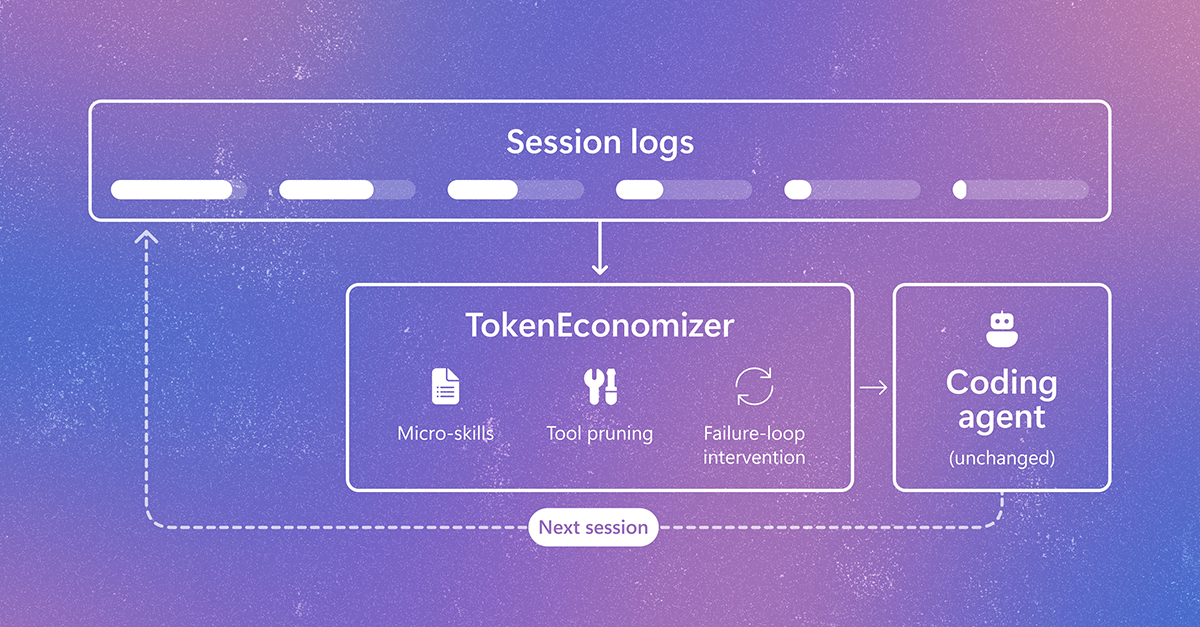
AI coding agents are increasingly help developers fix bugs and build features largely on their own, but every interaction with their models consumes tokens. In each session, an agent sends instructions, tool descriptions, and session history to its model. Most efforts to reduce this cost focus on individual tasks. Yet developers return to the same […] The post TokenEconomizer: Learning from Experience to Make AI Coding Agents More Efficient appeared first on Microsoft Research.
MIT News · Artificial Intelligence· news.mit.eduNov 9, 2026
A machine-learning approach called CheMeleon provides a practical way to develop new drugs or other molecules with much less detailed, expensive experimentation.
We use cookies to run the site and, with your consent, for analytics and to show ads.
See our Cookie Policy.