Nov 2026· Intelligent Service Robotics· Vol 20· 0 citations· 60 references
Power Line Inspection Robots
TL;DR
A comprehensive UAV-based inspection framework that integrates YOLOv8 for real-time power line detection and Transformer-based reinforcement learning for adaptive control under wind disturbances is proposed that provides a scalable and deployable solution for intelligent UAV-based power line inspection in complex field environments.
The increasing popularity of civilian unmanned aerial vehicles (UAVs) poses serious safety challenges to low-altitude airspace near power transmission and distribution lines. Existing monitoring technologies rely heavily on expensive radar or radio frequency devices that are susceptible to interference, while mainstrea...
Liang Chen, Rui-Qi Xu, Jin-Yu Ma et al.· Chinese Journal of Informati...· 0 citations
Accurate vehicle localization is critical for the safe operation of autonomous vehicles. However, in GPS-denied environments such as tunnels or urban canyons, localization accuracy significantly deteriorates due to poor GPS signal quality. Traditional methods, such as extended Kalman filtering (EKF) and map matching, f...
The proposed framework reduces dependence on hazardous manual inspection of overhead transmission lines by enabling systematic, UAV-based image acquisition combined with automated deep learning fault detection and a controlled multi-generation You Only Look Once (YOLO) benchmark for binary insulator fault detection.
Kartikey Pandey, Vandana Agrawal, J. Mohanta· International Journal of Int...· 0 citations
To address the challenges of dense obstacles and complex spatial structures in high-voltage transmission line inspection environments, as well as the difficulty of balancing search efficiency and path quality in traditional path planning algorithms, this paper proposes a Multi-source Adaptive Tornado Optimization algor...
Xin Fang, Lei Zhu, Fangxing Lyu· Engineering Research Express· 0 citations
In aerospace research on the cross-cutting growth of unmanned aerial vehicles (UAVs) in inspection, monitoring, and emergency response use cases, reliable operation in environments that are constrained by navigation and communication infrastructure is an issue of vital importance. Conventional UAV systems have a strong...
A. Tulembayev, G. Baiseitov, Z. Kutpanova et al.· International Journal of Adv...· 0 citations
Space weather can affect the reliability of satellite‐based positioning and thereby disrupt industrial operations that increasingly depend on Global Navigation Satellite System (GNSS) services. This concern is becoming more relevant with the rapid growth of the low‐altitude economy, where unmanned aerial vehicles (UAVs...
Meng-Fei Sun, Ning Li, Tong Liu· Space Weather· 0 citations
Related blog posts
MIT News · Artificial Intelligence· news.mit.eduNov 17, 2026
By studying the computational foundations of language learning, Associate Professor Jacob Andreas builds intelligent systems that can communicate effectively with humans.
MIT News · Artificial Intelligence· news.mit.eduNov 17, 2026
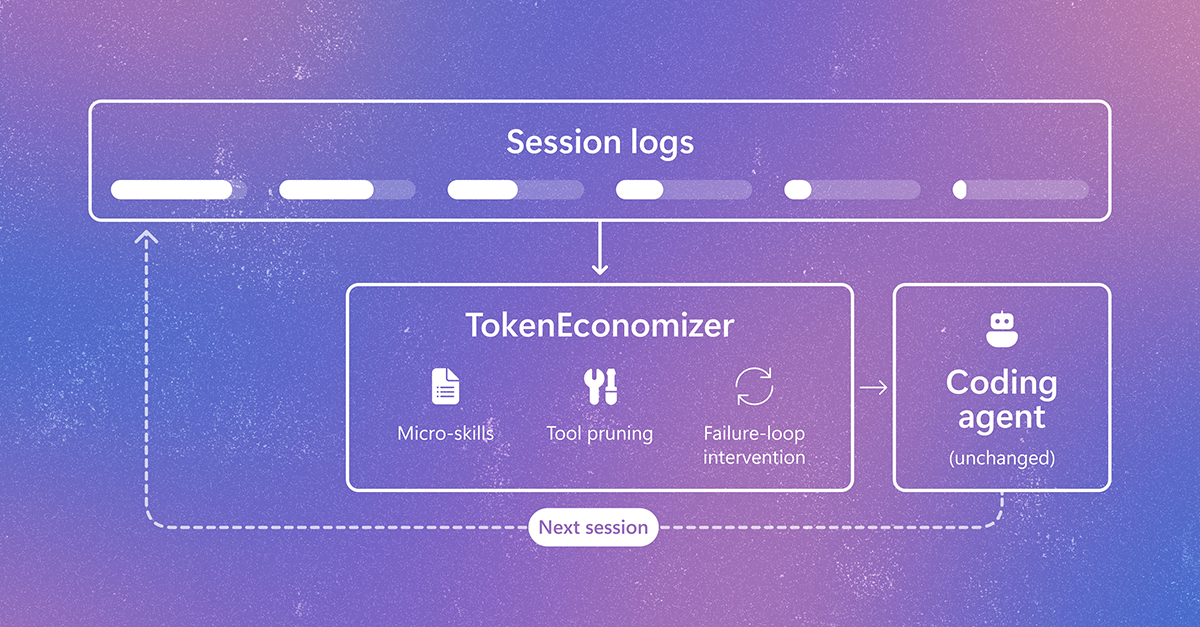
AI coding agents are increasingly help developers fix bugs and build features largely on their own, but every interaction with their models consumes tokens. In each session, an agent sends instructions, tool descriptions, and session history to its model. Most efforts to reduce this cost focus on individual tasks. Yet developers return to the same […] The post TokenEconomizer: Learning from Experience to Make AI Coding Agents More Efficient appeared first on Microsoft Research.
MIT News · Artificial Intelligence· news.mit.eduNov 9, 2026