A language model can write the weights of a small MLP, CNN, RNN or GNN from a plain-language specification, with no data and no gradient step. We ask when such a network can be proved exact in the float32 arithmetic it actually runs in. A float-safety lemma makes exhaustive float32 enumeration a proof for any summation order, and a layered error bound covers networks whose weights are not short binary fractions. With dynamic programming, template checks, an SMT proof, breadth-first search and induction for weight-tied recurrences, this certifies 12 of 15 written networks (one after a single constant fix) on every input of a stated domain (up to $10^{16}$ inputs, or every graph or grid up to a size bound), in a minute of CPU or less each. The certificates also say where a network stops being exact: the shortest-path network is exact iff the distance is at most 4,096 and fails at the predicted hops. Thirty new specifications were each written by a fresh session of one model family (Claude Opus 5.5). Twenty-five first submissions are certified exact for any summation order; the five tax schedules stay within \$0.11 of the true tax at every whole dollar in one fixed float32 run. An open 27B model passes 23 of the 30, and 25 with more thinking and code execution, so the method transfers in part. We also prove two limits of learning from examples: input coordinates never active in training cannot be learned from more in-range data, and Luhn-type checksums have exponentially small target-dependent gradient variance across their family. Tuned gradient descent on the same architectures agrees with both, which cover two of our five failure classes.

It is found that Llama 3 delivers comparable quality to leading language models such as GPT-4 on a plethora of tasks, and performs competitively with the state-of-the-art on image, video, and speech recognition tasks.
This paper investigates developing real-world perception for active agents, proposes Gibson Environment for this purpose, and showcases a set of perceptual tasks learned therein.
F. Xia, Amir Zamir, Zhi-Yang He et al.· 2018 IEEE/CVF Conference on...· 1,069 citations· ⚡112
Supporting data, adapters, predictions and code for the article *Low-Cost LoRA Fine-Tuning of Small Language Models for Multi-Step Arithmetic Reasoning* by Jake O'Grady, Asena Isik Gürhan, Chee Fong Ting and Effirul Ramlan (University of Galway). We generated 20,000 GSM8K-derived arithmetic problems with step-by-step s...
O'Grady, Jake, Gürhan, Asena Isik, Chee, Fong Ting et al.· Zenodo (CERN European Organi...· 465 citations
The results indicate that software engineering work practices are chosen opportunistically, adapted and configured to provide value under the constrains imposed by the startup context.
Nicolò Paternoster, Carmine Giardino, M. Unterkalmsteiner et al.· Information and Software Tec...· 394 citations· ⚡54
The possibility of inferring high-dimensional data inference in a model that consists of a prior and an auxiliary differentiable constraint given some additional information is considered, thereby allowing a range of potential applications in adapting models to new domains and tasks.
Alexandros Graikos, Esmeralda S. Whitammer, N. Jojic et al.· Neural Information Processin...· 316 citations· ⚡15
It is proved that any global minimizer of the trajectory balance objective can define a policy that samples exactly from the target distribution, and empirically demonstrate the benefits of the trajectories balance objective for GFlowNet convergence, diversity of generated samples, and robustness to long action sequenc...
Esmeralda S. Whitammer, Moksh Jain, Emmanuel Bengio et al.· Neural Information Processin...· 302 citations· ⚡60
Related blog posts
MIT News · Artificial Intelligence· news.mit.eduNov 17, 2026
By studying the computational foundations of language learning, Associate Professor Jacob Andreas builds intelligent systems that can communicate effectively with humans.
Microsoft Research Blog· microsoft.comNov 16, 2026
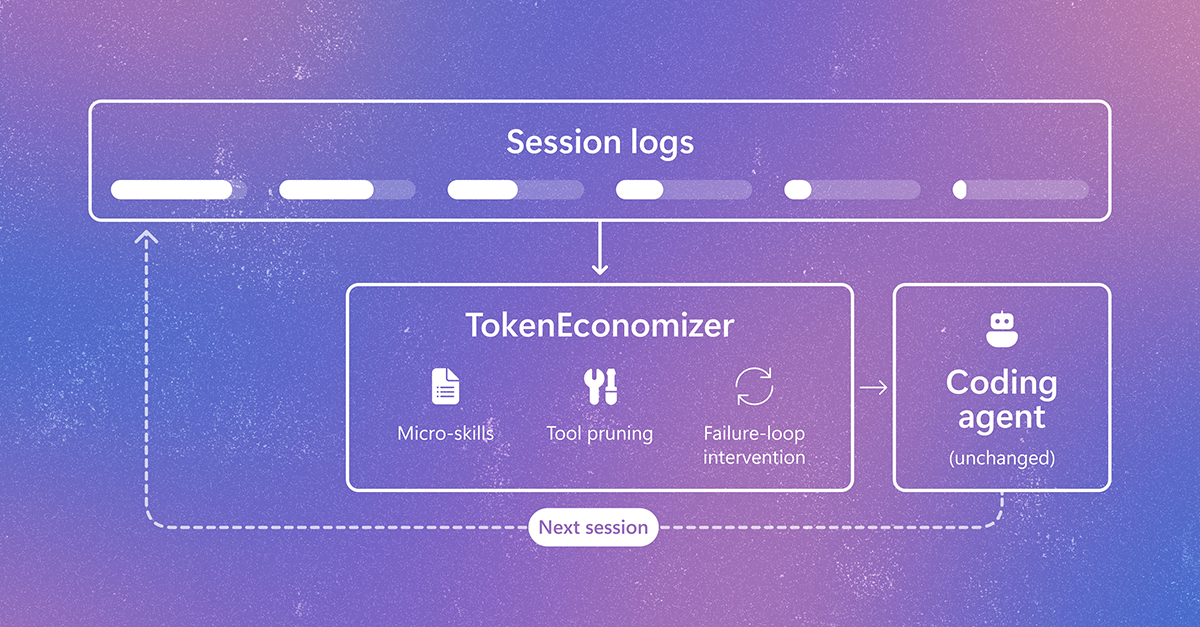
AI coding agents are increasingly help developers fix bugs and build features largely on their own, but every interaction with their models consumes tokens. In each session, an agent sends instructions, tool descriptions, and session history to its model. Most efforts to reduce this cost focus on individual tasks. Yet developers return to the same […] The post TokenEconomizer: Learning from Experience to Make AI Coding Agents More Efficient appeared first on Microsoft Research.
MIT News · Artificial Intelligence· news.mit.eduNov 9, 2026
Assistant Professor Benjamin Lindquist studies how engineers deliberately injected randomness into early AI, giving rise to deep-learning models that sometimes hallucinate.
We use cookies to run the site and, with your consent, for analytics and to show ads.
See our Cookie Policy.