Skip to content

CADKnitter: Compositional CAD Generation from Text and Geometry Guidance

Dec 2025 · arXiv.org · Vol abs/2512.11199 · 2 citations · 76 references
Computer Science

TL;DR

CadKnitter is able to generate a complementary CAD part that follows both the geometric constraints of the given CAD model and the semantic constraints of the desired design text prompt, which outperforms other state-of-the-art baselines by a clear margin.

Abstract

Computer-aided design (CAD) defines 3D models as compact, precise, and editable representations, making it directly useful for several fields. Recently, CAD generation has been gaining more attention in both the research community and industry. Crafting CAD models has long been a painstaking and time-intensive task, demanding both precision and expertise from designers. Prior works have achieved early success in single-part CAD generation, which is not well-suited for real-world applications, as multiple parts need to be assembled under semantic constraints and geometric compatibility. In this paper, we propose CADKnitter, a compositional CAD generation framework with geometric-guiding cues to steer diffusion sampling. CADKnitter is able to generate a complementary CAD part that follows both the geometric constraints of the given CAD model and the semantic constraints of the desired design text prompt. We also curate a dataset, so-called KnitCAD, containing over 310,000 samples of CAD models, along with textual prompts and assembly metadata that provide semantic and geometric constraints. Intensive experiments demonstrate that our proposed method outperforms other state-of-the-art baselines by a clear margin. Our project page is available at https://cadknitter.github.io/.

View source

Similar papers

Book Open access Aug 2026

CodeCAD: A Parametric CAD Dataset for Programmatic 3D Model Generation

This work presents a dataset of over 95,000 native OpenSCAD models, primarily containing mechanical parts and engineering components, designed specifically for the programmatic generation of 3D models, and aims to open new opportunities for programmatic 3D model generation.

D. Fresacher, Klaus Diepold · 0 citations
Preprint Aug 2026

MIRAGE-CAD: Construction-Mediated Multimodal Generation of Executable CAD Programs

MIRAGE-CAD maps each input to a shared construction representation and mediates program generation through an explicit construction-plan interface and shows that executable validity, geometric fidelity, and parametric responsiveness can diverge substantially and should therefore be evaluated separately.

Jizong Zhan · 0 citations
Preprint Aug 2026

ExpConCAD: Experience-Guided Text-to-CAD Generation from Shape Descriptions with Implicit Spatial Constraints

It is argued that missing spatial constraints should be inferred with respect to the underlying construction structure and informed by reusable design experience and informed by reusable design experience in ExpConCAD, an experience-enhanced framework for implicit spatial constraint completion.

Jingyao Liu, Jin Tang, Chen Huang et al. · 0 citations
#computer vision Preprint Sep 2026

VisCAD: A Foundation Model Suite with Multimodal Industrial CAD Intelligence

VisCAD is presented, a foundation model suite designed to provide both broad generalization and strong CAD capability for realistic industrial products that includes a domain-specific harness that leverages frontier models for complex assembly generation and demonstrates advantages over general-purpose harnesses in bot...

Guan-Ling Li, Zhi-Chao Huang, Hui-Mu Yu et al. · 0 citations
Open access Aug 2026

Hand-drawn sketch to parametric 3D CAD using a multimodal LLM and an intermediate representation

Informal hand-drawn sketches are used in mechanical design to convey information about part geometry, but their translation into parametric 3D CAD models is not fully addressed. Multimodal Large Language Models (LLMs) can interpret visual information and generate executable macros, opening the possibility to support...

D. Popescu, R. Iacob · 0 citations

Related blog posts

Microsoft Research Blog Aug 11, 2026

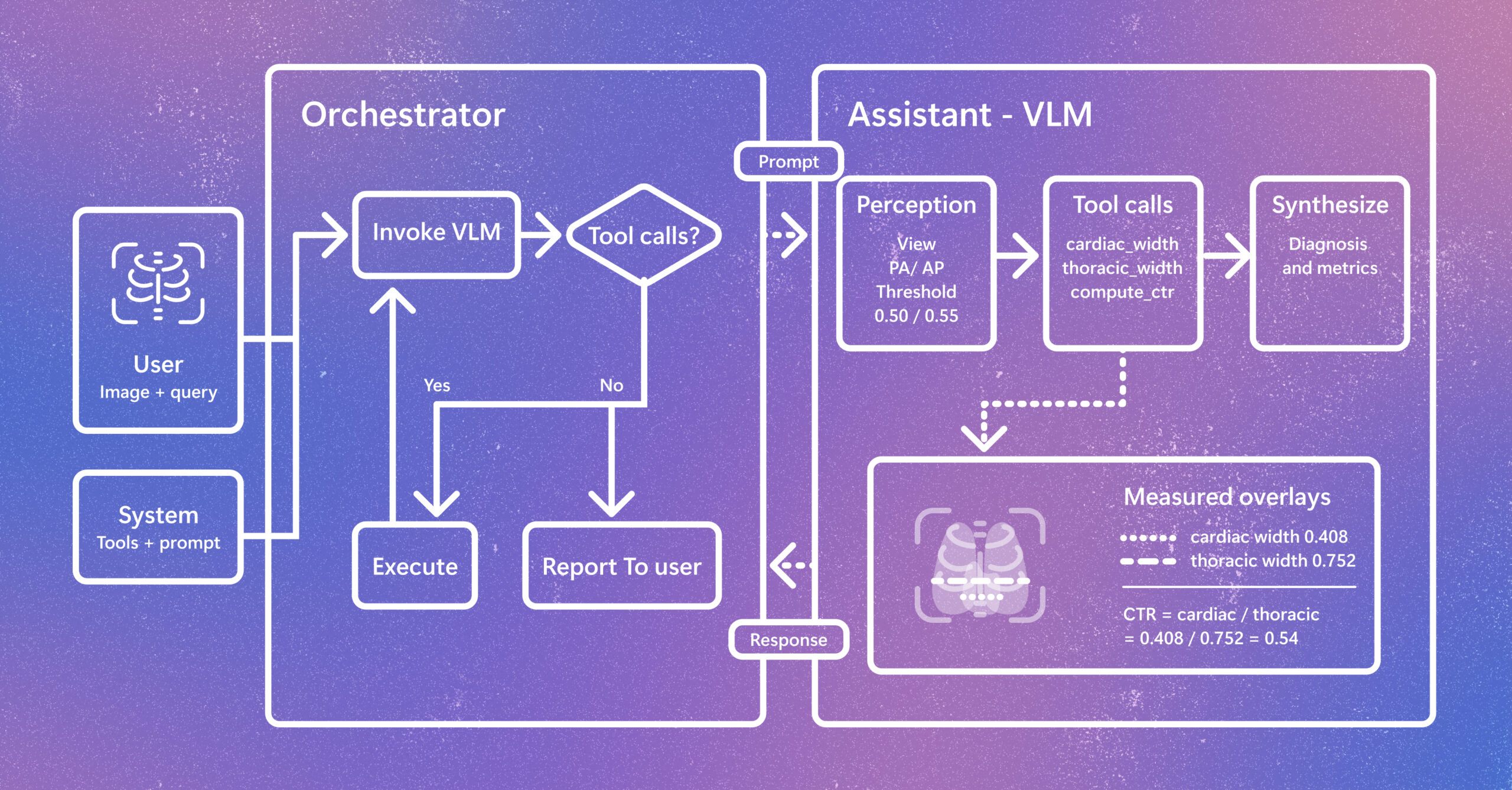
Introducing CARE-X: Towards Clinically Useful Radiology VLMs with Auxiliary Supervision, Reward-Aligned Learning, and Tool-Augmented Measurement

Radiology AI is evolving beyond report generation. CARE-X explores a unified approach that combines flexible reasoning, calibrated predictions, and measurement-based tools for chest X-ray interpretation. The post Introducing CARE-X: Towards Clinically Useful Radiology VLMs with Auxiliary Supervision, Reward-Aligned Learning, and Tool-Augmented Measurement appeared first on Microsoft Research.

MIT News · Artificial Intelligence Oct 23, 2026

Q&A: How AI came to model the “messy” human mind

Assistant Professor Benjamin Lindquist studies how engineers deliberately injected randomness into early AI, giving rise to deep-learning models that sometimes hallucinate.

We use cookies to run the site and, with your consent, for analytics and to show ads. See our Cookie Policy.