Experimental results show that the proposed AI twin achieves lower power reconstruction error than existing neural-field baselines while maintaining real-time inference capability, demonstrating the effectiveness of the proposed DT framework for THz wireless data-center planning and optimization.
Abstract
The rapid growth of AI computing has driven increasing demands for flexible and high-capacity data-center interconnections. Owing to its ultra-wide bandwidth and high spatial reuse capability, terahertz (THz) communication has emerged as a promising solution for future wireless data centers, while digital twins (DTs) enable efficient wireless planning and real-time optimization. In this work, a measurement-driven multi-layer DT framework is proposed for THz wireless data centers, where the physical, channel, evaluation, and manipulation layers are progressively constructed from bottom to top. First, extensive channel measurements are conducted at 140, 220, and 300 GHz to characterize frequency-dependent propagation behaviors. Based on the tri-band measurements, a measurement-calibrated physical twin is established by jointly optimizing the geometry, material, antenna, and hybrid propagation models. On top of the physical twin, a line-of-sight (LoS)-aware implicit neural field is developed to construct an AI channel twin for efficient channel reconstruction. The proposed AI twin learns location-dependent channel statistics from the calibrated twin, enabling real-time prediction of received power and LoS probability. Building upon the reconstructed channel field, a system-level evaluation layer is derived to analyze coverage and interference for both AP-to-rack and rack-to-rack communications. Experimental results show that the proposed AI twin achieves lower power reconstruction error than existing neural-field baselines while maintaining real-time inference capability. Moreover, the ceiling-mounted AP deployment achieves over 90% coverage under a 10 dB signal-to-interference-plus-noise ratio (SINR) threshold, demonstrating the effectiveness of the proposed DT framework for THz wireless data-center planning and optimization.
The ultra-high data rate and ultra-reliable low-latency communication (URLLC) requirements of Industry 4.0 and smart factory applications have made the evaluation of Sub-Terahertz (Sub-THz) frequencies, especially the 140 GHz band, in sixth-generation (6G) wireless networks a considerable research area. Nevertheless, m...
Cihat Şeker· Italian National Conference...· 0 citations
This survey stands apart from previous studies by providing the first comprehensive, energy-centric analysis of THz communications, along with key 6G technologies and applications to offer a holistic roadmap toward sustainable, high-performance THz communication systems.
Shikha Maurya, Soumen Mondal, Rahul Pal et al.· IEEE Communications Surveys...· 1 citation
Digital twin (DT) technology has emerged as a cornerstone for autonomous optical networks; however, its predictive fidelity is critically dependent on the accuracy of the underlying physical parameters—particularly the fiber attenuation, component insertion losses (ILs), and amplifier gain profiles. These parameters ar...
Yu-Jia Yang, Sheng-Nan Li, Yue Pang et al.· Journal of Lightwave Technol...· 0 citations
The ongoing advancement of the global Internet of Everything leads to an increasing number of wireless communication devices accessing the network and a continuous growth in data traffic. Leveraging an ultra-wideband and multi-mode transmission scheme, terahertz (THz) polarization multiplexing architectures are capable...
Ji-Cong Zhang, Bo Zhang, Yi-Nian Feng et al.· UK, Europe, China Millimeter...· 0 citations
Numerical results demonstrate that the proposed DT-assisted approach significantly reduces online interaction overhead by shifting the computational burden of ray-tracing to an offline generative phase, and achieves superior sum-rate performance and link robustness under dynamic blockages compared to conventional deep...
Ke Xu, Wei-Qiang Wu· Italian National Conference...· 0 citations
ABSTRACT The convergence of integrated sensing and communication (ISAC) across optical and wireless domains is a cornerstone for next‐generation networks, yet it is hindered by the fundamental incompatibility between fiber and wireless systems. Here, we introduce a unified fiber‐wireless ISAC system driven by a single...
By studying the computational foundations of language learning, Associate Professor Jacob Andreas builds intelligent systems that can communicate effectively with humans.
Microsoft Research Blog· microsoft.comNov 16, 2026
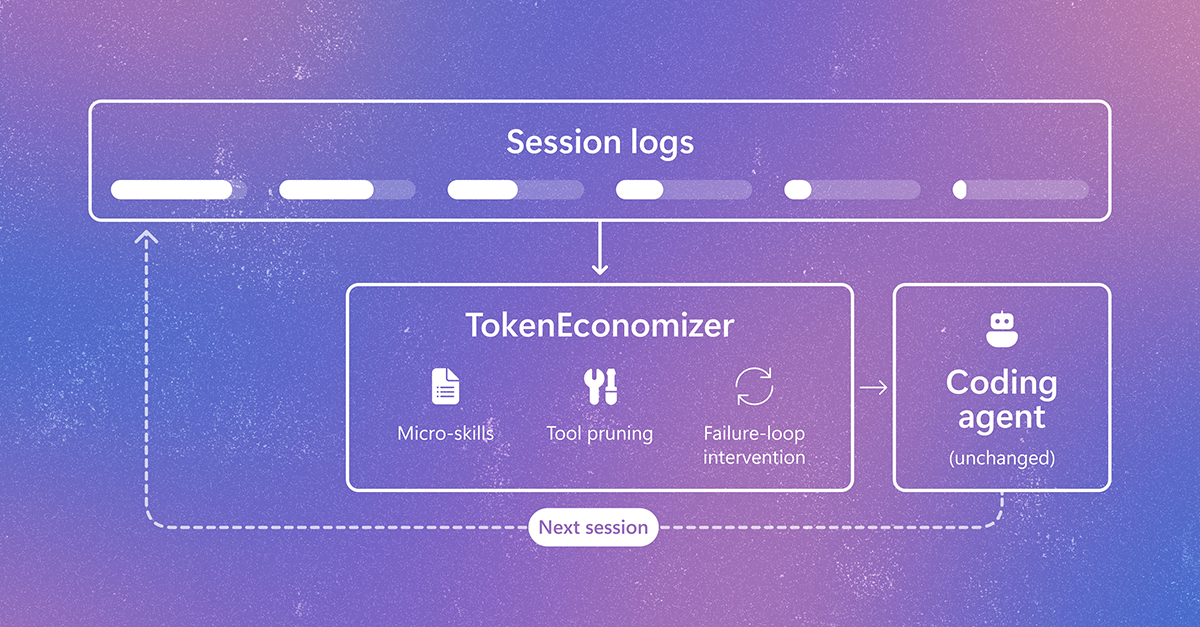
AI coding agents are increasingly help developers fix bugs and build features largely on their own, but every interaction with their models consumes tokens. In each session, an agent sends instructions, tool descriptions, and session history to its model. Most efforts to reduce this cost focus on individual tasks. Yet developers return to the same […] The post TokenEconomizer: Learning from Experience to Make AI Coding Agents More Efficient appeared first on Microsoft Research.
MIT News · Artificial Intelligence· news.mit.eduNov 13, 2026