Skip to content

Robust Few-Shot Malware Detection in IoT via ACL on Heterogeneous Behavior Graphs

Sep 2026 · IEEE Internet of Things Journal · Vol 13, pp. 38380-38391 · 0 citations · 24 references
Computer Science

Abstract

The proliferation of Internet of Things (IoT) devices has expanded the attack surface for sophisticated, polymorphic malware. Traditional intrusion detection systems (IDSs) and standard graph neural networks (GNNs) struggle with the heterogeneity of IoT traffic, adversarial structural perturbations, and the scarcity of labeled data for zero-day threats. This article introduces HeG-Defend, a novel framework unifying adversarial heterogeneous graph contrastive learning (AHGCL) with meta-learning. We propose a methodology to construct heterogeneous behavior graphs (HBGs) from raw traffic, preserving rich semantic contexts via meta-path topology. To combat label scarcity and adversarial fragility, we use a min–max contrastive training objective, where a learnable graph augmenter generates “hard” adversarial views to force the encoder to learn robust, invariant representations. Furthermore, a prototypical meta-learning module is integrated to enable rapid N-way K-shot adaptation to unseen malware. Experiments on the IoT-23 benchmark demonstrate that HeG-Defend achieves a 99.7% $F1$ -score on known classes and improves few-shot detection on zero-day variants by 14.5% over baselines. Crucially, under glass box PGD topology attacks, our model maintains 91.4% accuracy, significantly outperforming traditional GNNs.


View source

Similar papers

Enhanced IoT malware detection via robust and scalable federated learning

A decentralised federated learning (FL)-based IoT malware detection framework, evaluated using the recent IoT-23 dataset and systematically assessed in terms of robustness and scalability, highlighting the feasibility of robust and scalable FL-based security systems in real-world IoT deployments.

Saba Nayab, Sana Qadir, Madiha Khalid et al. · 0 citations
Open access Oct 2026

Deep Kronecker hashing generative adversarial network for intrusion detection in IoT against adversarial attacks

The rapid growth of wireless networks accelerates the adoption of the Internet of Things (IoT) devices in applications, such as industrial automation, healthcare, and smart homes, ensuring seamless connectivity and real-world data transmission. However, the widespread adoption of interconnected IoT systems makes them m...

A. Sunitha, S. G. Hymlin Rose · 0 citations
Open access Oct 2026

Latent-space feature squeezing for adversarially robust intrusion detection on IoT edge devices

Machine learning-based intrusion detection systems (IDS) for Internet of Things (IoT) environments are vulnerable to adversarial perturbations that can cause malicious traffic to be misclassified as benign. Existing defences, such as adversarial training and feature squeezing, are typically applied independently an...

Mansooreh Mirzaei, S. Saremi, Abdullah Khan et al. · 0 citations
#machine learning Preprint Oct 2026

Adversarial RL for Port-Scan Evasion: Attacker Feature Visibility in Edge-Deployed IDS

Machine learning-based intrusion detection systems (IDS) are increasingly used in resource-constrained Internet of Things (IoT) environments, yet their robustness is often evaluated against static attacks rather than adversaries that adapt to detection feedback. This paper investigates adaptive port-scan evasion agains...

Logan Andrew North, Priya Sanjay Kaluskar, Shasi Kumar Ramachandran Prabhu et al. · 0 citations
#federated learning Open access Sep 2026

EdgeSecure: A Heterogeneous Federated Learning Framework for Lightweight Malware Detection in Resource-Constrained IoT Networks

Overall, the proposed framework addresses three critical research gaps: preserving data privacy without centralized data aggregation, handling non-IID data distributions in IoT networks, and enabling efficient computation for resource-limited devices.

Baraa I. Farhan · 0 citations
Conference Aug 2026

FAME: From Adversarial Feature Vectors to Malware Evasion via SMT

Internet of Things (IoT) malware detection remains a challenging task due to the severe resource constraints of IoT devices, which require lightweight yet effective security solutions. SIMBIoTA-ML addresses this challenge by leveraging machine learning (ML) classifiers operating on TLSH-based static features for effici...

Endre Glocker, J. Sándor, Roland Nagy · 0 citations

Related blog posts

Microsoft Research Blog Jul 13, 2026

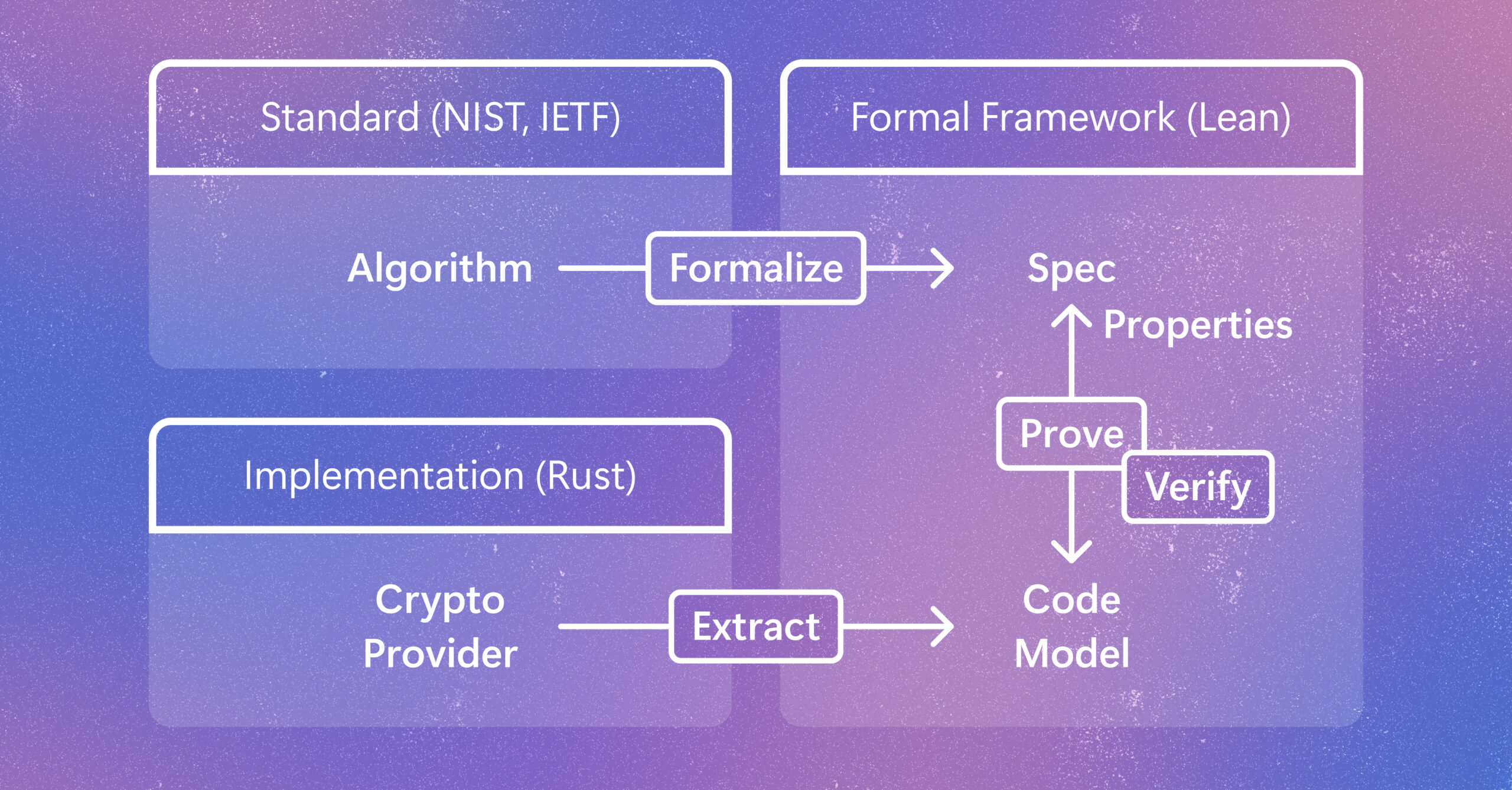
Verifying Rust cryptography in SymCrypt, from standards to code

Cryptographic code supports vital protections in modern computing systems. Learn how a new method helps verify code as developers write it while preserving speed and adaptability as it gets implemented and evolves. The post Verifying Rust cryptography in SymCrypt, from standards to code appeared first on Microsoft Research.

We use cookies to run the site and, with your consent, for analytics and to show ads. See our Cookie Policy.