Aug 2026· Knowledge Discovery and Data Mining· pp. 2521-2532· 1 citation· 30 references
Computer Science
TL;DR
NaviRAG is a novel framework that reformulates retrieval as a reinforcement learning-driven dynamic navigation problem on schema-less knowledge graphs (KGs), achieving state-of-the-art performance in multi-hop QA while maintaining robustness in single-hop QA.
Abstract
Retrieval-Augmented Generation (RAG) has become a fundamental paradigm for enhancing Large Language Models (LLMs) with external knowledge. However, while recent structure-augmented approaches organize documents into graphs to improve information access, their retrieval strategies remain largely static, relying on similarity ranking or static probability diffusion. We identify that this paradigm suffers from two inherent limitations in complex reasoning: popularity bias, where retrieval paths are trapped by high-degree distractors, and signal decay, where relevance signals attenuate over long reasoning chains. To overcome these challenges, we propose NaviRAG, a novel framework that reformulates retrieval as a reinforcement learning-driven dynamic navigation problem on schema-less knowledge graphs (KGs). Unlike passive diffusion, NaviRAG employs an agent that actively traverses the graph to act as a search-space pruning engine, identifying logical multi-hop reasoning paths. Technically, we introduce three key components: (1) Structure-Aware Query Expansion, which bridges the modality gap between unstructured queries and structured graph seeds for precise initialization; (2) Target-Driven Reward Shaping, which provides dense supervision based on semantic progress toward gold documents, effectively mitigating the sparse reward problem in large-scale graph traversal; and (3) a Multi-View Hybrid Reranking strategy that operates on the highly-pruned candidate subgraph, integrating policy confidence, semantic relevance, and global structural importance to ensure robust candidate selection. Extensive experiments on three multi-hop QA datasets and two single-hop QA datasets demonstrate that NaviRAG significantly outperforms baselines, achieving state-of-the-art performance in multi-hop QA while maintaining robustness in single-hop QA. Our code and data are available at https://github.com/CkingEW/NaviRAG.

Retrieval-Augmented Generation (RAG) improves Large Language Models (LLMs) by incorporating external documents, but its effectiveness degrades when retrieved passages are irrelevant, incomplete, or inconsistent with parametric knowledge. We present LPDG-RAG, a post-training framework that extends reasoning-based knowle...
Hai-Feng Liu, Rui-Qi Zhao, Nan Zhao et al.· IEEE Transactions on Audio,...· 0 citations
While retrieval-augmented generation (RAG) mitigates large language model (LLM) hallucinations, traditional flat vector retrieval in massive, heterogeneous databases suffers from high latency and noise interference. To address this, we propose HiRAG, a hierarchical RAG framework. Offline, HiRAG builds a “classification...
Sun-Jia Zhang· Journal of Artificial Intell...· 0 citations
Large language model search agents are often trained with synthetic questions whose difficulty is increased through larger evidence graphs, additional hops, and longer trajectories. These global properties, however, are only indirect proxies for the local retrieval capabilities required during search. To address this m...
The integration of Large Language Models and Reinforcement Learning offers a promising direction for complex sequential decision-making tasks, such as multi-hop question answering over knowledge graphs. While LLMs provide strong semantic understanding and reasoning capabilities, they often struggle with precise, multi-...
Artem Mikhaylov, Pavel Konoplev, N. Efanov et al.· 0 citations
Retrieval-Augmented Generation (RAG) mitigates hallucination and knowledge staleness in large language models (LLMs) by injecting external knowledge into the context window, yet its effectiveness is rigidly constrained by attention dilution and inference cost. Existing knowledge-graph-enhanced methods follow a sequenti...
Zi-Hao Zhou, Gang Yin, Ze-Jian Lu et al.· Electronics· 0 citations
Graph-based retrieval-augmented generation (GraphRAG) answers multi-hop questions by organizing a corpus into a graph and retrieving along its structure. Existing retrieval methods face two limitations. Diffusion- and similarity-based methods expand retrieval along fixed edge weights or by similarity to the question, w...
Jia-Te Liu, Liu-Yi Chen, Xiao-Fei Yuan et al.· 0 citations
Related blog posts
MIT News · Artificial Intelligence· news.mit.eduNov 17, 2026
By studying the computational foundations of language learning, Associate Professor Jacob Andreas builds intelligent systems that can communicate effectively with humans.
MIT News · Artificial Intelligence· news.mit.eduNov 17, 2026
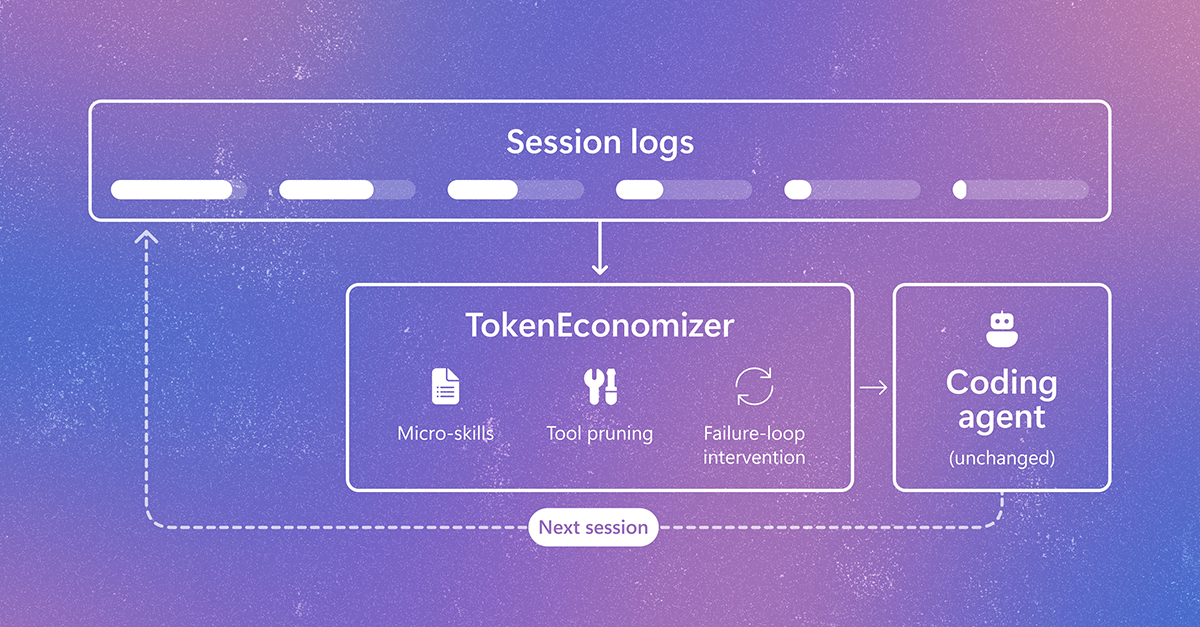
AI coding agents are increasingly help developers fix bugs and build features largely on their own, but every interaction with their models consumes tokens. In each session, an agent sends instructions, tool descriptions, and session history to its model. Most efforts to reduce this cost focus on individual tasks. Yet developers return to the same […] The post TokenEconomizer: Learning from Experience to Make AI Coding Agents More Efficient appeared first on Microsoft Research.
MIT News · Artificial Intelligence· news.mit.eduNov 9, 2026