Skip to content

Topology-aware GNNs under structural perturbations: Empirical robustness across domains

Sep 2026 · PLOS Complex Systems · 0 citations · 29 references

TL;DR

Results support a conditional empirical conclusion: combining structure, topology, and stability-oriented training can improve robustness under specified structural perturbations, with dataset-dependent accuracy–stability trade-offs rather than universal guarantees.
Abstract

Graph neural networks learn from relational structure but can be sensitive to edge-level noise. We study a hybrid graph classifier that combines a message-passing branch (Graph Isomorphism Network, GIN) with a topological branch based on extended persistence diagrams and PersLay embeddings. Training optionally uses a paper-specific hinge penalty motivated by stable persistence-diagram representations and Lipschitz regularity, which we abbreviate as “HK-inspired.” On six TUDataset benchmarks, we compare five ablations (Full, GIN+PersLay, GIN + HK, GIN only, PersLay only) and measure robustness as accuracy drop under 10% random edge removal at test time, with persistence diagrams fixed from the original graphs; we also report targeted perturbations on MUTAG and PROTEINS and runtime on all six datasets. The regularized configurations reduce relative accuracy degradation where GIN-only is sensitive, particularly on smaller molecular and protein graphs, but do not consistently maximize clean or perturbed accuracy. On large social-network benchmarks, robustness differences are small and clean accuracy is the main differentiator. Adding PersLay to GIN can improve accuracy on several datasets, while PersLay alone performs worst. Training the full model increases per-epoch cost relative to GIN-only, with most overhead during training rather than inference. Overall, the results support a conditional empirical conclusion: combining structure, topology, and stability-oriented training can improve robustness under specified structural perturbations, with dataset-dependent accuracy–stability trade-offs rather than universal guarantees.

Read PDF

Similar papers

Sep 2026

Generalizing on Diverse Shifts: A Unified Topology-Aware Reweighting Algorithm for Graphs.

Topology-Aware Dynamic Reweighting (TAR+), a model-agnostic framework for node classification under strict graph distribution shifts and related robustness stressors, is proposed, supporting the broad applicability of topology-aware reweighting across heterogeneous graph learning conditions.

Jia-Xing Li, Jia-Shuo Liu, Wei-Huang Zheng et al. · 0 citations
#artificial intelligence Preprint Aug 2026

NICE: Scale-Stable Perturbations for Graph Neural Network Explanations via Noise Corruption

Noise Corruption is introduced, a Noise Corruption-based explanation framework, which perturbs each message through matched-norm random-direction corruption while preserving the expected squared message norm, and NICE, a Noise Corruption-based explanation framework, which learns a Stochastic Restoration Boundary under...

Ziluowen Luo, Jun Yin, Ruo-Chen Liu et al. · 0 citations
#machine learning Preprint Oct 2026

Differentiable Koopman Operator for Contrastive Learning on Dynamic Graphs

Real-world interaction networks are inherently dynamic: edges form and dissolve as node behavior shifts over time. Most snapshot-based contrastive methods encode temporal dependencies implicitly in encoder weights, without an explicit model of how node representations evolve, making them brittle under distribution shif...

Md Abrar Jahin, Taufikur Rahman Fuad, Md. Rizwan Parvez · 0 citations
#artificial intelligence Preprint Sep 2026

Beyond Fixed Features: Architecture-Dependent Sensitivity to Node Representations under Heterophily

Graph Neural Networks perform well on homophilic graphs but struggle in heterophilic settings, where connected nodes often carry dissimilar labels, so architecture and representation cannot be treated as independent evaluation factors.

Priyanath Maji, Sidharth Gaur, Rajavinoth Paul Durai · 0 citations
Conference Open access Sep 2026

Local Geometry Improves Explanation Robustness for Graph Neural Networks

G EO XGNN (Local Geometry Improves Explanation Robustness for Graph Neural Networks), a robust explanation framework that explicitly models the directional sensitivity of structural perturbations from a geometric perspective that significantly improves explanation robustness over existing methods.

Mengting Diao, Li Sun, Sen Su · 0 citations
#machine learning Preprint Sep 2026

Edge-Level Automorphism in GNNs: A Quantitative Framework and Effective Designs For Link Prediction

A novel quantitative framework to assess GNN expressiveness for link prediction is introduced, and the edge automorphism ratio (EAR) is introduced, a scalar metric that quantifies a GNN's ability to distinguish links in a given graph.

Shao-Wei Chen, Donald Loveland, Tobias Käfer et al. · 0 citations

Related blog posts

Microsoft Research Blog Jul 13, 2026

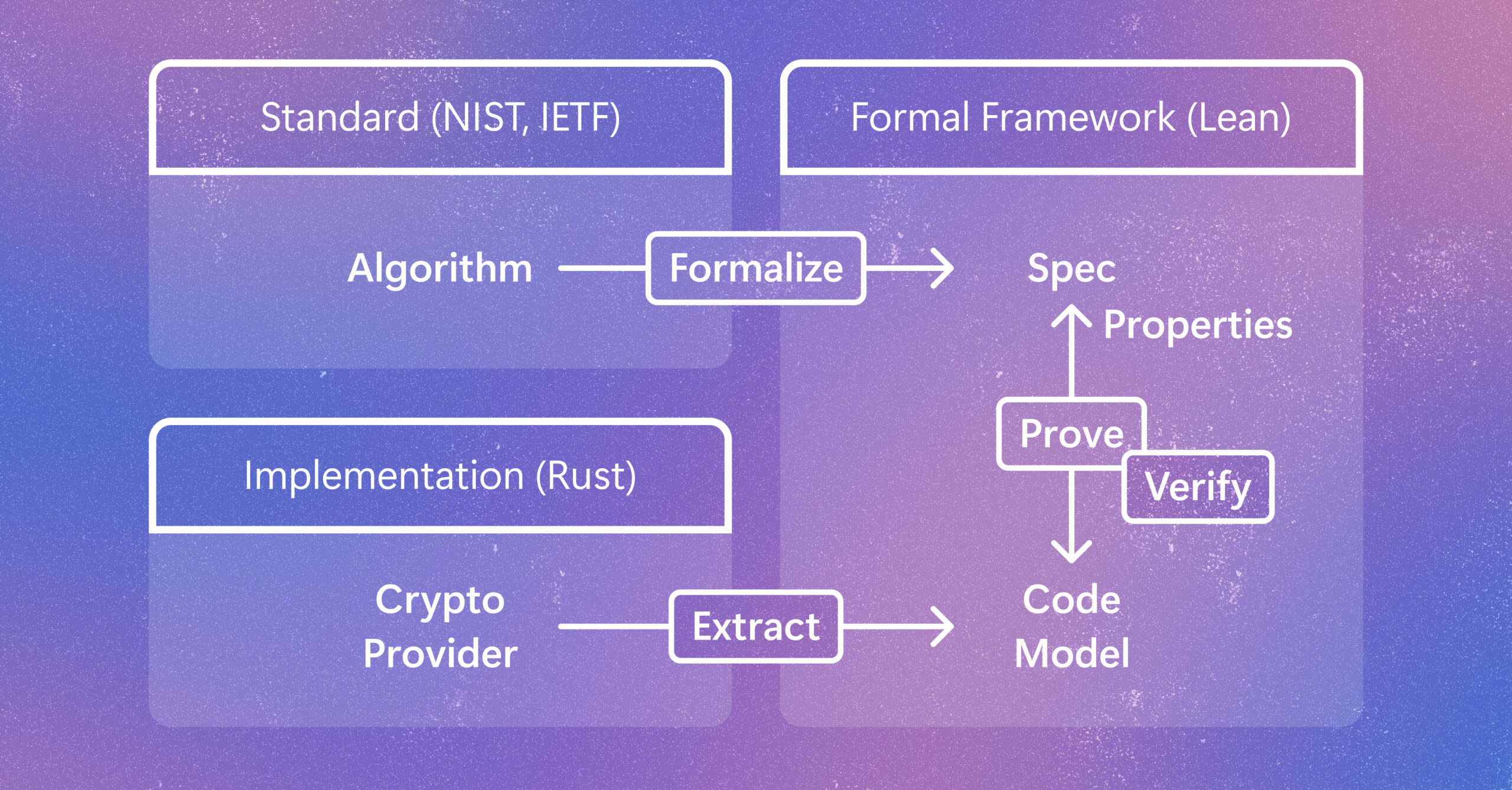
Verifying Rust cryptography in SymCrypt, from standards to code

Cryptographic code supports vital protections in modern computing systems. Learn how a new method helps verify code as developers write it while preserving speed and adaptability as it gets implemented and evolves. The post Verifying Rust cryptography in SymCrypt, from standards to code appeared first on Microsoft Research.

We use cookies to run the site and, with your consent, for analytics and to show ads. See our Cookie Policy.