Skip to content

Scaffolding Minds: Optimizing Latent Visual Target Representations for Multimodal Reasoning

Aug 2026 · 2 citations · 68 references
Computer Science

TL;DR

This paper proposes Scaffolding Minds, a dedicated scaffolding encoder that provides an optimized target in latent space, and learns both the mean and variance of the RL sampler, and shows that these two improvements are complementary, together yielding substantial gains over strong baselines.

Abstract

Latent reasoning has advanced multimodal reasoning through a two-stage training paradigm: (1) a helper image is encoded into latent tokens to teach visual chain-of-thought during a supervised fine-tuning (SFT) stage, and (2) these latent tokens are further refined with reward feedback during a reinforcement learning (RL) stage. In this paper, we identify two key limitations of this framework, one in each stage. First, the SFT stage typically relies on an off-the-shelf vision encoder to encode the helper image, yielding suboptimal latent representations that may not be well aligned with the downstream reasoning task. Second, existing RL methods treat the latent component only through deterministic regularization, which constrains policy drift but does not create alternative latent trajectories for exploration. To address these limitations, we propose Scaffolding Minds. Our approach learns a dedicated scaffolding encoder that provides an optimized target in latent space, and learns both the mean and variance of the RL sampler. We further show that these two improvements are complementary, together yielding substantial gains over strong baselines. Empirically, our method improves over the strongest latent reasoning baseline by +9.5 points on FrozenLake spatial planning, with the gain widening to +19 points on the 32x32 grids, and by +5.6 points on average across nine visual-centric reasoning benchmarks.

View source

Similar papers

Preprint Aug 2026

GLaQ: Grounding Latent Queries in Visual Evidence for Multimodal Reasoning

GLaQ, a grounded latent-query framework that replaces sequential latent rollout with a fixed set of context-conditioned queries grounded in the original visual tokens, is introduced, suggesting that direct query-to-image grounding can recover localized evidence from the full image without external visual operations or...

Ze-Sheng Yang, Lingling Zhang, Xinyu Zhang et al. · 1 citation
#computer vision Preprint Aug 2026

Deep Thought Alignment: Trajectory-Level Latent Distillation for Video Reasoning

Latent-OPD is proposed, which augments OPD with trajectory-level latent distillation and introduces a progressive teacher-lookahead strategy, which aligns middle-to-late student layers with increasingly deeper teacher layers, establishing Latent-OPD as a highly effective approach to frame-efficient video reasoning.

Aoni Shen, Yongheng Zhang, Ying-Hui Li et al. · 2 citations
#machine learning Preprint Sep 2026

Rethinking Latent Visual Reasoning: Grounding Latent Reasoning in Visual Evidence

ReaLVR is proposed, which brings visual-evidence supervision to the model's own free-running latent trajectories, and is the first to scale visual reasoning in latent space, showing that the framework continues to deliver robust improvements at frontier model scales up to 235B.

Xi Xiao, Tian-Chen Zhao, Youngeun Kim et al. · 0 citations
#machine learning Preprint Sep 2026

Latent-Aligned Reasoning for Multimodal Recommendation

LARK (Latent-Aligned Reasoning frameworK), a two-stage latent reasoning framework with complementary alignment mechanisms within a single VLM, achieves state-of-the-art performance across multiple recommendation architectures, with controlled ablations confirming the distinct contribution of each component.

Jia-Rui Jin, An-Ya Ji · 0 citations
Preprint Sep 2026

Breaking the Vision-Action Shortcut: Latent Interface Training for Generalizable Robotics Foundation Models

Latent Interface Training (LIT), a framework-agnostic two-stage strategy that first establishes a spatial-goal-conditioned action prior without images, then constrains visual conditioning through a pose-supervised latent interface, improves overall LIBERO-Plus success while preserving or improving average LIBERO succes...

Jian-Man Lin, S. Shailesh, Zhong-Yi Luo et al. · 1 citation

Related blog posts

Microsoft Research Blog Aug 11, 2026

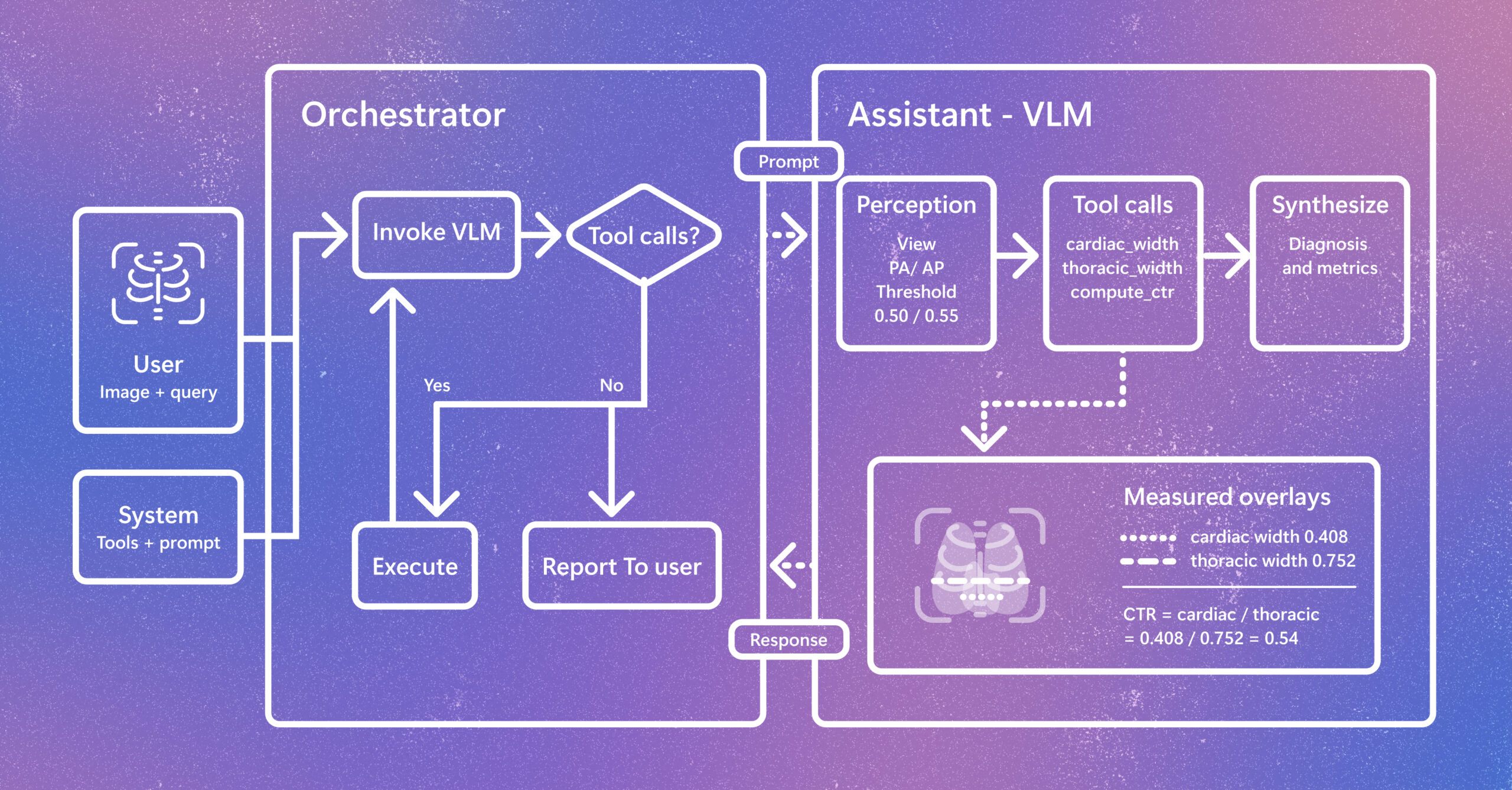
Introducing CARE-X: Towards Clinically Useful Radiology VLMs with Auxiliary Supervision, Reward-Aligned Learning, and Tool-Augmented Measurement

Radiology AI is evolving beyond report generation. CARE-X explores a unified approach that combines flexible reasoning, calibrated predictions, and measurement-based tools for chest X-ray interpretation. The post Introducing CARE-X: Towards Clinically Useful Radiology VLMs with Auxiliary Supervision, Reward-Aligned Learning, and Tool-Augmented Measurement appeared first on Microsoft Research.

We use cookies to run the site and, with your consent, for analytics and to show ads. See our Cookie Policy.