Sep 2026· IEEE Transactions on Mobile Computing· Vol 25, pp. 13460-13471· 0 citations· 38 references
Computer Science
Abstract
Due to data heterogeneity and parameter transmission failure, federated learning (FL) usually suffers performance degradation in wireless networks. To address this issue, a novel federated Learning via reusing historical Information (FedRe) is proposed for convergence acceleration and performance enhancement without any additional communication cost. Specifically, an analytical model is first built to characterize the impacts of data heterogeneity and parameter transmission failure on FL performance. Based on this, a local gradient correction method and a statistical aggregation correction method are proposed to deal with data heterogeneity and transmission unreliability problems respectively. Additionally, the convergence of the proposed FedRe is proved and analyzed theoretically. Finally, extensive numerical results are presented with experiments on two public datasets to validate the effectiveness of FedRe with comparisons of baselines.
A federated random walk averaging framework is proposed, which is a variant of federated averaging (FedAvg) that mitigates data heterogeneity by updating models along random walk (RW) paths and aggregating them at the server and reduces the problem to a general form agnostic to task type and model architecture.
Chang-Heng Wang, Xian-Chao Zhang, Zhi-Qing Wei et al.· 0 citations
Heterogeneous Split Federated Learning (HSFL) is a privacy-preserving technique for devices in different edge settings. However, the present methods adopt a static model partition that cannot adapt to network conditions, resulting in longer inference latency and higher communication costs. To address this issue, we pro...
M. Farooq, Paolo Bellavista, Hafiza Rohma Ahmed· 2026 International Conferenc...· 0 citations
Over-the-air computation has emerged as a scalable and efficient solution for deploying federated learning algorithms in wireless networks by exploiting waveform superposition for simultaneous model aggregation. Most existing work struggles with heterogeneous fading channels. These approaches either enforce unbiased up...
Ming Xiang, Nicolò Michelusi, Y. Eldar et al.· ACM Interational Symposium o...· 0 citations
This paper proposes a selection strategy according to data heterogeneity, bandwidth and system constraints, and recommends the unified reporting of accuracy, communication volume, communication rounds, time, and energy consumption.
Chang Ma· Applied and Computational En...· 0 citations
As the size of machine learning models scales up, conventional federated learning (FL) encounters challenges on wireless edge clients due to scarce resources. Split federated learning (SFL) mitigates these constraints by offloading part of the model to the edge server. However, most prior work adopts two-tier synchrono...
Chun-Feng Xie, Zhi-Xiong Chen, Wen-Qiang Yi et al.· IEEE International Symposium...· 0 citations
Related blog posts
MIT News · Artificial Intelligence· news.mit.eduNov 17, 2026
By studying the computational foundations of language learning, Associate Professor Jacob Andreas builds intelligent systems that can communicate effectively with humans.
MIT News · Artificial Intelligence· news.mit.eduNov 17, 2026
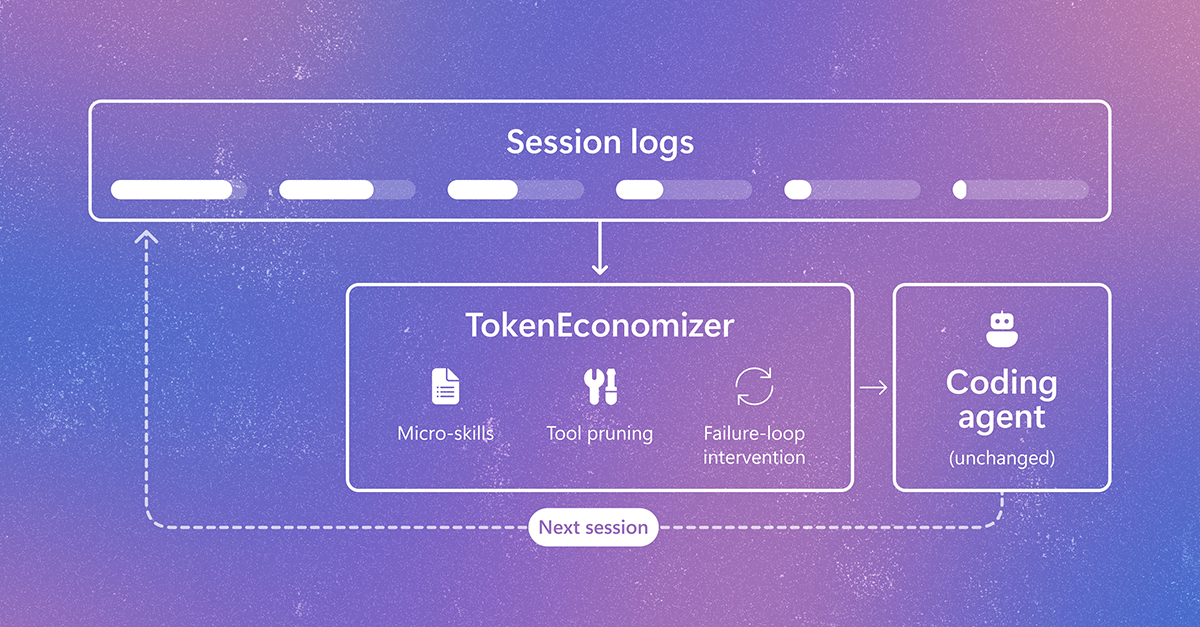
AI coding agents are increasingly help developers fix bugs and build features largely on their own, but every interaction with their models consumes tokens. In each session, an agent sends instructions, tool descriptions, and session history to its model. Most efforts to reduce this cost focus on individual tasks. Yet developers return to the same […] The post TokenEconomizer: Learning from Experience to Make AI Coding Agents More Efficient appeared first on Microsoft Research.
MIT News · Artificial Intelligence· news.mit.eduNov 9, 2026