Sep 2026· Proceedings of the Thirty-Fifth International Joint Conference on Artificial Intelligence· 1 citation· 42 references
Computer Science
TL;DR
This work proposes an efficient algorithm to achieve regret bound O(K sqrt(T) log T) under concave revenue conditions and O(K^(2/3) T^(2/3) (log T)^(1/2) for the general case, with matching lower bounds confirming optimality.
Abstract
To make optimal joint pricing and inventory control decisions is a critical challenge for modern retailers. In practice, retailers face changing market conditions where demands are influenced by various contextual factors, while simultaneously dealing with the difficulty of lost sales that obscure true demand information. However, existing approaches often fail to account for both contextual information and censored demand observations. We address this gap by presenting a framework where we model demand as a linear combination of basis functions with unknown coefficients, allowing for adaptive pricing and inventory decisions that respond to changing contexts. We propose an efficient algorithm to achieve regret bound O(K sqrt(T) log T) under concave revenue conditions and O(K^(2/3) T^(2/3) (log T)^(1/2)) for the general case, with matching lower bounds confirming optimality. Extensive numerical experiments across diverse scenarios demonstrate our algorithm’s effectiveness.
A Mean-Calibrated Kernel UCB (MCK-UCB) algorithm is proposed that turns each incomplete sales record into a reliable guide for both inventory and price decisions, using data from past rounds with similar market conditions.
Ze-An Han, Jing Liang, Rui-Han Lin et al.· 0 citations
Threshold-UCB is developed, which improves the expected regret to $\widetilde{\mathcal{O}}(T^{2/3})$ and reuses sales observations across inventory levels through shared estimates of demand-tail probabilities, allowing the same data to support revenue upper bounds for multiple inventories rather than a single inventory...
The proposed model possesses attractive finite-sample performance guarantees and can be effectively approached using an enhanced affine recourse adaptation to resolve the issue of intractability, and it can be extended to broader contextual decision-making problems under mild conditions.
Problem definition: Startup firms, often small in size, face the challenge of making cross-functional decisions due to the absence of distinct departments like marketing and operations. These interdependent decisions are further complicated by the lack of historical customer data. As a result, these firms must learn ab...
Huseyin Gurkan, N. Keskin, R. Parker· Manufacturing & Service...· 0 citations
Learning how to replenish inventory and estimating the cost of doing so require different information. We establish information-theoretic lower bounds for offline multistage inventory control with independent bounded demand. For fixed additive error in total expected cost, policy learning requires cubically many scalar...
Han-Zhang Qin, D. Simchi-Levi, Rui-Hao Zhu· 0 citations
This paper studies the algorithmic design of price competition in oligopolistic markets, with a focus on long-run market dynamics under reference price effects. We consider a sequential price competition framework with multiple sellers operating over a finite horizon, each lacking prior knowledge of the demand functi...
Yong-Ge Yang, Jian-Nan Ke, Cong Shi· Production and operations ma...· 0 citations
Related blog posts
Microsoft Research Blog· microsoft.comNov 16, 2026
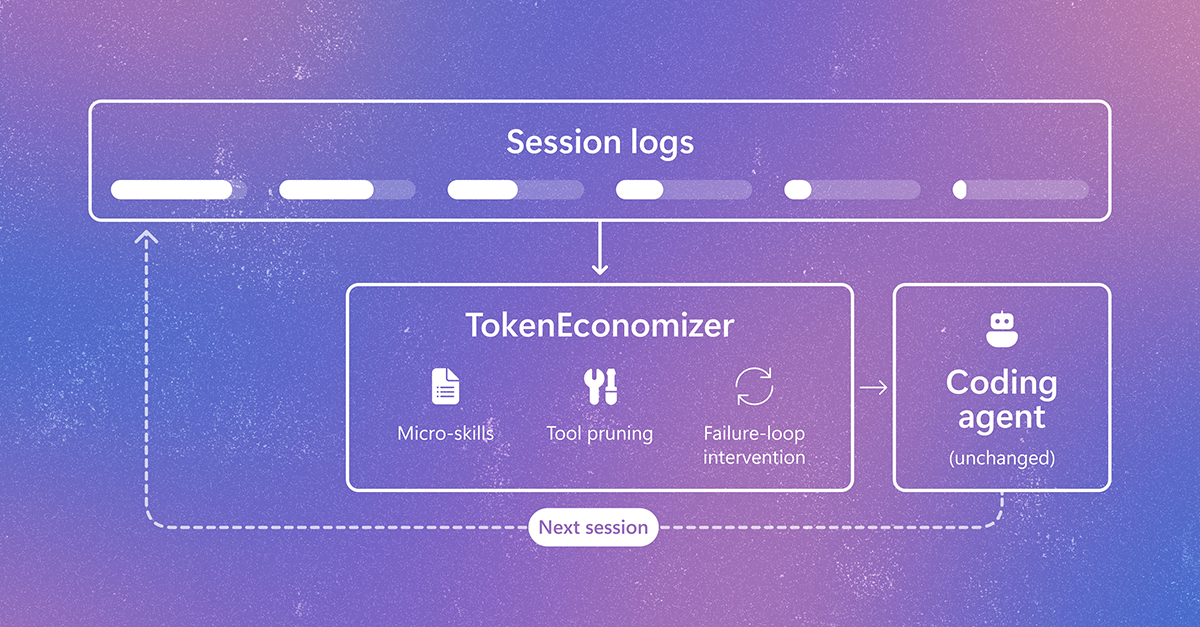
AI coding agents are increasingly help developers fix bugs and build features largely on their own, but every interaction with their models consumes tokens. In each session, an agent sends instructions, tool descriptions, and session history to its model. Most efforts to reduce this cost focus on individual tasks. Yet developers return to the same […] The post TokenEconomizer: Learning from Experience to Make AI Coding Agents More Efficient appeared first on Microsoft Research.
MIT News · Artificial Intelligence· news.mit.eduNov 13, 2026