An end-to-end expected learning guarantee is proved where the approximation term is determined by the omitted Fourier mass, while a normalized unbiased estimator yields an explicit statistical bound for empirical truncations.
Abstract
We study variational quantum distribution learning through a hierarchy of Walsh--Fourier approximations on the Boolean cube. At each level, a selected set of target Fourier coefficients defines a spectral truncation, which is projected onto the probability simplex and used as the target of a quantum circuit Born machine. Parameters learned at one level initialize the next through a warm-start map. We prove an end-to-end expected learning guarantee where the approximation term is determined by the omitted Fourier mass, while a normalized unbiased estimator yields an explicit statistical bound for empirical truncations. We then instantiate the abstract discrepancy conditions for total variation distance and relate the resulting distributional error to quantum-state fidelity. The total-variation specialization incurs the explicit factor $2^{n-1}$ under our normalized $\ell_2$ convention and is therefore informative only for sufficiently concentrated Fourier tails. The framework does not establish global trainability or eliminate barren plateaus; rather, it identifies the conditions under which low-to-high spectral training admits a approximation--estimation--optimization analysis.
A new methodology is developed for quantum machine learning which enables variational quantum circuits to learn linear and non-linear solution operators to differential equations, leveraging the quantum universal approximation theorem.
The redundancy distribution of the frequency spectrum has been shown in the literature to impact the expressivity and trainability of Quantum Fourier Models (QFMs). In this work, we address the question of how this redundancy spectrum is shaped by the choice of eigenvalues of the data re-uploading Hamiltonians, using a...
Felix Paul, Bhilahari Jeevanesan, Peter Jung· 0 citations
This work proposes a physics-informed quantum machine learning (PIQML) framework with hard constraint embedding, specifically designed for NISQ era, and demonstrates that the quantum model successfully learns the solution, showing close agreement with a high-precision classical numerical benchmark.
A variational framework that learns the noise model directly from quantum-error-correction syndrome and logical-observable data collected during error-corrected memory experiments is presented, and it is proved that a sufficiently expressive noise ansatz attains the information-theoretic minimum logical error rate.
Nicola Pancotti, Vedika Saravanan, K. Svore· 0 citations
This work proposes Quantum SEDONet (Spectral-Embedded Deep Operator Network), which assigns each trunk coordinate a spectral basis according to its boundary condition: Fourier features for periodic coordinates and Chebyshev features for bounded, non-periodic coordinates.
Muhammad Abid, Arth Sojitra, Bipin Tiwari et al.· 0 citations
A protocol for approximating the measurement distributions of quantum states, extending beyond standard observable estimation is introduced, and tightened gate complexity bounds for practically relevant systems, including those with k-local interactions, long-tailed matrix ensembles, and conserved quantities are provid...
Arul Rhik Mazumder, James D. Watson, Samson Wang· 0 citations
Related blog posts
MIT News · Artificial Intelligence· news.mit.eduOct 2, 2026
A weeklong summer workshop brought higher education faculty to campus to explore how AI and machine learning materials can be adapted for their classrooms.
MIT News · Artificial Intelligence· news.mit.eduAug 27, 2026
A new machine-learning framework aims to improve the success rate of computational protein design while moving away from results that reproduce sequences found in nature.
Microsoft Research Blog· microsoft.comAug 20, 2026
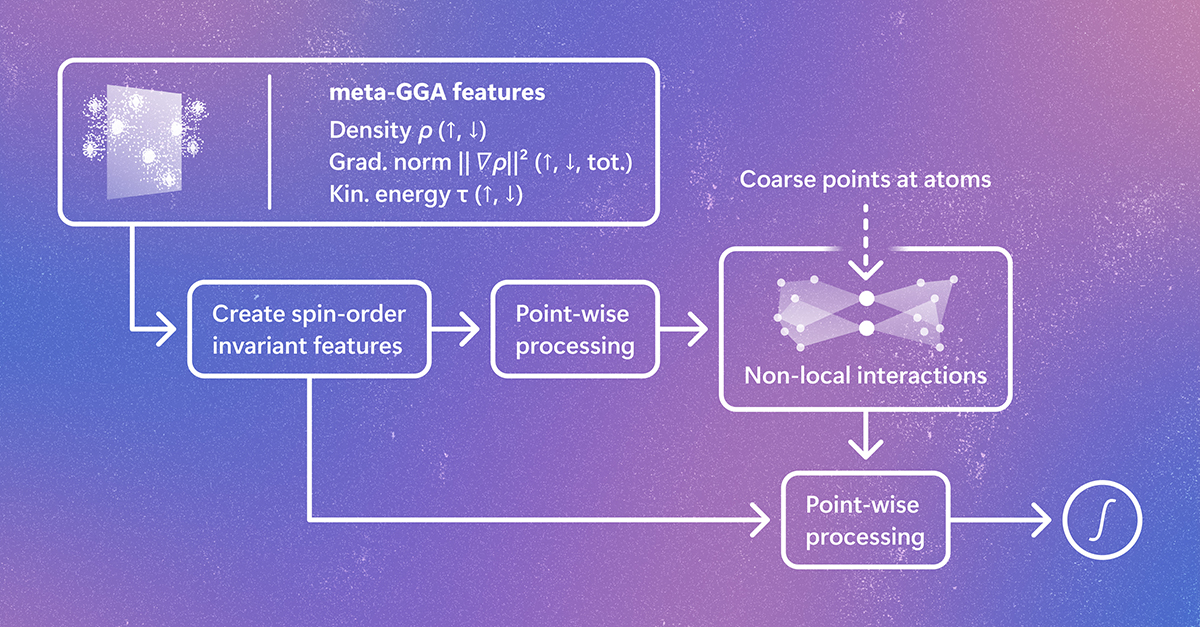
Skala 1.1, the updated deep-learning exchange-correlation functional from Microsoft Research, provides greater accuracy, expanded accessibility across the computational chemistry ecosystem, and a living benchmark to track computational performance. The post Broadening access to Skala creates a faster path to predictive DFT appeared first on Microsoft Research.
We use cookies to run the site and, with your consent, for analytics and to show ads.
See our Cookie Policy.