How many past requests are needed to decide which qubits should share entanglement? We show that the answer depends on the allocation choices created by the queries: a larger memory can require no more data. The memory stores a classical bit and answers requests through a fixed detector that preserves coherence within each measured sector. For independent commuting $X$- and $Z$-type Pauli queries, we characterize the full attainable prediction-contrast region and construct encodings that preserve the bit at every nonzero vertex. With sharp reports, a $d$-qubit path and groups of at most $k$ qubits have minimax excess error after $m$ requests proportional to $k^{-1}\min\{1,\sqrt{d\log(k+1)/m}\}$, uniformly for $2\leq k<d$. Connected biclique regions can grow without increasing sample demand when depth, region count and connections per region stay bounded. Preparation noise introduces a separate calibration requirement. We derive an exact tradeoff with extra fresh detector calls and transfer the learning law to structured transaction co-location. Population-risk experiments test the statistical predictions. We also compare encodings on a native 15-qubit device and learned partitions on public purchase baskets. The full chain wins on the device; frequency grouping outperforms basket search in the largest-capacity retail setting.
Consider the task of identifying an unknown classical codeword delivered to a register of quantum sensor qubits through a sequence of weak phase interactions that each encode one bit. Suppose that each received bit controls an identical $Z$-rotation of angle $\theta$ applied to every sensor qubit; receivers may also us...
John Blue, Zachary E. Chin, Vlad S. Oros et al.· 0 citations
Additional qubits can reduce the depth of a quantum circuit by providing workspace for parallel computation, but standard constructions assume that this workspace is initialized in a known state. In this work we study catalytic implementations, i.e. asking whether dirty qubits can instead be used provided that their jo...
Marten Folkertsma, Ian Mertz, S. Strelchuk et al.· 0 citations
This work defines the universal margin as the smallest correlator magnitude that can be guaranteed with prescribed signs for every target sign assignment, and shows that it is exactly $\Delta_{\rm Maj}(n)=\tan\!\left(\frac{\pi}{4n}\right)=\Theta(1/n)$, whereas uniformly random sign assignments retain $\Theta(1/\sqrt n)...
Entanglement can reduce the communication required for coding tasks, but establishing the minimum achievable cost is essential to understanding its limits. We address this question in a zero-error source-coding task where Alice receives a word and Bob knows an unordered pair of candidates containing it. Alice does not...
We study state tomography when each measurement acts on at most $k$ fresh copies and no quantum memory is retained between blocks. We prove a lower bound matching the upper bound in [arXiv:2510.07788]. Thus the copy complexity of estimating an arbitrary $d$-dimensional state to trace distance $\epsilon$ is, up to absol...
U. Keskin, Jason Luo, Mahbod Majid et al.· 3 citations· ⚡2
Recent work established that, for independent erasures, storing $K$ logical qubits for $S$ time steps with error at most $\varepsilon$ requires a spacetime cost of $\Omega(S(K+\log(S/\varepsilon)))$. A matching construction was also given, but assumes ideal error correction. Here we show that the same scaling can be ac...
Kishor Bharti, Tobias Haug, Derek Khu et al.· 0 citations
Related blog posts
MIT News · Artificial Intelligence· news.mit.eduOct 2, 2026
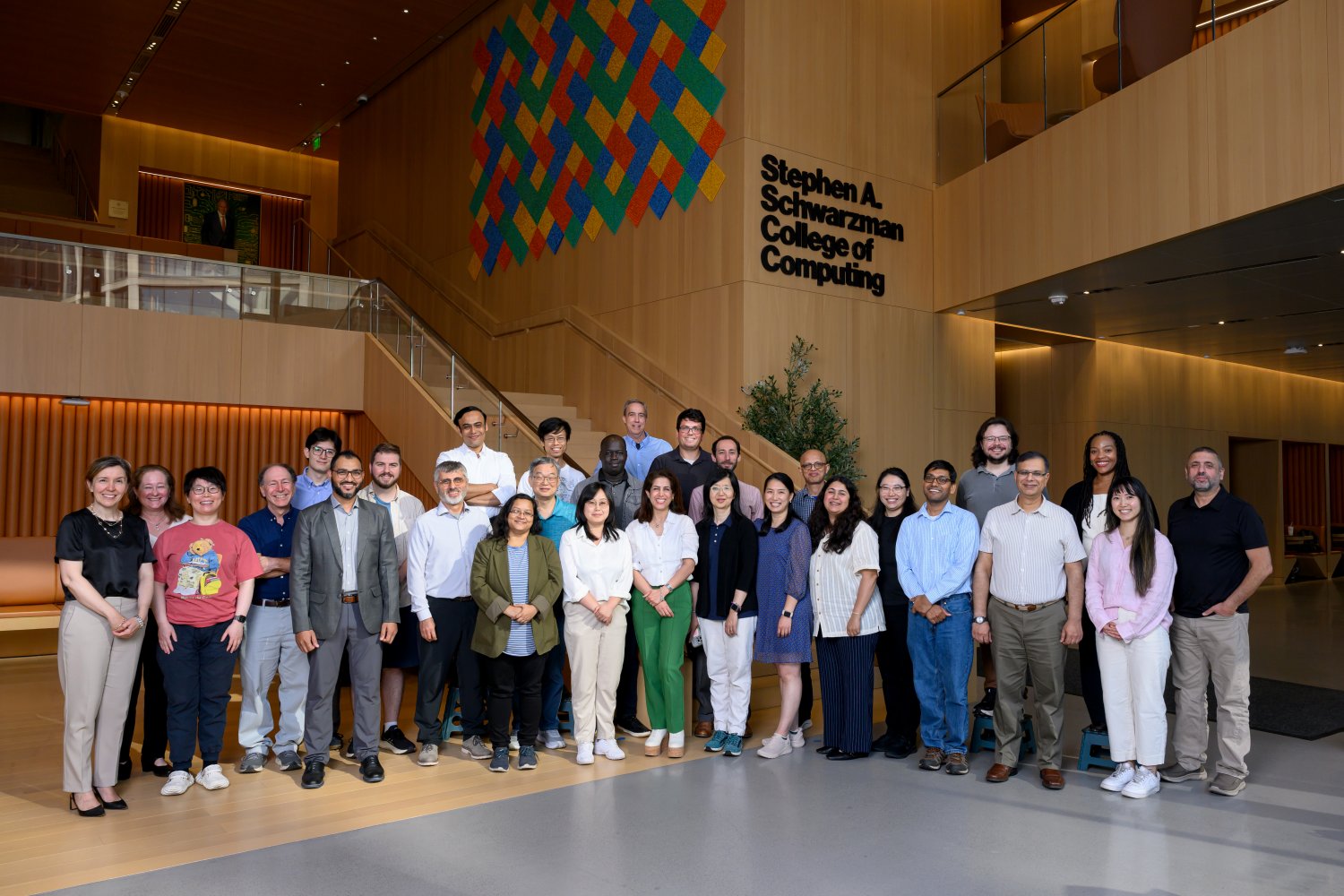
A weeklong summer workshop brought higher education faculty to campus to explore how AI and machine learning materials can be adapted for their classrooms.
MIT News · Artificial Intelligence· news.mit.eduAug 27, 2026
A new machine-learning framework aims to improve the success rate of computational protein design while moving away from results that reproduce sequences found in nature.
Microsoft Research Blog· microsoft.comAug 20, 2026
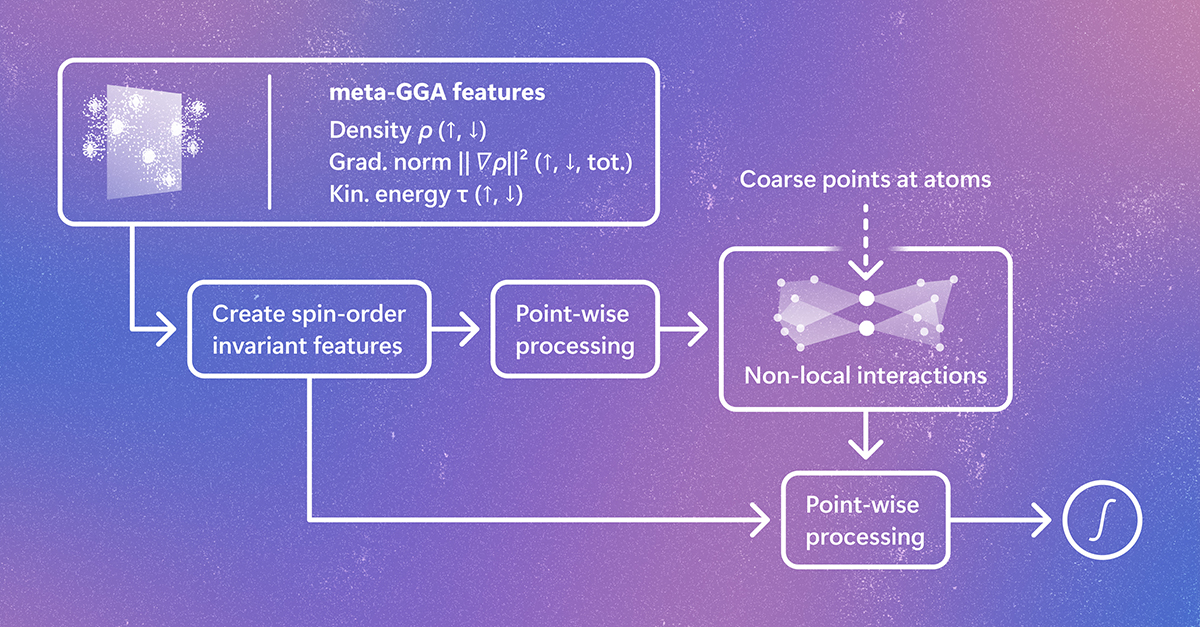
Skala 1.1, the updated deep-learning exchange-correlation functional from Microsoft Research, provides greater accuracy, expanded accessibility across the computational chemistry ecosystem, and a living benchmark to track computational performance. The post Broadening access to Skala creates a faster path to predictive DFT appeared first on Microsoft Research.
We use cookies to run the site and, with your consent, for analytics and to show ads.
See our Cookie Policy.