GeoSteer is proposed, an optimization-based method for norm-preserving activation steering that consistently improves over state-of-the-art activation steering baselines and replaces predefined one-step edits with adaptive, geometry-aware optimization.
Abstract
Activation steering provides a lightweight way to control large language models (LLMs) by modifying their hidden activations at inference time. Among these approaches, norm-preserving steering aims to change model behavior without altering the activation norm, reducing the risk of representation collapse and degradation. However, existing norm-preserving methods are limited by predefined steering trajectories and by their reliance on one-step updates, which may fail to capture the complex structure of activation distributions. We propose GeoSteer, an optimization-based method for norm-preserving activation steering. GeoSteer formulates steering as a Riemannian optimization problem and updates activations through a sequence of small geodesic steps on the representation manifold. To avoid fixed steering directions, GeoSteer learns a nonlinear activation-space objective that distinguishes desired from undesired activations, and uses this function to adaptively guide each steering step. This multistep formulation yields smoother, more stable, and more consistent steering behavior while preserving the activation norm. Across TruthfulQA, RealToxicityPrompts, and UltraFeedback benchmarks, GeoSteer consistently improves over state-of-the-art activation steering baselines. These results suggest that norm-preserving steering can be made more effective by replacing predefined one-step edits with adaptive, geometry-aware optimization.

Steering Vector Dissection is proposed, a framework to explicitly isolate individual and semantically consistent features from these composite directions that tend to entangle multiple semantic and stylistic concepts into a single composite direction, leading to unpredictable steering effects.
Takeru Hiramatsu, Kyohei Atarashi, Koh Takeuchi et al.· 2 citations
This work proposes a disentanglement-based intervention framework, termed IB-ACT, that identifies both where and how to intervene by exploiting the layer-wise geometry of representation spaces to isolate behavior-relevant information without disturbing other dimensions, and introduces a layer-selection mechanism determ...
Toan Doan, Thin Nguyen, Sunil Gupta· Proceedings of the 32nd ACM...· 0 citations
Activation steering is a powerful training-free paradigm for controlling large language models at inference time. However, standard approaches estimate a per-layer steering direction from contrastive data and apply it on the layer's entire representation space, which may couple the intervention to off-target properties...
Irene Tallini, Lorenzo Basile, Valentino Maiorca et al.· 0 citations
As large language models (LLMs) are increasingly deployed in alignment-sensitive contexts, activation steering has emerged as a lightweight, inference-time alternative to fine-tuning methods (e.g., RLHF, DPO) for behavioral control. However, existing work typically validates steering on isolated behaviors, leaving it u...
Mohammad Mahdi Abootorabi, Armin Saghafian, Ali Bazshoushtari et al.· 0 citations
Manifold-valued data, and consequently the distributions they induce, are prevalent across many domains, ranging from the locations of geospatial events, such as earthquakes, to biomolecular torsion angles that encode information about three-dimensional structure. While diffusion and flow-based generative models have b...
Ualibyek Nurgulan, Seungwoo Yoo, Prin Phunyaphibarn et al.· 0 citations
GeometricSPRINT (Geometric Step Pruning for Inference in Trajectories), a training-free framework for constructing non-uniform sampling schedules from the geometry of denoising trajectories, consistently improves over uniform DDIM (Denoising Diffusion Implicit Models) schedules at matched NFE budgets.
Adaptive AI agents can help make BIM data more machine-readable by navigating IFC models, interpreting inconsistent information, and mapping it to defined standards. In this blog, Alok Rawat shares findings from a real-world pilot in construction workflows. The post Adaptive AI Agents in Construction Workflows appeared first on GPT-Lab.
What does it take to trust AI-driven HVAC optimization? Our AI Model Factory combines agents, machine learning, reinforcement learning and deterministic checks in a governed workflow designed for messy, real-world building data. The post We built an AI factory for HVAC control appeared first on GPT-Lab.
MIT News · Artificial Intelligence· news.mit.eduAug 18, 2026
A new method for surgically removing training examples from a model reveals that as datasets grow, the link between what a model learns and what it produces dissolves.
Microsoft Research Blog· microsoft.comJul 30, 2026
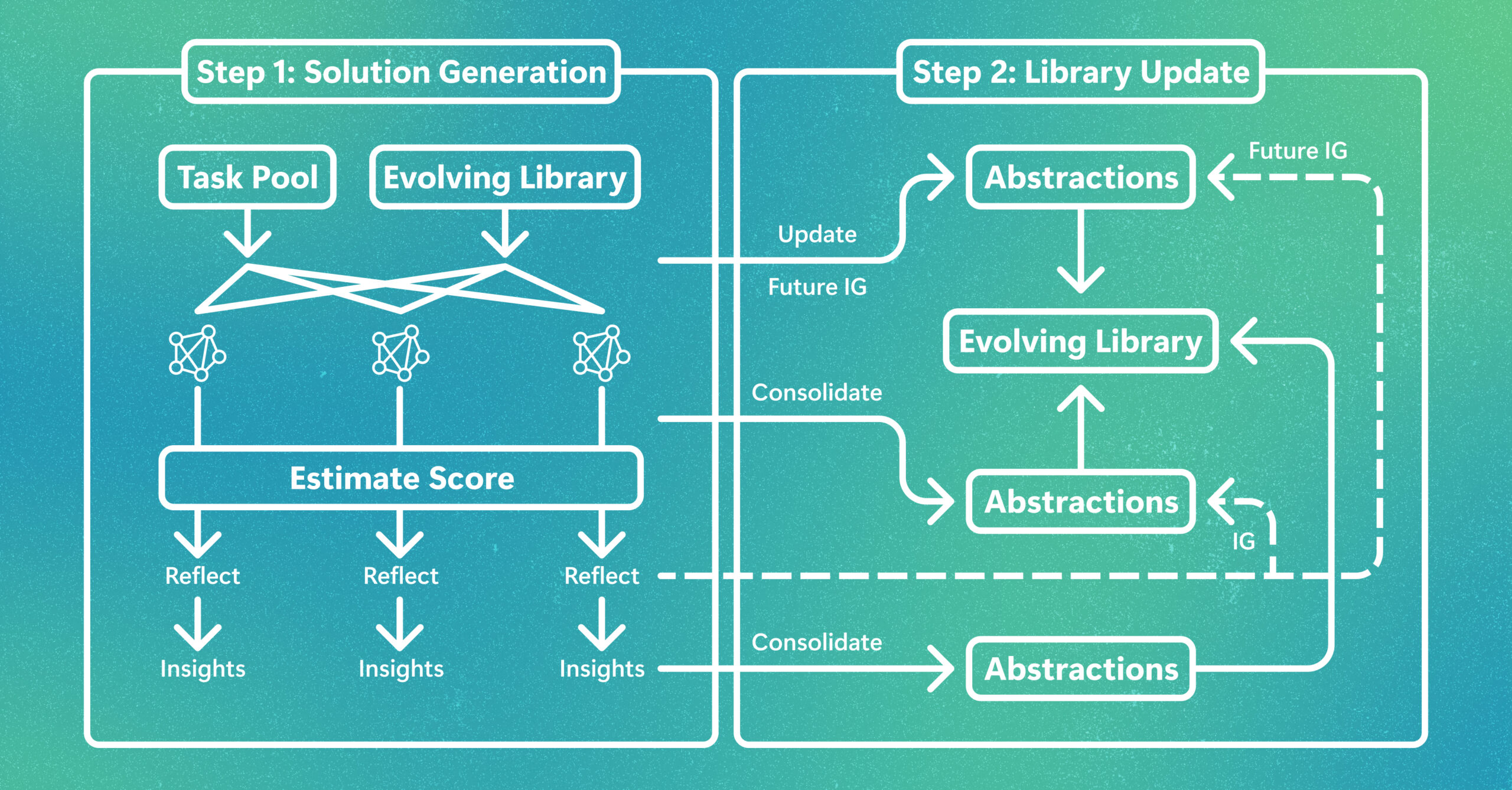
LLMs do not get smarter just by remembering more. EvoLib turns experience into evolving knowledge, taking reusable skills and insights that help models learn and adapt across tasks long after deployment. The post EvoLib: Turning experience into evolving knowledge appeared first on Microsoft Research.
We use cookies to run the site and, with your consent, for analytics and to show ads.
See our Cookie Policy.