Skip to content

The Platonic brain bridge hypothesis: human brain networks as an architectural prior for multimodal large language models

Sep 2026 · 0 citations · 68 references
Biology Computer Science

TL;DR

The Platonic brain bridge hypothesis is proposed: omni models, multimodal large language models that process video, audio and text jointly, converge on brain-like representations usable in both directions, and human brain organization is a usable architectural prior for multimodal large language models.

Abstract

Multimodal large language models predict brain activity, but brain alignment has been a measurement, not a design tool. We propose the Platonic brain bridge hypothesis: omni models, multimodal large language models that process video, audio and text jointly, converge on brain-like representations usable in both directions. From model to brain, brain-likeness of seven omni models is stable across participants, rises with every input channel in three bases, and our encoders lead the Algonauts 2025 out-of-distribution leaderboard. From brain to model, Brain-MoE fixes the expert partition of a frozen base to the seven networks of human cortex, trains experts on network-labelled Brain-AVQA questions, raises held-out accuracy in all 15 model-benchmark pairs by 6.42 percentage points on average and exceeds capacity-matched random experts in 14. Brain-Scope localizes the correspondence to sparse features whose removal weakens brain prediction. Human brain organization is therefore a usable architectural prior for multimodal large language models.

View source

Similar papers

#natural language process... Preprint Sep 2026

Cognitive Expert Language Models Better Align with the Corresponding Brain Systems

Large language models (LLMs) can predict human brain activity across a variety of brain regions during natural language comprehension. Typically, however, LLM-brain alignment is measured using one model for different regions of the brain, and then model performance is summarized across regions. This one-model-fits-all...

Zhivar Sourati, Meng-Hong Wu, Nona Ghazizadeh et al. · 0 citations
#artificial intelligence Preprint Sep 2026

Which Attention Heads are like the Human Head? Not the Ones that Compute

Alignment and causation dissociate: brain-aligned heads contribute to performance, but their removal is substantially less disruptive than removal of heads selected via attribution patching, and FV-ranked removal is substantially more disruptive than brain-ranked removal.

Christopher Pinier, Gustaw Opielka, Hannes Rosenbusch et al. · 0 citations
Open access Aug 2026

Quantifying Large Language Model Influence in Brain Computer Interface Communication for Amyotrophic Lateral Sclerosis

This retrospectively re-decoded 3,373 P300-speller selections from 47 people with amyotrophic lateral sclerosis, reconstructing a neural posterior and combining it with 25 language priors ranging from 5-grams to 46.7-billion-parameter models to reveal how strongly a fused brain-computer interface decision depends on it...

A. Gorenshtein, M. Omar, E. Jia et al. · 1 citation
#artificial intelligence Preprint Oct 2026

CortexBridge: Cortical Alignment of EEG Montages for Foundation Models

Electroencephalography (EEG) foundation models are often pretrained with a fixed channel vocabulary or a limited set of montages, making transfer difficult when electrode layouts change. We propose CortexBridge, a lightweight adapter that combines EEG features with electrode and atlas coordinates to map arbitrary monta...

Jia-Zhen Hong, Xiao-Tian Zhou, Zi-Hao Ding et al. · 1 citation
Open access Aug 2026

Brain–Language Alignment During Naturalistic Reading and Its Disruption by Mind-Wandering

Encoding models offer a principled framework for linking computational representations of language to neural activity, but most electroencephalography (EEG) evidence for brain–language alignment comes from tightly controlled, word-by-word reading paradigms. Whether such alignment is detectable during naturalistic readi...

Haorui Sun, D. Jangraw · 0 citations

Related blog posts

Microsoft Research Blog Nov 16, 2026

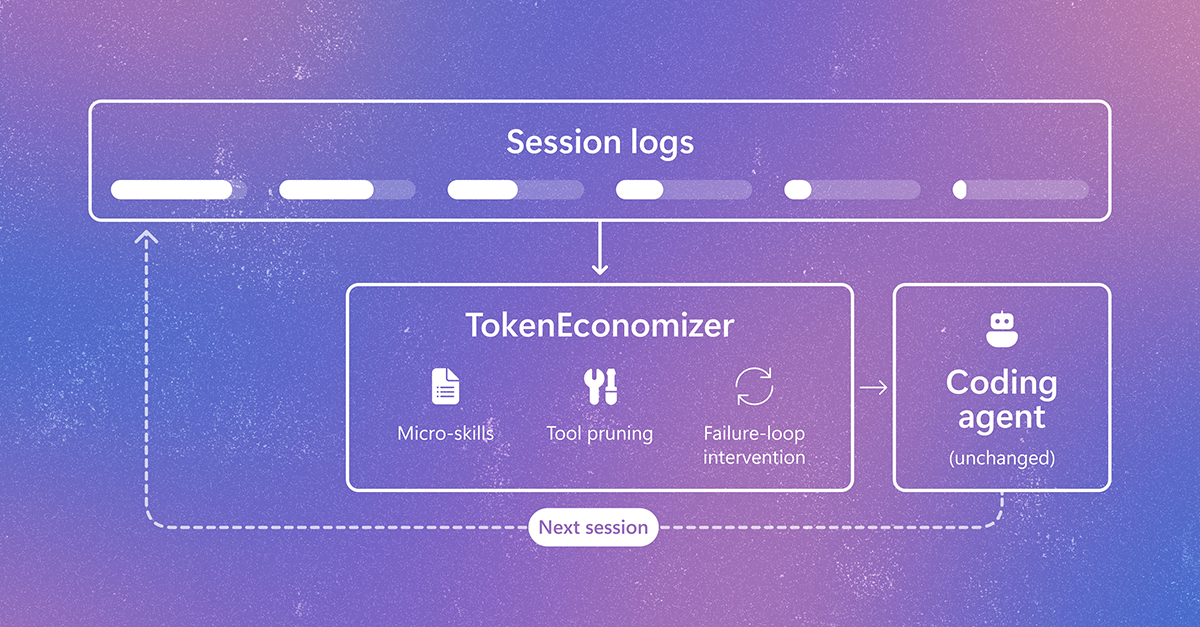
TokenEconomizer: Learning from Experience to Make AI Coding Agents More Efficient

AI coding agents are increasingly help developers fix bugs and build features largely on their own, but every interaction with their models consumes tokens. In each session, an agent sends instructions, tool descriptions, and session history to its model. Most efforts to reduce this cost focus on individual tasks. Yet developers return to the same […] The post TokenEconomizer: Learning from Experience to Make AI Coding Agents More Efficient appeared first on Microsoft Research.

We use cookies to run the site and, with your consent, for analytics and to show ads. See our Cookie Policy.