This paper proposes a meta-learning framework that leverages a comprehensive set of meta-features capturing dataset complexity to predict classifier performance without exhaustive training, and achieves an average ranking prediction accuracy exceeding 86%, demonstrating its effectiveness in guiding model selection.
Abstract
No Free Lunch theorem implies that any performance gains achieved by a classifier on a particular image distribution are necessarily offset by a loss of performance over the set of all possible problems; thus, no single model is universally optimal. Selecting the most suitable classifier for image datasets is a critical yet challenging task due to the intrinsic complexity and diversity of images. This paper proposes a meta-learning framework that leverages a comprehensive set of meta-features capturing dataset complexity to predict classifier performance without exhaustive training. By extracting and selecting features using methods such as autoencoders, pre-trained networks, and dimensionality reduction techniques, we train regression models to efficiently estimate classifier accuracies. Additionally, clustering techniques are employed to group classifiers with similar performance patterns, simplifying the recommendation process. The datasets used span a wide range of concepts, including nature, animals, numbers, motorcycles, medical images, and human bodies, to ensure broad generalization. Evaluated on 56 diverse image datasets, our approach achieves an average ranking prediction accuracy exceeding 86%, demonstrating its effectiveness in guiding model selection. This scalable and interpretable framework provides a practical solution to improve classification performance while reducing computational costs.
ARMDIL is an ensemble that uses a multimodal large language model (MLLM) agent to dynamically route each image to the most suitable vision backbone, drastically improves adaptability by allowing new information to be integrated via simple prompt modifications, while enhancing interpretability through natural language r...
Daniel A. Perkins, J. Squires, Janou Milligan et al.· 0 citations
The proposed meta-adaptive resampling selection plus plus (MARS) is a stability aware meta-adaptive framework that chooses the best method based on the data based on the data, suggesting that selecting methods based on stability worked well on the evaluated datasets.
Noor Baha Aldin· Journal of King Saud Univers...· 0 citations
Evaluating the performance of Greedy K-center across a variety of metric spaces shows that mapping unlabeled instances into a predictive probability space and weighting the result by entropy often dominates the other options for active learning selection with Greedy K-center.
Class imbalance remains a critical challenge in supervised learning, often biasing classifiers toward majority classes. While resampling techniques like Synthetic Minority Oversampling Technique (SMOTE) are widely used, the combined effect of data balancing and hyperparameter optimization across diverse datasets is rar...
Necati Vardar, Mehmet Fatih Ören· Sakarya University Journal o...· 0 citations
It is demonstrated that hyperparameter optimization dynamics depend heavily on dataset complexity, where computational efficiency is the primary differentiator for simpler classification tasks, but optimization architecture selection becomes critical for navigating challenging medical imaging applications.
Sarab Almuhaideb, Ahmad Raza Khan· Applied Sciences· 0 citations
Exploring how generative AI could make machine vision more accessible to businesses. The post GenEye in a Box: Making Machine Vision Something You Can Just Ask For appeared first on GPT-Lab.
Microsoft Research Blog· microsoft.comAug 11, 2026
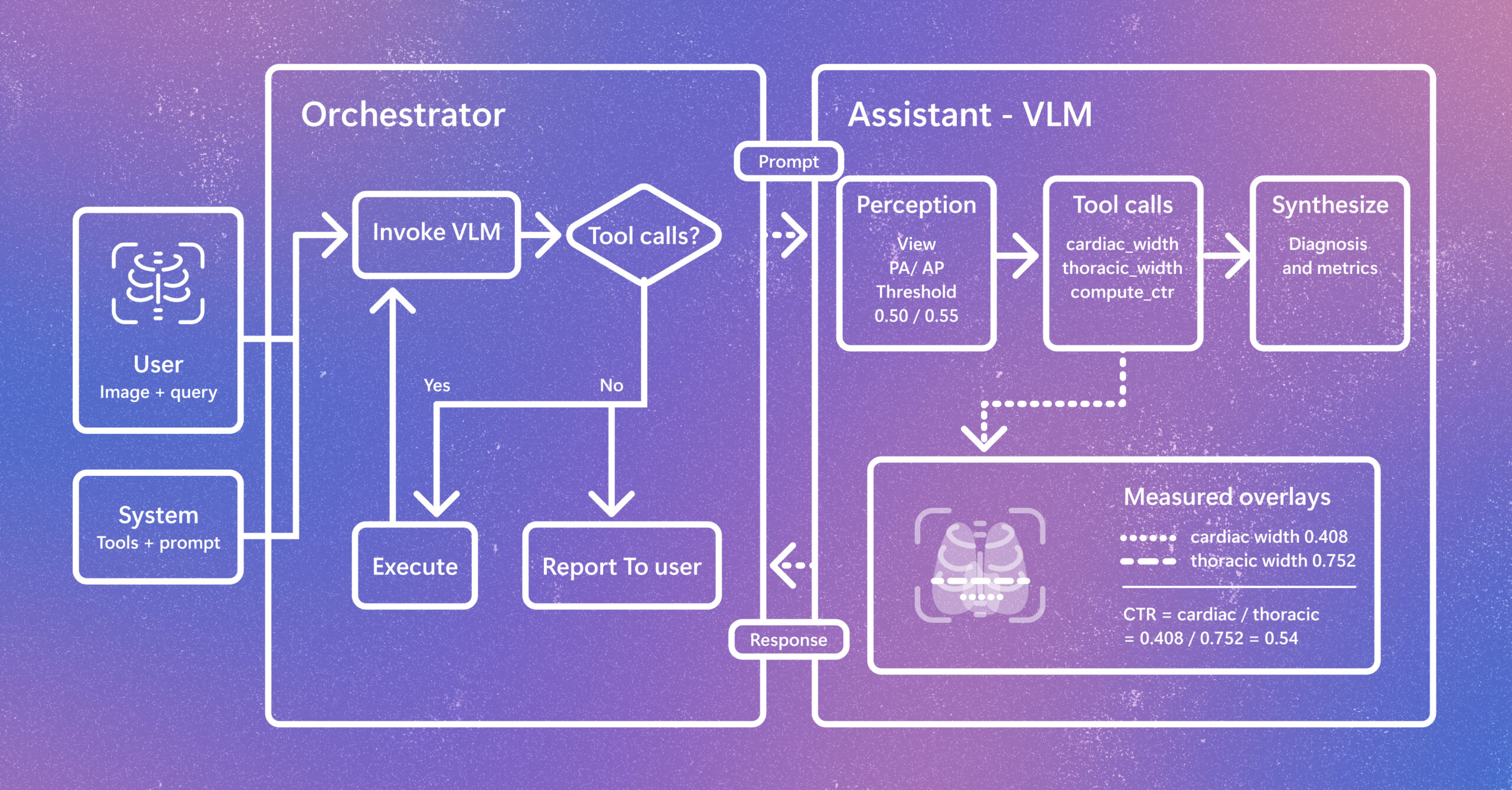
Radiology AI is evolving beyond report generation. CARE-X explores a unified approach that combines flexible reasoning, calibrated predictions, and measurement-based tools for chest X-ray interpretation. The post Introducing CARE-X: Towards Clinically Useful Radiology VLMs with Auxiliary Supervision, Reward-Aligned Learning, and Tool-Augmented Measurement appeared first on Microsoft Research.