We introduce Complex-Valued Quadratic Phase Gaussian (CVQPG), a novel hologram representation method that augments each 2D Gaussian primitive with a quadratic phase profile controlled by a learnable curvature parameter. Against the planar Gaussian baseline, CVQPG improves the average PSNR of holographic reconstructions by 0.19 dB (RGB) and 0.33 dB (grayscale) at equal primitive counts, and by 0.05 dB (RGB) and 0.08 dB (grayscale) at equal parameter counts, where it still leads in all visual quality metrics. Our frequency-domain analysis shows that CVQPG better preserves the mid-to-high frequency band of natural images, where the reconstruction MSE drops by up to 11% (RGB) and 22% (grayscale), indicating that modulating primitive wavefronts is an effective and lightweight enhancement.
Phase-only hologram (POH) generation remains a fundamental challenge in holographic displays because of the inherent difficulty in encoding complex amplitudes using phase-only modulation. Existing methods often suffer from the speckle noise introduced by random phase modulation, high computational costs, or reduced spa...
Jianglian Wang, Y. Tokunaga, Atsushi Okamoto· Optics Express· 0 citations
Stochastic order-independent transparency enables efficient and elegant rendering of primitive-based radiance fields like 3D Gaussian Splatting models, but remains impractical due to the inherent visible noise in the output. We propose a principled approach to minimize high-frequency noise, addressing its sources at th...
Felix Windisch, Thomas Köhler, Lukas Radl et al.· 0 citations
360° images, defined on a sphere, are widely used in immersive applications, but their equirectangular projection introduces distortions, especially near the poles, while the equatorial region is most perceptually important. This paper adapts the HiFiC model to ${360}^{{\circ}}$ imagery through three changes: (i) repla...
G. S. Baggio, D. R. Chaves, T. D. Da Silveira· Symposium on Integrated Circ...· 0 citations
3D Gaussian Splatting has become an effective representation for real-time novel view synthesis by optimizing explicit 3D Gaussian primitives from a set of posed images. A key component of this framework is adaptive density control, where Gaussians are cloned, split, or pruned during training to improve scene coverage...
Javlon Tursunov, Gregor Rozinaj, Vivek Dwivedi et al.· International Symposium ELMA...· 0 citations
This work proposes HoOPOE (Holography-Optimized Perceptual ObjectivE function), a CGH-specific, perceptually-aware loss function that hides speckles from human vision and yields the most visually pleasing results.
Ethan Chen, Peng Xi, Alexandre Chapiro et al.· 0 citations
Gaussian Splatting has emerged as a prominent technique in computer vision and graphics, enabling high-fidelity scene reconstruction from a vast collection of 3D Gaussian primitives. Each primitive's appearance is governed by a viewindependent opacity parameter and a view-dependent color derived from spherical harmonic...
Hao-Chen Sun, Rui Xu, Zhiyang Dou et al.· IEEE Transactions on Visuali...· 0 citations
Exploring how generative AI could make machine vision more accessible to businesses. The post GenEye in a Box: Making Machine Vision Something You Can Just Ask For appeared first on GPT-Lab.
Microsoft Research Blog· microsoft.comAug 11, 2026
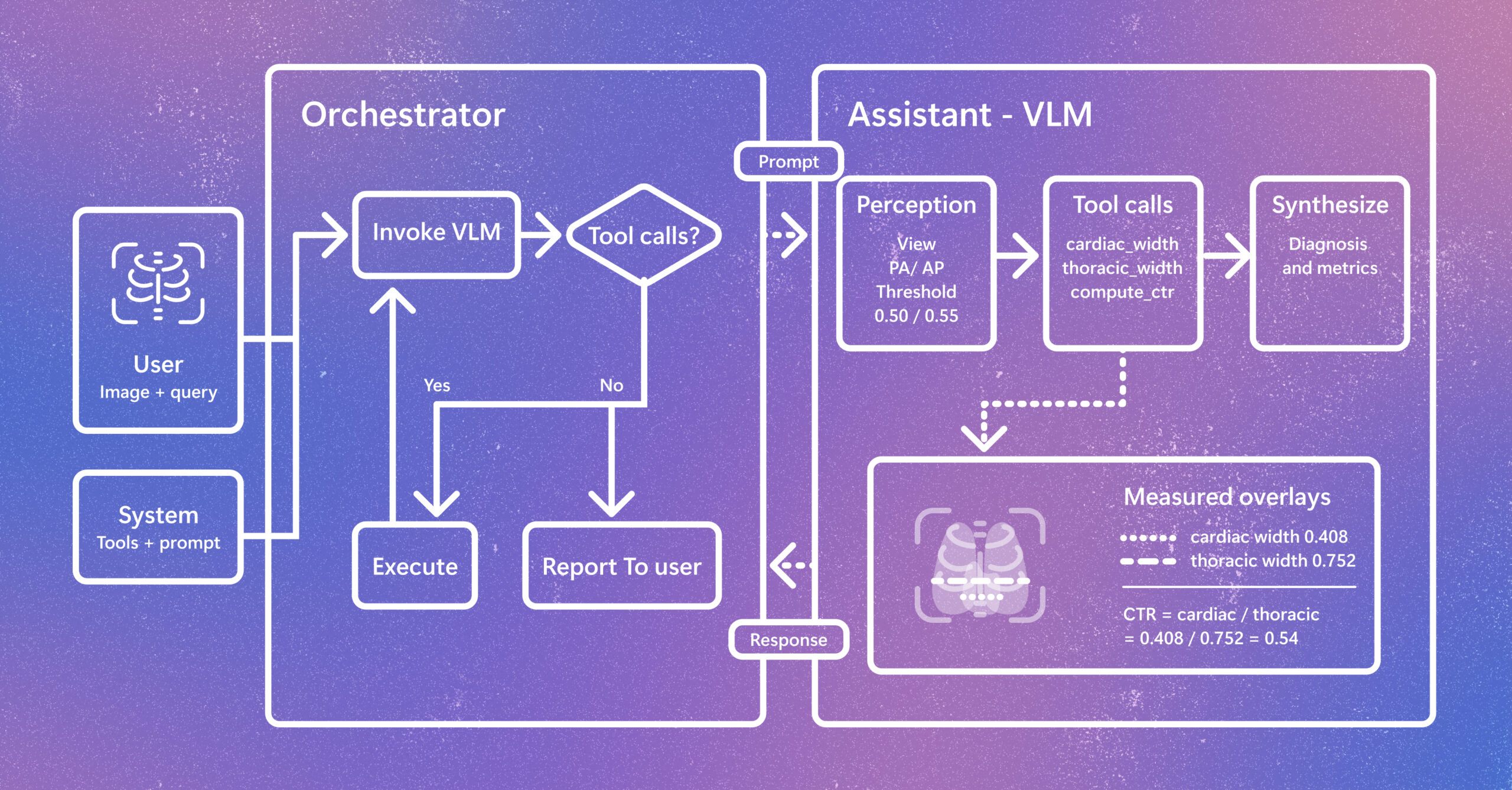
Radiology AI is evolving beyond report generation. CARE-X explores a unified approach that combines flexible reasoning, calibrated predictions, and measurement-based tools for chest X-ray interpretation. The post Introducing CARE-X: Towards Clinically Useful Radiology VLMs with Auxiliary Supervision, Reward-Aligned Learning, and Tool-Augmented Measurement appeared first on Microsoft Research.