By decoupling haptic control loops from network bottlenecks, CARLAverse enables scalable, cross-institutional HITL experiments without compromising physical immersion.
Abstract
The development of autonomous driving demands comprehensive testing in mixed-traffic scenarios involving vulnerable road users (VRUs), where purely artificial agents often fail to capture authentic human social negotiations. While human-in-the-loop (HITL) simulators enable safe investigation of these interactions, existing multi-agent platforms struggle with the network latency and synchronization constraints required for high-fidelity haptic feedback. To resolve this, we present CARLAverse, an open-source, multimodal simulation ecosystem. Extending modular hardware abstraction, CARLAverse integrates driving (DrivoCARLA), cycling (CycloCARLA), and pedestrian (WalkoCARLA) simulators into a shared virtual environment. Its core methodological contribution is a distributed physics architecture: latency-critical ego dynamics and high-frequency force feedback are computed locally on client nodes, while a central CARLA server orchestrates non-player character (NPC) physics and global traffic. By decoupling haptic control loops from network bottlenecks, CARLAverse enables scalable, cross-institutional HITL experiments without compromising physical immersion. Code and documentation: https://git.ieem-ka.de/simulator-environments/carlaverse

This paper investigates developing real-world perception for active agents, proposes Gibson Environment for this purpose, and showcases a set of perceptual tasks learned therein.
F. Xia, Amir Zamir, Zhi-Yang He et al.· 2018 IEEE/CVF Conference on...· 1,069 citations· ⚡112
This publication proposes a definition and a classification of agile software development approaches and analyses ten software development methods that can be characterized as being "agile" against the defined criterion.
P. Abrahamsson, O. Salo, Jussi Ronkainen et al.· arXiv.org· 727 citations· ⚡54
The study shows that agile practices improve both informal and formal communication, but indicates that, in larger development situations involving multiple external stakeholders, a mismatch of adequate communication mechanisms can sometimes even hinder the communication.
M. Pikkarainen, Jukka Haikara, O. Salo et al.· Empirical Software Engineeri...· 401 citations· ⚡48
The results indicate that software engineering work practices are chosen opportunistically, adapted and configured to provide value under the constrains imposed by the startup context.
Nicolò Paternoster, Carmine Giardino, M. Unterkalmsteiner et al.· Information and Software Tec...· 394 citations· ⚡54
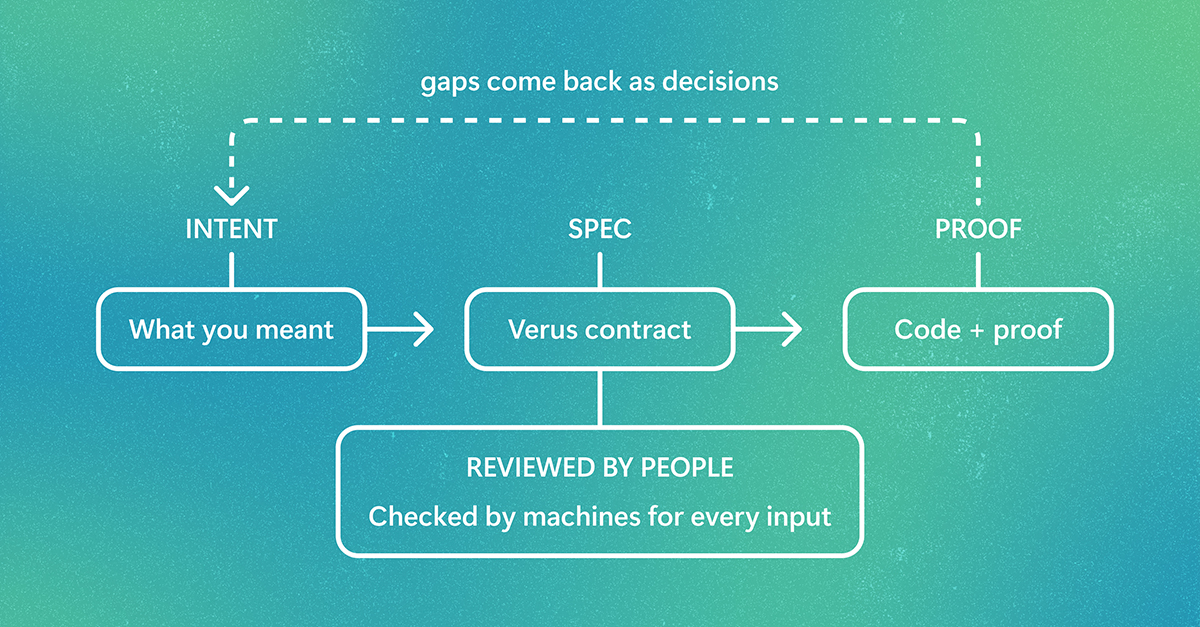
AI agents can generate code at a scale that’s hard for humans to review line-by-line. PDD Kit helps ensure the code is doing what the developer intended by creating formal specifications and testing against them. It converts developer intent into a Verus specification, proves AI-generated code meets it for every input, and uses tests where proofs aren't practical. Developers review intent, not every line. The post Formally verifying agent-written full-stack web apps with PDD Kit appeared first o…
MIT News · Artificial Intelligence· news.mit.eduNov 5, 2026
A new system identifies and corrects unreliable object descriptions stored in a robot’s memory, improving the robot’s ability to interact with its environment.