This paper presents an empirical evaluation of Large Language Models (LLMs) for automated model-based test generation, compared with a state-of-the-art model-based testing tool (GraphWalker) and its built-in algorithms (random and quick random for edge and vertex coverage settings).
Abstract
Large language models have shown strong potential for software engineering tasks, particularly software testing. Model-based testing (MBT) is a software testing technique. To address the broad scalability challenge for industrial adoption of MBTs, our paper presents an empirical evaluation of Large Language Models (LLMs) for automated model-based test generation, compared with a state-of-the-art model-based testing tool (GraphWalker) and its built-in algorithms (random and quick random for edge and vertex coverage settings). Our evaluation indicates strong potential to optimize and shorten test paths and step sizes using the recent five state-of-the-art LLMs (GPT-5.1, GPT-5.2, Claude Opus 4.5, Claude Sonnet 4.5, and Gemini 2.5 Pro) against four GraphWalker models (two web applications (Parabank and Testinium) and two hardware applications (TLC and RISC-V) ) of escalating complexity.
The results show that appropriate model slicing significantly improves completion correctness while simultaneously reducing token usage across several structural and semantic evaluation metrics, and establish model slicing as a key factor in LLM-based model completion and provide guidance for effective context selectio...
Alisa Welter, Benedict Bliem, Omer Iqbal et al.· Proceedings of the ACM/IEEE...· 0 citations
This paper presents a formal mathematical model for categorizing the outcome of generated-tests into four classes, a couple of basic metrics: Bug-Revealing Rate (BRR) and Bug-Validating Rate (BVR); and two basic statistical tests to ensure that the results are rigorous.
Zeyad Farooq Lutfi· Al-Noor Journal of Engineeri...· 0 citations
Public tests are widely used to guide large language model code generation, but whether models treat them as executable specifications or merely as extra prompt context remains unclear. We study test-driven code generation on HumanEval+, MBPP+, and recent LiveCodeBench tasks using Qwen2.5-Coder-7B and Qwen3.6-27B. We c...
Yunhao Liang, Chengguang Gan, Ruixuan Ying et al.· 0 citations
It is found that the usefulness of coverage and mutation is highly context-dependent: in regression-style settings where the code provided to the LLM can be reasonably assumed bug-free, these metrics can provide meaningful signals when comparing across models; in another common scenario where the code-under-test may al...
This survey synthesises research from 2020 to 2026 on AI-driven techniques for code review and software quality evaluation, focusing on two complementary paradigms: Automated Machine Learning (AutoML) and Large Language Models (LLMs).
R. Borgalli, Uma Raj, Shwetha Shetty· International Conference on...· 0 citations
This paper performs a broad analysis on the refactoring capabilities of small open-weight language models (SLMs) by evaluating 12 models on 3453 Python programs and indicates that current open SLMs can support refactoring tasks, especially larger ones with reasoning capabilities, but they are best used with human overs...
Tamás Márton, Balázs Szalontai, Bal'azs Pint'er et al.· 0 citations
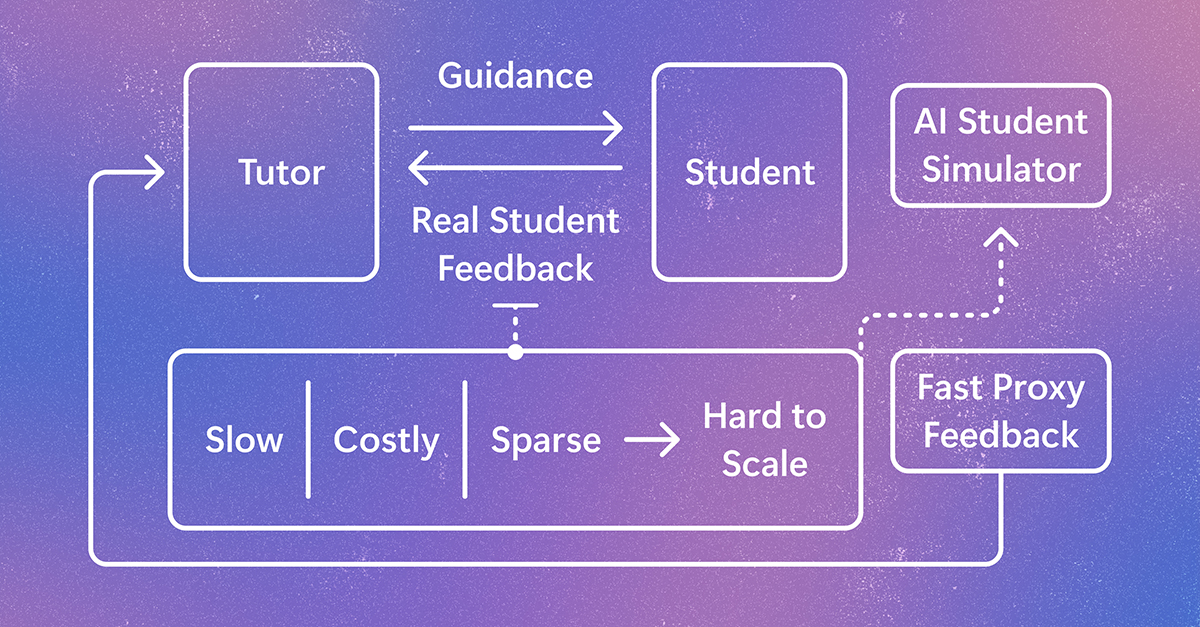
StudentSim is a research system for evaluating and improving AI tutoring tools before they are tested with learners. It models how individuals may engage with tutors, giving feedback to improve tutor performance across subjects like chess, writing, and mathematics. The post Simulating student learning for better AI tutoring appeared first on Microsoft Research.
MIT News · Artificial Intelligence· news.mit.eduOct 6, 2026
Writing as a participant and researcher, PhD student JS Tan SM ’22 has co-authored a new book about the rise of tech worker protests and the employer backlash that followed.
We use cookies to run the site and, with your consent, for analytics and to show ads.
See our Cookie Policy.