The androgen receptor (AR) represents a pivotal therapeutic target for prostate cancer. However, existing orthosteric ligand-binding pocket (LBP) antagonists [e.g., enzalutamide (ENZ)] encounter significant obstacles due to resistance-conferring mutations in the LBP. Allosteric antagonists targeting the BF3 site exhibit great potential in overcoming such resistance but have low inhibitory efficacy. In our study, we employed an integrated computational modeling strategy, including Gaussian-accelerated molecular dynamics (GaMD), MM/GBSA free-energy calculations, and elastic network model (ENM)-based signaling communication pathway analyses. This approach is used to probe the cooperativity of allosteric BF3 antagonists [e.g., VPC-13808 (VPC)] with diverse orthosteric LBP ligands [e.g., ENZ and testosterone (TES)] in suppressing AR activity. Herein, four types of AR systems were examined: AR bound to LBP agonist (AR·TES), LBP antagonists (e.g., AR·ENZ), and combinations of LBP agonist/antagonist with BF3 antagonist (e.g., AR·TES·VPC and AR·ENZ·VPC). Results indicate that BF3 antagonists can synergize with the LBP antagonist to amplify conformational flexibility in H12 and induce anticorrelated dynamics of H12 with H3 and H4. This induces the downward movement of H12 and its displacement away from H3/H4, triggering the wide opening of the AF2 binding cleft and substantially reducing the coactivator recruitment. Furthermore, the BF3 antagonist can interact with specific residues (e.g., F673, F826, L830, and Y834) and cooperate with the LBP agonist or antagonist to allosterically perturb the AF2 conformation. Multiple short- and/or long-range BF3→AF2 and LBP→AF2 signaling transition pathways are involved, such as F673→Y834→L722→L812→L744→V746→L873→ENZ→L880/V889/V891. These mechanistic insights establish the foundation for developing novel AR BF3 antagonist and LBP-BF3 combination therapies, suggesting a promising avenue for enhancing the efficacy and overcoming the resistance in castration-resistant prostate cancer treatment.
Xiaotian Kong, Yushan Zou, Peng Cao et al.· Journal of Chemical Informat...· 1 citation
Atomic charge is a fundamental quantum chemical property essential for advancing drug design and discovery. Although quantum mechanics (QM) methods offer the highest level of accuracy, their computational demands scale quadratically with the number of atoms, limiting their practicality for large-scale applications. In light of this, empirical and semiempirical methods have been introduced to improve computational efficiency, albeit often at the expense of accuracy. The advent of artificial intelligence has witnessed a growing application of machine learning (ML) techniques to accelerate atomic charge predictions. However, existing ML models often suffer from low accuracy and limited generalization capabilities. To address these challenges, we introduce an advanced equivariant graph attention neural network specifically engineered to model long-range atomic electrostatic interactions with high precision. This model introduces a sophisticated global graph attention mechanism, enabling it to capture charge contributions across multiple scales. By utilizing a combination of structural symmetry-preserving transformations and multiscale attention, our approach not only preserves the inherent symmetries of molecular structures but also substantially improves the model's accuracy, generalization, and robustness in complex scenarios. Our empirical analyses demonstrate that, compared to leading baseline models, the proposed model improves charge prediction accuracy by over 40% on average across various charge-calculation schemes. Remarkably, the model achieves superior performance on the external RESP (restrained electrostatic potential) test data sets, with a 54.6% improvement over the baseline. Additionally, we evaluated our charge model under the setting of virtual screening, where it outperforms both the OPLS3 charges and baseline deep learning models across all evaluation metrics, highlighting its extensive potential for scientific discovery.
Qiaolin Gou, Qun Su, Jike Wang et al.· Journal of Chemical Informat...· 1 citation
Accurate modeling of protein-peptide interactions is essential for understanding fundamental biological processes and designing peptide-based drugs. However, predicting the complex structures of these interactions remains challenging, primarily due to the high conformational flexibility of peptides. To support a fair and systematic evaluation of recent deep learning (DL) approaches, we introduce PepPCBench, a benchmarking framework tailored to assess protein folding neural networks (PFNNs) in protein-peptide complex prediction. As part of this framework, we curated PepPCSet, a data set of 261 experimentally resolved complexes with peptides ranging from 5 to 30 residues. We benchmark five full-atom PFNNs, including AlphaFold3 (AF3), AlphaFold-Multimer (AFM), Chai-1, HelixFold3 (HF3), and RoseTTAFold-All-Atom (RFAA), using comprehensive evaluation metrics. Our benchmarking reveals meaningful performance differences among these methods and highlights the influence of peptide length, conformational flexibility, and training set similarity on prediction accuracy. While AF3 shows strong performance in structure prediction, further analysis indicates that confidence metrics correlate poorly with experimental binding affinities, underscoring the need for improved scoring strategies and generalizability. By providing a reproducible and extensible framework, PepPCBench enables a robust evaluation of PFNN-based methods and supports their continued development for peptide-protein structure prediction.
Silong Zhai, Huifeng Zhao, Jike Wang et al.· Journal of Chemical Informat...· 13 citations· ⚡1
The interest in covalent drugs has resurged in recent decades, spurring the development of numerous specialized computational docking tools to facilitate covalent ligand design and screening. Herein, we present CarsiDock-Cov, a new paradigm distinguishing itself as the first deep learning (DL)-guided approach for covalent docking. CarsiDock-Cov retains the core components of its non-covalent predecessor, leveraging a DL model pretrained on millions of docking complexes to predict protein–ligand distance matrices, along with a dedicated-designed geometric optimization procedure to convert these distances into refined binding poses. Additionally, it incorporates several key enhancements specifically tailored to optimize the protocol for covalent docking applications. Our approach has been extensively validated on multiple public datasets regarding the docking and screening of covalent ligands, and the results indicate that our approach not only achieves comparably improved applicability compared to its non-covalent predecessor, but also exhibits competitive performance against various state-of-the-art covalent docking tools. Collectively, our approach represents a significant advance in covalent docking methodology, offering an automated and efficient solution that shows considerable promise for accelerating covalent drug discovery and design.
Chao Shen, Hongyan Du, Xujun Zhang et al.· Acta Pharmaceutica Sinica B· 12 citations
Reach audiences
Advertise in front of researchers, engineers, and readers.
MHC-II neoantigens play a critical role in immunotherapy, either as direct effectors or through their influence on CD8+ T cells. However, only a small fraction of tumor DNA mutations qualify as functional neoantigens, and current prediction tools often lack accuracy, leading to the low immunogenicity of predicted neoantigens in vivo. Here, we present EpiMII, a Graph Neural Network model for MHC-II epitope design, which learns from the structural features of epitopes to predict their sequences. To train EpiMII, we constructed a reliable, large dataset containing 142,934 MHC-II epitope structures. This approach achieves a 4.2x improvement over ProteinMPNN, with a sequence recovery rate of 78.0% for known MHC-II epitopes in the Protein Data Bank. As a case study, we designed a neoantigen from hepatocellular carcinoma. All five designed epitopes significantly activated CD4+ T cells in vitro and induced secretion of IFN-γ and TNF-α. Notably, one epitope treatment significantly reduced tumor volume in mice in vivo. EpiMII offers a novel and efficient approach for identifying MHC-II epitopes/neoantigens, potentially contributing to vaccine development.
Jiayi Yuan, Xiaowei Xu, Ze-Yu Sun et al.· bioRxiv· 1 citation
Targeted covalent drugs have demonstrated remarkable potential in disease treatment over the past decades. However, existing methods for covalent drug design are often limited to serine and cysteine, ignoring other potentially ligandable binding sites. Statistical analyses indicate that over 95% of binding pockets contain covalent-binding residues, suggesting that all ligands that targeting these pockets possess the potential to be modified into covalent ligands. To achieve this goal, we introduced CovalentLab, an interactive computational platform that integrates ligand-based and warhead-based strategies into a unified workflow for the rational design of covalent ligands. Leveraging a covalent binding site prediction model constructed on ESM-2 with LoRA fine-tuning, CovalentLab enables the prediction and ranking of nine classes of covalent-binding residues in proteins according to their reactivity and facilitates systematic warhead attachment to ligands using 210 electrophilic groups or user-defined warheads. Using this platform, a comprehensive library of more than 100,000 covalent molecules across 95 targets was generated. Notably, CovalentLab has been successfully applied to various essential real-world targets, identifying wet-laboratory-validated bioactive compounds ranging from TRK orthosteric inhibitors to GAC allosteric inhibitors. By bridging gaps in covalent drug discovery, CovalentLab offers a versatile, publicly accessible resource to expand the druggable targets and accelerate the development of targeted covalent therapies.
Xi Xue, Xiangying Liu, Xue Liu et al.· JACS Au· 4 citations· ⚡1
To fulfill functions for differentially regulating the downstream signaling pathways, functional ligands (i.e., agonists or antagonists) targeting nuclear receptors (NRs) are designed to stabilize different conformations (active or inactive) of the proteins. However, in practical applications, it is usually difficult to determine the molecular category of an NR ligand because these molecules all bind in the same location of an NR protein, namely, the ligand-binding pocket (LBP). Considering that ligands with different properties (agonists or antagonists) prefer to bind with differential conformations of NRs, it is possible to identify the molecular type of a given ligand through the differential binding environment (active or inactive conformations) of the protein-ligand interaction. Therefore, in this study, we established a unified model (NRIGN) based on the deep graphic architecture to discriminate agonists and antagonists targeting 26 successful or in-clinical-trial NR targets. Our result shows that NRIGN achieves an excellent prediction accuracy (ACC >0.95) and is robust enough to be applied in various real-world scenarios, such as predicting the molecular type of ligands in crystallized NR structures, ligands with multiple NR activities, and ligands with their types altered by target mutations. The proposed model is expected to promote rational design of drugs targeting NR proteins.
Kaimo Yang, Dejun Jiang, Qirui Deng et al.· Journal of Chemical Informat...· 2 citations
Photodynamic therapy (PDT) is a clinically approved therapeutic modality that has demonstrated significant potential for cancer treatment, and triplet photosensitizers (PSs) play a key role in its efficacy. Despite deep learning having emerged as a next-generation tool for material discovery, existing methods mainly target a limited subset of triplet PSs, such as thermally activated delayed fluorescence (TADF) materials, neglecting the critical intersystem crossing (ISC) between the high-lying singlet and triplet states (ΔESnTn). To overcome this limitation, we compiled a comprehensive dataset (∼1.90 × 10⁹) of triplet PSs encompassing various ISC mechanisms. Then, we proposed a novel strategy that incorporates two models: a fragment-based model (Frag-MD) and a character-based model (MD), both integrating a conditional transformer, recurrent neural networks, and reinforcement learning. In silico experiments revealed that the Frag-MD model outperforms the MD model in generating larger conjugated motifs with higher average ring numbers and atom counts; while the MD model generates twice as many unique motifs and excels in novelty and diversity, as evaluated by conditional and MOSES metrics. Therefore, our approach is highly effective for modifying conjugated motifs and designing novel triplet PSs. Notably, the recently reported high-efficiency triplet PSs have been re-identified through ablation experiments using our proposed models, which target ΔESnTn and significantly outperform traditional baselines, achieving a prediction accuracy of 73% versus 4%. Our approach holds the potential to establish a new paradigm for discovering novel PSs applicable in PDT.
Kepeng Chen, Xiaoting Zhang, Jike Wang et al.· Chemical Science· 3 citations
Protein-protein interactions play pivotal roles in a wide range of biological processes. Determining the atomic-level structures of protein-protein complexes is indispensable for elucidating macromolecular interaction mechanisms and advancing structure-based drug design. Protein-protein docking, as one of the leading computational approaches for predicting complex structures, has seen considerable progress but requires rigorous evaluation in practical applications. In this study, we proposed a comprehensive benchmarking framework to evaluate 11 docking methods spanning traditional (HDOCK, PatchDock, PIPER, ZDOCK) and deep learning (DL)-based (EquiDock, ElliDock, EBMDock, GeoDock, DiffDock-PP, AlphaFold-Multimer, AlphaFold3) approaches. Our framework incorporates the classical DockingBenchmark 5.5 data set for evaluating flexible docking, introduces a newly curated data set (AACBench) for antibody-antigen complex docking, and establishes the PPCBench data set to examine the out-of-distribution (OOD) generalization capabilities of DL-based methods. In docking against apo structures, AlphaFold3 achieves a superior top-5 success rate of 77.98%, whereas the traditional approach HDOCK reaches merely 12.84%, despite its highest top-5 success rate of 85.24% when docking against holo structures. For antibody-antigen docking, AlphaFold3 remains the most accurate method (top-5 success rate: 31.78%) and substantially outperforms AlphaFold-Multimer in modeling the CDR-H3 loop. In OOD generalization tests, all DL-based models exhibit markedly reduced performance on the PPCBench data set. Overall, our work establishes a unified benchmarking framework that enables systematic evaluation of docking methods across diverse tasks and provides critical insights into the strengths and limitations of current docking strategies, thereby informing future developments in protein-protein docking research.
Linlong Jiang, Ke Zhang, Kai Zhu et al.· Journal of Chemical Informat...· 3 citations
Accurate prediction of metalloprotein-ligand interactions is critical for metalloprotein-targeted drug discovery. Conventional docking tools and existing deep learning (DL) models fail to reliably capture metal-ligand interactions, hampering the discovery of potent metalloprotein inhibitors. Here, we propose MetalloDock, the first DL-based docking framework specially designed for metalloprotein targets. By innovatively integrating an autoregressive spatial decoding engine with a physics-constrained geometric generation paradigm, MetalloDock can precisely reconstruct metal coordination geometries and accurately capture metal-ligand interactions, which enhance both the accuracy of metalloprotein-ligand docking and binding affinity prediction. Extensive evaluations on our custom-built benchmark data set demonstrate that MetalloDock outperforms existing methods, including AlphaFold3, in docking success rate and virtual screening performance for metalloprotein targets. In real-world applications, MetalloDock successfully identified multiple novel hit compounds in a virtual screening campaign targeting the prostate-specific membrane antigen. Additionally, it enabled rational drug design for acidic polymerase endonuclease, leading to the discovery of potent inhibitors. These results highlight the broad applicability of MetalloDock in accelerating metalloprotein-targeted drug discovery and provide a standardized framework for future evaluation of metalloprotein-specific docking algorithms.
Hui Zhang, Xujun Zhang, Qun Su et al.· Journal of the American Chem...· 5 citations
Colorectal cancer (CRC) exhibits substantial molecular heterogeneity, necessitating the inference of subtype-specific driver genes and their interactions for drug-target discovery and precision oncology. Prior studies often fail to capture subtle, latent nonlinear regulatory mechanisms (dark causal relationships) driving tumor progression in specific subtypes. Here, we develop an explainable intelligence computational framework, Symbolic Trajectory-Embedded Dark Causal Interaction Inference (STE-DC2I), which combines symbolic trajectory embedding with historical prediction mechanisms to model nonmonotonic oscillatory dependencies between genes. Integrating single-cell transcriptomic and multiomics profiles from malignant epithelial subpopulations, STE-DC2I classifies CRC subtypes, reconstructs developmental trajectories, and uncovers interpretable subtype-specific driver genes with functional relevance. Unlike correlation-based and explicit causal approaches, STE-DC2I captures weak yet biologically critical regulatory signals, outperforming state-of-the-art methods in predicting subtype-specific CRC driver genes. Functional assays in CRC cell lines (in vitro) validated nine predicted driver genes, highlighting their therapeutic potential.This work systematically explores dark causal interactions between genes in CRC subtypes. STE-DC2I offers interpretable insights and a generalizable strategy for CRC drug-target discovery.
Meng Huang, Huijin Hu, Ming Li et al.· Journal of Chemical Informat...· 0 citations
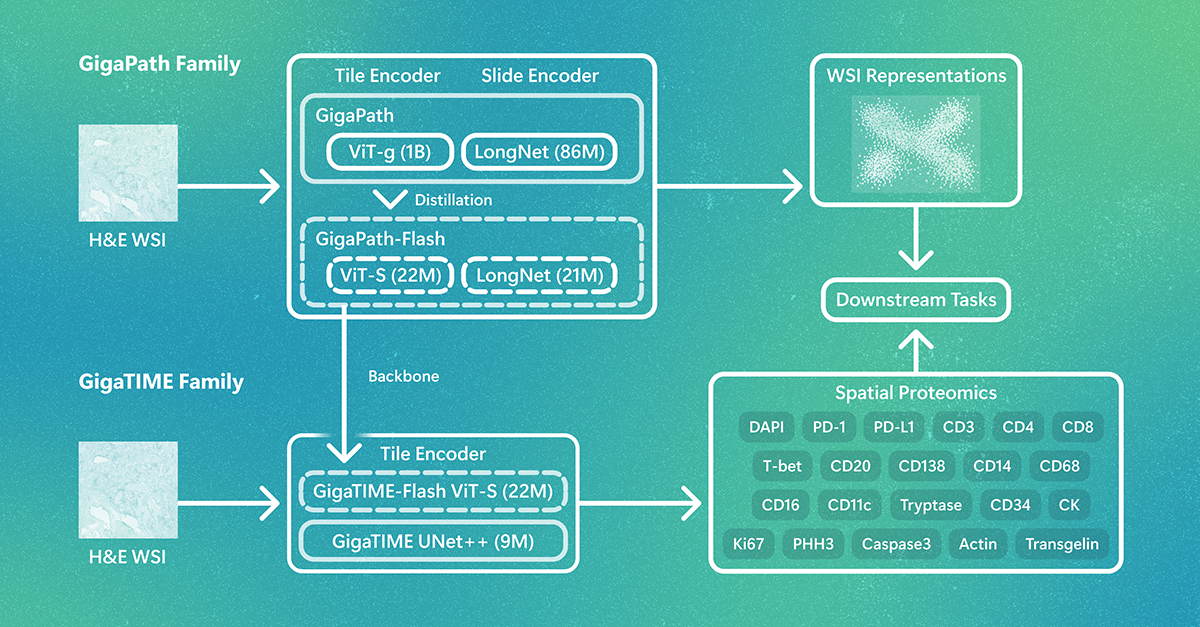
What if pathology foundation models could do more with less? GigaPath-Flash and GigaTIME-Flash cut computational demands while maintaining strong performance, opening the door to larger studies and broader exploration. The post GigaPath-Flash and GigaTIME-Flash: Toward population-scale discovery with efficient pathology foundation models appeared first on Microsoft Research.