Glucocorticoids (GCs) are limited by severe side effects, driving the development of selective glucocorticoid receptor modulators (SGRMs) with improved therapeutic profiles. We previously development the SGRM lead B53, which suffered from poor metabolic stability. In this study, structure-guided optimization of B53 yielded 43 novel sulfonamide derivatives. Among them, D8, which contained 2-oxo-tetrahydroquinoline by carbonyl migration form B53, manifests an excellent SGRM with remarkable transrepression potency (IC50NF-κB = 0.9 nM) superior to dexamethasone (IC50 NF-κB = 5.0 nM). Besides, D8 exhibits a significantly higher specificity for GR over AR, MR, and PR and exhibited less adverse effects on osteoprotegerin. Furthermore, D8 demonstrated improved metabolic stability and optimized binding mode within the GR LBD. In vivo, oral administration of D8 significantly alleviated dermatitis and autoimmune hepatitis in mouse models, underscoring its therapeutic potential and validating our design strategy.
Xiaodong Bao, Yuxin Zhou, Zhaoxu Yang et al.· Journal of Medicinal Chemist...· 1 citation
Molecular glues, including protein degraders and protein-protein interaction (PPI) stabilizers, have emerged as a new paradigm of drug design for regulating interactions between biomacromolecules; yet it is still a challenge for rational design of molecular glues. KRAS, as a prevalent oncogenic driver, is notoriously difficult to target by traditional small molecular drugs due to its challenging binding surface and frequent mutations. Although the small molecular drug RMC7977 has been designed as a PPI stabilizer for stabilizing the inherently weak RAS-CYPA interaction, the precise molecular mechanism underlying its stabilization effect and selectivity difference requires a deeper understanding. To this end, we leverage an integrated computational strategy combining molecular dynamics (MD) simulation, end-point binding free-energy calculation, and enhanced sampling technologies to elucidate the dynamic characteristics of RAS-ligand-CYPA interactions. Our result exhibits a high correlation between the predicted binding affinities and the experimental observations, demonstrating that RMC7977, acting as a strong PPI stabilizer, significantly enhances the stability of the KRAS-CYPA interaction, where, by delicately remodeling the protein-protein interface, the drug optimizes various interactions. Moreover, the results also uncover the dynamic process of stabilizer-mediated KRAS-CYPA stabilization and the mechanistic origin of the binding selectivity. This study provides essential molecular-level insights into RMC7977's function and offers a valuable computational framework for evaluating the stabilization effect of ligands targeting the KRAS-CYPA and other challenging PPI systems.
Kexin Xu, Mingyun Shen, Zhe Wang et al.· Journal of Chemical Informat...· 0 citations
ConspectusThe field of covalent drug discovery has witnessed a remarkable resurgence in recent years, a trend underscored by the approval of more than 125 covalent drugs by the US FDA as of 2025, which demonstrates their immense therapeutic potential. Driven by ever-increasing computational power and vast amounts of data, deep learning (DL) is profoundly transforming numerous fields, from natural language processing to drug discovery. In the development of covalent drugs, in particular, advanced computational methods centered on data-driven approaches and artificial intelligence (AI) exhibit immense potential. The realization of this potential depends on the construction of a synergistic ecosystem. Here, we define this "ecosystem" as an integrated set of components─including (i) curated covalent-relevant databases, (ii) AI/physics-based predictive and scoring models, (iii) interoperable computational workflows spanning site identification, docking/virtual screening, and lead optimization, and (iv) closed-loop feedback that systematically incorporates experimental outcomes to update data resources and refine/validate models. This begins with the systematic collection of past experimental results to build high-quality databases. These databases, in turn, provide the foundation for developing AI-driven computational tools capable of precisely interfacing with and accelerating downstream tasks, such as molecular docking (for generating physically plausible conformations and conducting large-scale virtual screening) and lead optimization. The application of these AI tools not only guides experimental design, but the resulting key data also feed back into and enrich the databases. Furthermore, in the cutting-edge field of covalent drugs, the precise identification of "druggable" covalent sites on target proteins has emerged as another critically important downstream task.In this Account, we describe a computational and AI-driven ecosystem for structure-based covalent drug discovery and highlight our contributions to this field. By explicitly linking databases, models, workflows, and experimental feedback into a single framework, this Account moves beyond a simple inventory of individual tools to instead offer a systematic and panoramic perspective on an integrated ecosystem for covalent drug discovery, driven by data and computational engines including AI. We focus on how this ecosystem systematically addresses the challenges from covalent binding site identification to lead discovery, thereby fundamentally accelerating the development of next-generation covalent therapies. We first articulate the philosophy behind the construction and updating of covalent databases, emphasizing the necessity of high-quality data. Subsequently, we delve into a suite of cutting-edge, AI-driven computational methods, exploring the potential of deep learning in tasks such as molecular docking, covalent binding site prediction, and lead optimization. To bridge the gap between computational theory and experimental validation, we will use the discovery of potent covalent CRM1 inhibitors as a specific case study, detailing how our customized, structure-based virtual screening pipeline was utilized to achieve a seamless workflow from computational prediction to biological validation. This section is intended to offer actionable guidance for experimental researchers seeking to leverage these powerful computational tools. Finally, we highlight the limitations and potential pitfalls of this AI engine─concerns that are equally relevant when developing AI-driven covalent docking algorithms. Building on our group's recent benchmarking of AI docking methods, we objectively evaluate current performance and discuss how transformative advances such as AlphaFold3 may reshape the field.
Shi Li, Hongyan Du, Xujun Zhang et al.· Accounts of Chemical Researc...· 4 citations
Reach audiences
Advertise in front of researchers, engineers, and readers.
Structure-based machine learning algorithms have been utilized to predict the properties of protein-protein interaction (PPI) complexes, such as binding affinity, which is critical for understanding biological mechanisms and disease treatments. While most existing algorithms represent PPI complex graph structures at the atom-scale or residue-scale, these representations can be computationally expensive or may not sufficiently integrate finer chemical-plausible interaction details for improving predictions. Here, we introduce MCGLPPI, a novel geometric representation learning framework that combines graph neural networks (GNNs) with the MARTINI molecular coarse-grained (CG) model to predict overall PPI properties accurately and efficiently. This framework maps proteins onto a concise CG-scale complex graph, where nodes represent CG beads and edges encode chemically plausible interactions. The GNN-based encoder is tailored to extract high-quality representations from this graph, efficiently capturing the overall properties of the protein complex structure. Extensive experiments on three different downstream PPI property prediction tasks demonstrate that MCGLPPI achieves competitive performance compared with the counterparts at the atom- and residue-scale, but with only a third of the computational resource consumption. Furthermore, the CG-scale pre-training on protein domain-domain interaction structures enhances its predictive capabilities for PPI tasks. MCGLPPI offers an effective and efficient solution for PPI overall property predictions, serving as a promising tool for the large-scale analysis of biomolecular interactions.
Yang Yue, Shu Li, Yihua Cheng et al.· bioRxiv· 14 citations
The integration of organic synthesis with enzymatic catalysis offers a promising route toward efficient and sustainable construction of complex molecules. While organic synthesis enables diverse transformations, enzymatic catalysis enhances stereoselectivity under mild conditions, improving cost-effectiveness and environmental impact. However, current enzymatic synthesis planning algorithms face challenges in formulating robust hybrid organic–enzymatic strategies. Key issues include the difficulty in devising hybrid planning approaches and the reliance on template-based enzyme recommendations, which limits their adaptability across diverse scenarios. Here we show ChemEnzyRetroPlanner, an open-source hybrid synthesis planning platform that combines organic and enzymatic strategies with AI-driven decision-making. The platform features advanced computational modules, including hybrid retrosynthesis planning, reaction condition prediction, plausibility evaluation, enzymatic reaction identification, enzyme recommendation, and in silico validation of enzyme active sites. A central innovation is the RetroRollout* search algorithm, which outperforms existing tools in planning synthesis routes for organic compounds and natural products across multiple datasets. ChemEnzyRetroPlanner provides an intuitive graphical interface and programmatic APIs for scalability, while leveraging the chain-of-thought strategy and the Llama3.1 model to autonomously activate hybrid synthesis strategies for diverse scenarios. The results indicate that this fully automated, open-source system holds potential value for improving the efficiency and sustainability of molecular synthesis. The integration of organic and enzymatic synthesis enhances molecule construction efficiency. Here, the authors present ChemEnzyRetroPlanner, an AI-driven platform for automated hybrid synthesis planning, improving synthesis route efficiency and sustainability.
Accurate atomistic biomolecular simulations are vital for understanding disease mechanisms and drug discovery, yet existing methods struggle to balance quantum-mechanical accuracy with computational scalability. Classical force fields often lack precision, while quantum methods are computationally prohibitive for complex biological systems. Here we show that LiTEN, a scalable equivariant neural network, resolves this dilemma by efficiently modeling complex three- and four-body interactions with linear complexity via Linearly Tensorized Quadrangle Attention. We introduce LiTEN-FF, a foundation model pre-trained on extensive datasets to ensure broad chemical generalization across diverse molecular spaces. We demonstrate that LiTEN achieves state-of-the-art accuracy on standard benchmarks, consistently outperforming leading approaches in both precision and speed. Furthermore, LiTEN-FF enables comprehensive modeling tasks, ranging from geometry optimization to free energy surface construction, with high computational efficiency for large biomolecules. This framework provides a physically grounded, versatile foundation for advanced biomolecular modeling and drug design applications.
Qun Su, Kai Zhu, Qiaolin Gou et al.· Nature Communications· 2 citations
Designing effective mRNA sequences for therapeutics remains a formidable challenge. Inspired by successes in protein design, language models (LMs) are now being applied to RNA, but progress is often impeded by the lack of comprehensive training data. Existing models are frequently limited to UTR or CDS regions, restricting their application for complete mRNA sequences. We introduce mRNABERT, a robust, all-in-one mRNA designer pre-trained on the largest available mRNA dataset. To enhance performance, we propose a dual tokenization scheme with a cross-modality contrastive learning framework to integrate semantic information from protein sequences. On a comprehensive benchmark, mRNABERT demonstrates state-of-the-art performance, outperforming previous models in the majority of tasks for 5’ UTR and CDS design, RNA-binding protein (RBP) site prediction, and full-length mRNA property prediction. It also surpasses large protein models in several related tasks. In conclusion, mRNABERT’s superior performance across these diverse tasks signifies a substantial leap forward in mRNA research and therapeutic development. Designing complete mRNA sequences for new vaccines and therapies is a complex challenge. Here, the authors develop mRNABERT, a foundational AI model that designs entire mRNA sequences and demonstrates superior performance across comprehensive benchmarks.
Ying Xiong, Aowen Wang, Yu Kang et al.· Nature Communications· 22 citations· ⚡1
Molecular representation learning (MRL) has shown promise in accelerating drug development by predicting chemical properties. However, imperfectly annotation among datasets pose challenges in model design and explainability. In this work, we formulate molecules and corresponding properties as a hypergraph, extracting three key relationships: among properties, molecule-to-property, and among molecules, and developed a unified and explainable multi-task MRL framework, OmniMol. It integrates a task-related meta-information encoder and a task-routed mixture of experts (t-MoE) backbone to capture correlations among properties and produce task-adaptive outputs. To capture underlying physical principles among molecules, we implement an innovative SE(3)-encoder for physical symmetry, applying equilibrium conformation supervision, recursive geometry updates, and scale-invariant message passing to facilitate learning-based conformational relaxation. OmniMol achieves state-of-the-art performance in properties prediction, reaches top performance in chirality-aware tasks, demonstrates explainability for all three relations, and shows effective performance in practical applications. Our code is available in our https://github.com/bowenwang77/OmniMol public repository. AI models for drug discovery often struggle with real-world, incomplete data. Here, the authors present OmniMol, a framework using hypergraphs to improve predictions of molecular properties, addressing challenges of imperfect data annotation and enhancing model explainability.
The integration of large language models (LLMs) into drug design is gaining momentum; however, existing approaches often struggle to effectively incorporate three-dimensional molecular structures. Here, we present Token-Mol, a token-only 3D drug design model that encodes both 2D and 3D structural information, along with molecular properties, into discrete tokens. Built on a transformer decoder and trained with causal masking, Token-Mol introduces a Gaussian cross-entropy loss function tailored for regression tasks, enabling superior performance across multiple downstream applications. The model surpasses existing methods, improving molecular conformation generation by over 10% and 20% across two datasets, while outperforming token-only models by 30% in property prediction. In pocket-based molecular generation, it enhances drug-likeness and synthetic accessibility by approximately 11% and 14%, respectively. Notably, Token-Mol operates 35 times faster than expert diffusion models. In real-world validation, it improves success rates and, when combined with reinforcement learning, further optimizes affinity and drug-likeness, advancing AI-driven drug discovery. In this work the authors present Token-Mol, a token-only 3D drug design model, which deploys the Gaussian cross-entropy (GCE) loss function for regression tasks. It exhibits superior performance in molecular conformation generation, property prediction, and pocket-based generation, thus opening up new avenues for drug design.
Jike Wang, Rui Qin, Mingyang Wang et al.· Nature Communications· 30 citations· ⚡1
Proteolysis-targeting chimeras (PROTACs) present a potentially effective strategy against various diseases via selective proteolysis. How to increase the efficacy of PROTACs remains challenging. Here, we explore the necessity of the linker, which has been deemed as an integral part of heterobifunctional PROTACs. Adopting single amino acid-based degradation signals, we find that the linker is not a required feature of the PROTACs. Notably, the linker-free PROTAC, Pro-BA, exhibits superior efficacy over its linker-bearing counterparts in degrading EML4-ALK and inhibiting lung cancer cell growth, as Pro-BA induces a stronger interaction between the target and the E3 ubiquitin ligase. Pro-BA is a water-soluble, orally administered degrader that significantly inhibits the tumor growth in a xenograft mouse model. The broad applicability of this linker-free PROTAC strategy is further validated through the development of BCR-ABL degrader. Our study introduces a design paradigm for PROTACs, potentially facilitating the advancement of more efficient therapeutic degraders. Linkers are traditionally seen as important for PROTAC activity. Here, the authors demonstrate that linker-free PROTACs can outperform traditional designs, marking a paradigm shift in PROTAC development for targeted protein degradation.
Drug repositioning holds promise for discovering new therapeutic applications for existing drugs, accelerating drug development and reducing associated costs. However, current methodologies encounter difficulties in managing diverse network representations, tackling cold start issues, and handling intrinsic attribute representations. Here we introduce a Unified Knowledge-Enhanced deep learning framework for Drug Repositioning (UKEDR), which integrates knowledge graph embedding, pre-training strategies, and recommendation systems to address these challenges. To overcome the cold start issue, UKEDR utilizes a semantic similarity-driven embedding approach. Our evaluations show that UKEDR performs better than various baselines, including classical machine learning, network-based, and deep learning approaches. In cold start scenarios, it demonstrates an improved capability in handling unseen nodes and generalizing to new compounds. The model also demonstrates strong robustness on imbalanced datasets and shows excellent generalization capabilities in specific drug-centric and disease-centric cold-start scenarios, validating its potential for real-world applications. Drug repositioning offers a promising avenue for accelerating drug development, yet existing methods struggle with network diversity, cold start issues, and intrinsic attribute representation. Here, the authors introduce UKEDR, a deep learning framework that integrates knowledge graph embedding and pre-training strategies to overcome the intractable cold start issue, achieving superior performance and interpretability in drug repurposing.
Kun Li, Jiacai Yi, Qing Ye et al.· Communications Chemistry· 1 citation
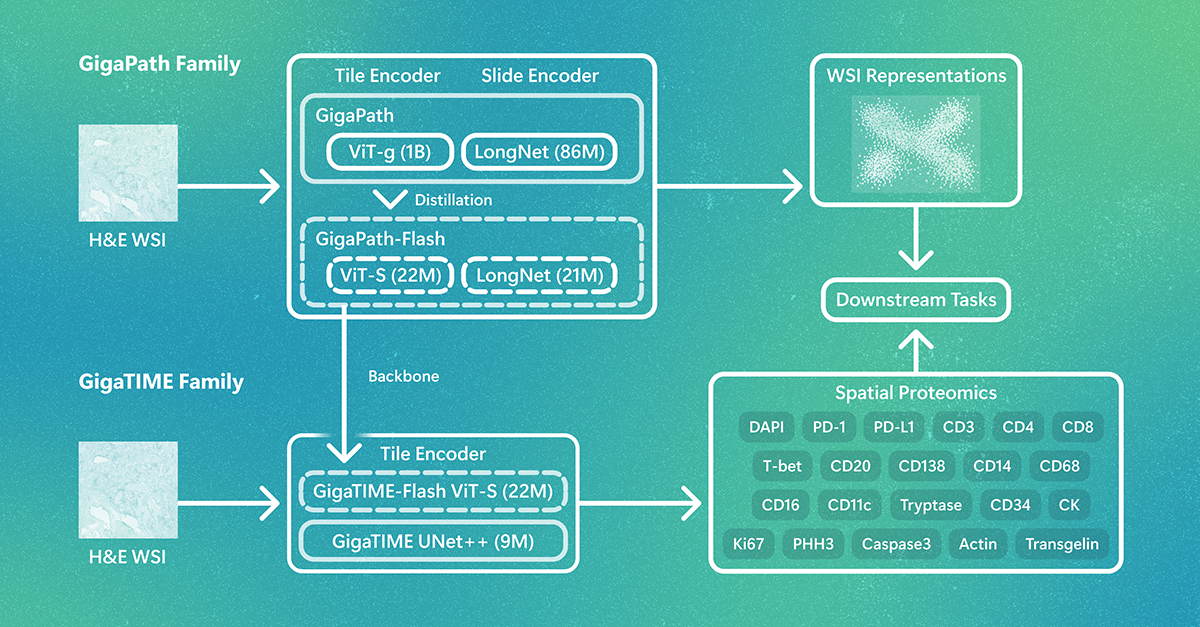
What if pathology foundation models could do more with less? GigaPath-Flash and GigaTIME-Flash cut computational demands while maintaining strong performance, opening the door to larger studies and broader exploration. The post GigaPath-Flash and GigaTIME-Flash: Toward population-scale discovery with efficient pathology foundation models appeared first on Microsoft Research.