The article examines the impact of artificial intelligence technologies on the transformation of marketing strategies of transnational companies in international business. The relevance of the study stems from the rapid expansion of the global artificial intelligence market and the fact that marketing and sales have consistently remained among the business functions with the highest intensity of AI adoption worldwide. For transnational companies, which coordinate marketing activities across dozens of national markets with different languages, consumer cultures and regulatory regimes, artificial intelligence directly affects the classical dilemma of international marketing between standardisation and adaptation: the technology promises to deliver globally consistent brand communication that is simultaneously tailored to local audiences at a scale and speed unattainable for traditional marketing organisations. The article discusses the main directions in which artificial intelligence penetrates the international marketing activity of transnational companies, including hyper-personalisation of customer experience based on machine learning, generative production of advertising and communication content, restructuring of organisational models of marketing departments, and localisation of global campaigns for national markets. Particular attention is paid to the experience of leading transnational corporations in the consumer goods, digital services and e-commerce sectors, as well as to the organisational conditions under which investments in artificial intelligence translate into measurable economic outcomes. The study also addresses the risks accompanying the diffusion of the technology, including changes in consumer attitudes towards AI-generated advertising, reputational threats, and the new regulatory environment created by the European Union Artificial Intelligence Act for companies operating in the European market. The consequences of the uneven global distribution of AI infrastructure, investment and competencies for the competitive positions of companies from developed and developing economies in international markets are considered as a separate dimension of the problem within the field of international economic relations.
М. С. Гожик· State and regions Series Eco...· 0 citations
Results for counterfactual image generation for the CRC-VAL-HE-7K dataset. A, Tissue-type classifier-guided counterfactuals of a dysplastic tile, generated by shifting its feature vector toward the predicted healthy colon mucosa class. Changes reflect what the model requires to flip the prediction, with increasing manipulation amplitude shown above each image. B, The t-SNE projection of the feature extractor’s latent space (training set), colored by class: adipose (ADI), background (BACK), debris (DEB), lymphocytes (LYM), mucus (MUC), smooth muscle (MUS), healthy colon mucosa (NORM), cancer-associated stroma (STR), colorectal adenocarcinoma epithelium/dysplastic tissue (TUM). The features of dysplastic tile in A, initially near the boundary between TUM (aqua) and NORM (gray), shift toward the healthy cluster (pink points in the zoomed-in plot; gray area—arbitrary healthy mucosa zone) as manipulation amplitude increases. C, Morphologic feature prevalence in original and counterfactual image pairs. Horizontal bars show the percentage of image pairs in which at least one of four raters (three board-certified pathologists and one pathology trainee) identified each morphologic feature as present in the original (dark gray) or counterfactual (light gray) image. Right, Mean pairwise inter-rater agreement (Cohen κ) per feature, computed across all pairs and both directions combined. D, Counterfactuals of a healthy mucosa tile shifted toward dysplastic epithelium. Below, Pixel-level difference maps (darker regions indicate greater changes), showing the most change in gland regions, and SSIM values, which quantify the similarity between the original and manipulated tiles. Bottom, Segmented and classified nuclei: pink (epithelial), orange (connective tissue), blue (plasma), deep purple (lymphocytes), aqua (neutrophils), and green (eosinophils). E, Tile-level differences in cell type fractions between (left) real NORM tiles (n = 741) and synthetic (counterfactual images generated from TUM tiles, n = 1,233; full statistical details are provided in Supplementary Table S4). Right, Tile-level differences in cell-type fractions between real TUM tiles (n = 1,233) and synthetic (counterfactual images generated from NORM tiles, n = 741).
Laura Žigutytė, Tim Lenz, Tianyu Han et al.· 0 citations
Existing diffusion-based enhancement methods provide strong generative capability for low-light image enhancement (LLIE), yet they either rely on paired supervision or lack reliable scene constraints in zero-shot settings, often leading to structural inconsistency and color drift. Motivated by conventional Retinex models, which offer physically interpretable priors that can serve as reliable scene constraints yet struggle with mixed degradations in real-world scenarios, we propose DARD, a zero-shot Degradation-Aware Retinex-guided Diffusion framework for LLIE. DARD first extracts image-specific physical priors from the degraded input through a test-time degradation-aware Retinex decomposition, thereby providing reliable structural guidance for zero-shot restoration. It then injects these priors into reverse diffusion through a timestep-adaptive frequency fusion strategy to balance structural anchoring and detail generation. Finally, a guided reverse refinement process with physical consistency and Contrastive Language-Image Pre-training (CLIP)-based semantic guidance is introduced to suppress structural artifacts and semantic drift during sampling. Extensive experiments show that DARD achieves strong distortion and perceptual performance and consistently outperforms existing zero-shot baselines across multiple real-world low-light benchmarks. To further validate the practical utility of our method for downstream applications, we evaluated its impact on semantic segmentation. Experiments demonstrate that images enhanced by DARD achieve a 28.10% relative improvement in mIoU over AGLLDiff.
Wenjie Cai, Yuezhe Yang, Jian-Yang Xia et al.· 0 citations
Reach audiences
Advertise in front of researchers, engineers, and readers.
Purpose: To develop and evaluate a diffusion-based reconstruction framework for highly accelerated 2D real-time (RT) cine cardiovascular magnetic resonance imaging (CMR). Methods: We trained an unconditional patch-based diffusion model and incorporated it into a reconstruction framework, termed CineDiff, using diffusion posterior sampling for data consistency. CineDiff was evaluated in four settings: (i) 30 retrospectively undersampled breath-held cine at 1.5T and 3T from healthy participants across multiple acceleration rates, (ii) 15 prospectively undersampled free-breathing RT cine at 1.5T and 3T from patients indicated for clinical CMR, and (iii) 10 prospectively undersampled mid-field (0.55T) free-breathing scans, including five from healthy subjects and five from porcine models. For retrospective undersampling, reconstruction quality was assessed using peak signal-to-noise ratio (PSNR), structural similarity index measure (SSIM), learned perceptual image patch similarity (LPIPS), and deep image structure and texture similarity (DISTS). For prospective undersampling, image quality was evaluated by blinded expert scoring on a 5-point Likert scale. Results: In retrospectively undersampled breath-held cine data, CineDiff achieved higher PSNR and SSIM and lower LPIPS and DISTS than the comparison methods across all evaluated acceleration rates. In prospectively undersampled free-breathing RT cine data, CineDiff received higher expert image-quality scores. Qualitatively, CineDiff reduced block-like artifacts and preserved finer anatomical detail compared with traditional compressed sensing and a variational network method, termed CineVN. Conclusion: CineDiff enabled high-quality reconstruction of highly accelerated 2D RT cine CMR. The method also demonstrated robustness to out-of-distribution data, including mid-field and porcine acquisitions.
Xuan Lei, Philip Schniter, Juliet Varghese et al.· 0 citations
This paper presents a multi-branch fusion framework for detecting and characterising the propagation of health misinformation in online social networks (OSNs). Grounded in the Elaboration Likelihood Model (ELM) and the Theory of Planned Behaviour (TPB), the model fuses transformer-based semantics with rhetorical cues, stance representations, and psychologically motivated proxies in a unified multi-task architecture. In addition to binary classification, we introduce the Cognitive Propagation Score (CPS), an interpretable post-hoc auxiliary score computed from psychologically motivated, text-derived cues capturing argument complexity, emotional intensity, and content-derived virality potential, to support diffusion-risk reasoning when engagement ground truth is incomplete or unavailable. Experiments on three benchmark datasets, Constraint, COVID--19\_FNIR, and Monkeypox, show strong classification performance, achieving ROC--AUC up to 0.9999 on COVID--19\_FNIR, while propagation-oriented ranking achieves near-perfect agreement when engagement-derived supervision is available (Monkeypox, Spearman's $\rho = 0.9952$) and similarly high ranking alignment under proxy-based supervision on COVID--19\_FNIR ($\rho = 0.9954$). Compared with representative literature baselines, the fusion model improves detection on Constraint and COVID--19\_FNIR, while Monkeypox remains more challenging, reflecting domain- and signal-specific differences. Ablation analysis further indicates that psychological and rhetorical branches provide complementary gains beyond semantic embeddings. Overall, the framework bridges cognitive theory and neural modelling to improve transparency and to support scalable misinformation monitoring, with future work required to validate CPS against human-centred diffusion judgements.
Mkululi Sikosana, Sean Maudsley-Barton, Oluwaseun Ajao· 0 citations
Differentially private (DP) synthesis has been extensively studied for tabular and image data separately, yet many real-world datasets contain images paired with multivariate tabular records. Synthesizing such data is particularly challenging under DP, as the two modalities favor different private learning mechanisms while their dependence must also be preserved. To address this challenge, we propose DP-TabImage, a modality-specialized framework for private paired synthesis. DP-TabImage instantiates the factorization $p(x,y)=p_T(y)p_I(x\;|\;y)$ using a private Probabilistic Graphical Model for the multivariate table distribution and a table-conditioned diffusion model trained with DP-SGD for the conditional image distribution. To facilitate conditional learning under clipped and noisy gradients, we further pretrain the model on private table-image prototypes, pairing privately constructed attribute-conditioned images with tabular vectors derived from the already private tabular model at no additional privacy cost. Experiments on three real-world datasets show that DP-TabImage achieves a strong balance among tabular fidelity, image fidelity, and cross-modal alignment. Our analysis further reveals that visual warm-up primarily improves marginal image fidelity, whereas aligned table-image warm-up is critical for improving cross-modal correspondence. Our source code is available in the GitHub repository, https://github.com/KaiChen9909/TabImage_Syn.
Kai Chen, Josephine Lamp, S. Jha et al.· 0 citations
Satellites are emerging as promising platforms to extend generative \emph{artificial intelligence} (AI) services to remote areas lacking terrestrial infrastructure. However, deploying space generative AI is fundamentally constrained by the limited, time-varying onboard energy supplied by solar \emph{energy harvesting} (EH). This paper presents a framework for solar-powered space generative AI in which a satellite receives a user prompt, executes a diffusion-based image-generation model, and downlinks the compressed result within a strict time window. We identify the fundamental \emph{computation--communication} (C$^2$) trade-offs governed by the shared harvested-energy budgets. Specifically, increasing the number of generation steps improves intrinsic image quality but depletes energy and time available for downlink transmission, whereas prioritizing communication guarantees reliable delivery but sacrifices semantic quality. To balance these trade-offs and maximize \emph{end-to-end} (E2E) generative performance, we exploit the predictable solar-EH dynamics induced by deterministic orbital motion and develop a joint C$^2$ resource-optimization framework using a tractable two-step approach. First, we characterize the maximum downlink throughput for a fixed generation depth under continuous solar EH. This establishes a separation principle that decouples waiting-time selection from optimal transmit-power control. Next, we formulate a joint C$^2$ utility-maximization problem and derive a closed-form, low-complexity step-selection policy in the dominant constant-power regime. Extensive experiments under realistic orbital dynamics demonstrate that the proposed policy dynamically balances generation quality and transmission reliability. This yields significant E2E performance gains over static computation- and communication-centric baselines across diverse solar-EH states.
Jierui Zhang, Jianhao Huang, Zhanwei Wang et al.· 0 citations
Retrieval-Augmented Generation (RAG) mitigates large language models (LLMs) hallucinations, yet conventional dense retrieval struggles with the complex reasoning paths of multi-hop question answering (QA). Graph-based RAG captures multi-step relationships but suffers from severe semantic drift and high online latency due to noisy global graph traversals. Thus, we propose ISO-RAG (ISOperimetric Retrieval-Augmented Generation), a geometry-aware RAG framework. By projecting the underlying knowledge graph into a hyperbolic Poincare ball to precompute node-wise isoperimetric profiles, ISO-RAG prunes spurious edges during retrieval, restricting the search space to a strictly localized subgraph. This topological purification regulates Personalized PageRank (PPR) diffusion driving the retrieval process, ensuring exact and low-latency convergence. Experiments on multi-hop QA benchmarks demonstrate that ISO-RAG outperforms state-of-the-art baselines by average absolute gains of 10.0% in retrieval recall and 4.3% in downstream exact match, achieving a superior accuracy-efficiency trade-off by fundamentally eliminating the latency bottleneck of global traversals. Our source code is available at https://github.com/ZaiizaiZHANG/ISO-RAG.
Si-Yuan Zhang, Hanchen Wang, Dong Wen et al.· 0 citations
Robust estimation is a core computer vision task frequently tackled using sample consensus. However, traditional methods suffer from inefficient sampling as they struggle to identify effective minimum sets before hypothesis evaluation. To address these challenges, we propose a novel Diffusion-guided Sampling for Consensus-based Robust Estimation (DiffSAC) framework. DiffSAC introduces a diffusion model to learn the distribution of effective minimum sets. It refines the confidence for each data point, indicating whether it belongs to a good minimum set, rather than ranking the data points as in previous work. This significantly reduces the need to process numerous bad sets. To constrain the refinement direction, geometric features are incorporated as conditions within our diffusion model. Consequently, DiffSAC outputs a small number of high-quality minimum sets, enabling identification of the best hypothesis via consensus evaluation. Notably, compared to previous works requiring evaluating over ten thousand hypotheses, DiffSAC achieves state-of-the-art performance with only dozens, significantly boosting efficiency. Extensive experiments across five classic computer vision tasks demonstrate the superiority of DiffSAC. The diffusion model's sampling accelerators enable real-time operation, and DiffSAC can be used as a plug-and-play module to improve existing sample consensus methods.
Chang Nie, Guangming Wang, Zhe Liu et al.· 0 citations
Text-to-spatial audio generation, such as text-to-First-Order Ambisonics (FOA), provides a convenient way to create spatial audio for billion-dollar gaming and film industries. However, existing text-to-FOA methods are largely data-driven and may produce audio that violates acoustic relations between source direction and distance. They also separate descriptive and parametric control, forcing users to trade usability for precision. In this paper, we present PhysWave, a physics-guided latent diffusion model for controllable text-to-FOA generation. PhysWave unifies natural-language and trajectory control through a shared waypoint-caption representation, and augments diffusion training with two differentiable acoustic priors: spherical-harmonic direction consistency and inverse-square distance consistency. To support dynamic spatial generation, we further construct a 300K-clip FOA dataset with diverse sound categories and source trajectories. Extensive results show that the proposed priors help PhysWave generate spatially consistent FOA audio while maintaining competitive audio quality. Further analyses show that these physics priors improve spatial consistency during training and can also be used as inference-time guidance for training-free spatial refinement.
Lingfeng Yao, Chenpei Huang, Xingke Yang et al.· 0 citations
Cross-domain variability in medical imaging, arising from differences in scanners, acquisition protocols, and patient populations, remains a major challenge for reliable semantic segmentation. Existing unsupervised domain adaptation (UDA) methods predominantly rely on image-level transformations or feature alignment, which often fail to preserve anatomical consistency under large domain shifts. In this work, we propose a novel structured latent UDA framework that performs domain alignment in a topology-aware representation space rather than directly modifying image appearance. Specifically, we introduce a
Frequency-Conditioned Graph Diffusion
paradigm, where convolutional features are transformed into anatomical graphs to explicitly capture structural relationships. A latent diffusion process then progressively refines these graph embeddings, guided by frequency-aware contextual cues, enabling robust cross-domain alignment. To further enhance generalization, we integrate structural consistency regularization with adversarial latent alignment, eliminating the need for labeled target data. A dedicated decoder reconstructs dense segmentation maps, while stochastic diffusion sampling provides uncertainty estimates for improved potential clinical reliability. Extensive experiments on multiple public medical imaging benchmarks demonstrate that our method consistently outperforms state-of-the-art UDA approaches, achieving superior segmentation accuracy and robustness under significant domain shifts. These results highlight the effectiveness of structured latent modeling and diffusion-based learning for robust domain-adaptive segmentation.
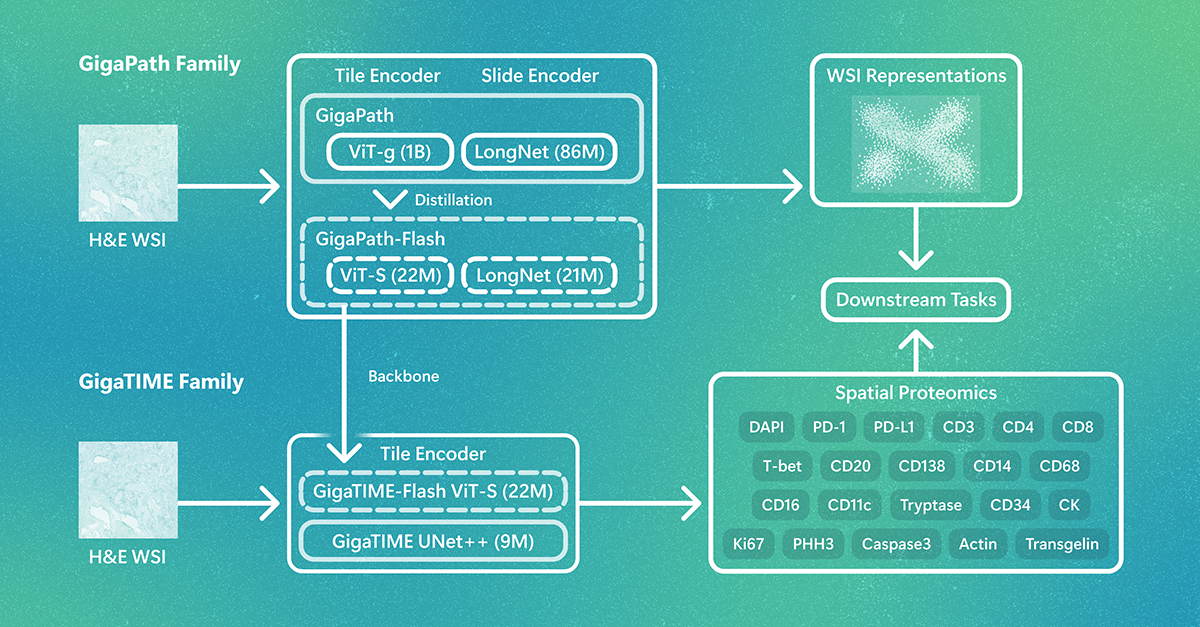
What if pathology foundation models could do more with less? GigaPath-Flash and GigaTIME-Flash cut computational demands while maintaining strong performance, opening the door to larger studies and broader exploration. The post GigaPath-Flash and GigaTIME-Flash: Toward population-scale discovery with efficient pathology foundation models appeared first on Microsoft Research.