The purpose of this study is to advance knowledge for managers, policymakers, and researchers regarding the important key factors of successful Digital Transformation (DT) adoption, which can shed light on research gaps and help form a research agenda. A systematic literature review was conducted to analyse 26 peer-reviewed journal articles published between 2020 and 2025 from the Scopus, Emerald, Insight, Google Scholar, and ProQuest databases, following the PRISMA guidelines. Four DT adoption models, such as Diffusion of Innovation (DOI), Technology Acceptance Model (TAM), Task-Technology Fit (TTF), and Theory of Planned Behaviour (TPB), have been analysed to understand why people embrace DT either positively or negatively. According to the literature, the success factors for adopting DT have been identified. In addition, it is found that using only one DT adoption model does not ensure success. It is advisable to use an integrated multi-model or multiple frameworks for the theoretical adoption of DT. Using multiple frameworks makes DT adoption easier to understand. The Input-Process Output (IPO) schema allows consolidating the gaps in the present state and setting out the research agenda. The IPO schema can be considered a helpful tool for identifying research gaps and setting the research agenda, as well as for planning, decision-making, and policymaking.
Amando Singun· International Journal of Inn...· 0 citations
Understanding the mechanisms underlying large scale protein conformational changes in signaling pathways is critical for elucidating disease processes and developing targeted therapeutics. However, existing experimental and computational methods struggle to resolve the dynamic ensembles of intermediate states that mediate such transitions, particularly in large biomolecular complexes. Here, we introduce a two-stage generative diffusion modeling framework designed to support pathway discovery in protein complexes, demonstrated using RAF kinase dimerization, a key event for kinase activation and oncogenic signaling. Our approach first generates ultra-coarse-grained structures conditioned on low dimensional descriptors along the monomer-to-dimer transition. It then applies a super-resolution model to recover detailed coarse-grained topologies suitable for molecular simulation. We show that this framework produces physically plausible, diverse, and robust intermediate structures, even for previously unseen interpolated descriptor values. The resulting ensemble enables generation of closely spaced candidate intermediate structures between biophysically distinct states, providing valuable starting points for downstream adaptive sampling and mechanistic studies. Overall, our results highlight the potential of diffusion-based generative models to bridge the gap between static structural data and isolated ensembles, and the dynamic complexity of protein signaling pathways.
Tim Hsu, Konstantia Georgouli, Michael Jones et al.· Machine Learning: Science an...· 0 citations
Digital transformation (DT) remains central to information systems and public administration scholarship, particularly amid the rapid emergence of generative artificial intelligence (GenAI). This study presents a systematic literature review of 125 peer-reviewed articles published between 2021 and 2026 to synthesise contemporary public-sector DT dynamics. Following the PRISMA 2020 reporting standard and thematic synthesis, the review maps conceptualisations of DT, identifies key organisational, technological and environmental drivers, and examines their implications for public value. The findings indicate that DT is predominantly conceptualised as a sociotechnical and public-value-oriented process shaped primarily by leadership, organisational culture and strategic alignment rather than technological investment alone. Organisational and managerial factors emerge as the most consistent predictors of transformation outcomes across diverse institutional contexts, while technological and environmental conditions influence the pace, direction and unevenness of implementation. Despite the rapid diffusion of AI and GenAI in government practice, only a limited proportion of the literature substantively engages with AI, and fewer studies address GenAI, large language models or foundation models, revealing a widening gap between technological developments and scholarly inquiry. Building on the established organisational-technological-environmental framework, the review identifies four additional explanatory dimensions: citizen co-production, digitally induced administrative burden, street-level administrative reconfiguration, and multidimensional public-value evaluation. The study concludes by identifying priorities for future research on GenAI governance, accountability and equity, while offering practical implications for public managers and policymakers pursuing AI-enabled public-sector transformation.
Fluorogenic probes that report enzyme activity are essential for studying biological functions. However, designing them for targets with low catalytic turnover and narrow substrate specificity remains a significant challenge. Here, we present a precision design framework that separates the requirements for sensitivity and selectivity by integrating molecular docking, quantum chemical modeling of fluorogenic mechanisms, and targeted fine-tuning of the probe structures. As a proof of concept, we developed A5, a fluorogenic substrate for aldehyde dehydrogenase 2 (ALDH2) that exhibits high isoform selectivity and a >240-fold signal enhancement over the standard NADH assay. A5 enables quantitative imaging of ALDH2 activity across multiple biological scales─in blood samples, live cells, and intact mouse brains─and supports the identification of small-molecule activators with therapeutic potential in an Alzheimer's disease model. This work establishes a modular strategy for creating activity-based probes tailored to challenging enzymatic targets, with broad applications in precision imaging, drug discovery, and mechanistic biochemistry.
Rongrong Tao, Yu Chen, Taorui Yang et al.· Journal of the American Chem...· 4 citations
Atomic charge is crucial in drug design for analyzing reactive sites and interactions between ligands and targets. While quantum mechanical methods offer high accuracy, they are generally computationally costly. Conversely, empirical approaches, while computationally efficient, frequently suffer from lack of precision and generalizability. Recent a number of machine learning-based models have been developed for atomic charge predictions, but they struggle with accurately representing molecular structures and capturing the chemical environments affecting atomic charges, thus limiting their generalization and accuracy. To overcome these limitations, we propose LumiCharge, a novel atomic charge prediction framework that incorporates high-order spherical harmonics convolutions and explicitly models multibody interactions. In constructing this model, we employ a strategy that integrates both high- and low-order information, enhancing its geometric spatial perception capability, which is currently underexplored in the field. Benchmark evaluations demonstrate that LumiCharge outperforms state-of-the-art (SOTA) models by 30%-60% across diverse data sets. Additionally, in cross-scale experiments, LumiCharge demonstrates exceptional extrapolation capability and robustness across molecules of varying sizes, effectively overcoming the limitations imposed by molecular sizes. On an external halogen-containing test set, LumiCharge achieves an RMSE of 0.055e, meeting practical application requirements. Finally, a case study of virtual screening for the androgen receptor (AR) target further validates its outstanding accuracy compared to the OPLS3e force field and other deep learning (DL)-based baseline models, highlighting its exceptional generalization capacity and practical utility in real-world scenarios.
Qun Su, Hui Zhang, Qiaolin Gou et al.· Journal of Physical Chemistr...· 2 citations
Accurate prediction of the peptide-protein interaction (PepPI) is crucial for developing peptide-based therapeutics and vaccines. However, this computational task has traditionally faced significant challenges, such as the scarcity of structure data along with the corresponding label of the binding affinity for bound complexes. To address these challenges, we introduce PepBAN, a deep learning framework for modeling PepPI predictions. PepBAN incorporates two technical advancements: (1) adopting the protein language model ESM-2 to characterize proteins and ESM-2 or a graph-based foundation model for peptides without structure data and (2) leveraging the conditional domain adversarial learning to enhance generalization across a broad range of protein targets, especially when there are limited binding data. At the core of PepBAN is a bilinear attention network (BAN) that effectively learns the pattern of pairwise local interactions, enables the identification of key residues participating in the peptide-protein interactions, and offers an intuitive approach to interpret the underlying mechanisms of PepPIs via analyzing attention weights. Our numerical experiments demonstrated that PepBAN outperformed the previous state-of-the-art models across several well-established benchmark studies. Furthermore, we evaluated PepBAN's applicability in predicting cyclic peptide-protein interactions, a task that poses significant challenges due to the presence of noncanonical amino acids. These nonstandard residues require specialized handling, which most existing sequence-based PepPI prediction models did not adequately address, and we adopt an atom-resolved molecular graph approach to process cyclic peptides. Despite this complexity, PepBAN demonstrated a clear advantage by achieving a superior prediction performance and offering a distinct edge in tackling the emerging chemical space of cyclic peptides, which has great potential for novel therapeutic development. In summary, PepBAN serves as a valuable tool for advancing peptide-based drug and therapeutic development.
Shuaiyan Li, Xiaorui Wang, Yuchen Zhu et al.· Journal of Chemical Informat...· 2 citations
Resistance-conferring mutations in the androgen receptor (AR) ligand-binding pocket (LBP) compromise the effectiveness of clinically approved orthosteric AR antagonists. Targeting the dimerization interface pocket (DIP) of AR presents a promising therapeutic approach. In this study, we report the design and optimization of N-(thiazol-2-yl) furanamide derivatives as novel AR DIP antagonists, among which C13 was the most promising candidate. C13 exhibited excellent AR antagonistic activity (IC50 = 0.010 μM), effectively blocked AR dimerization and nuclear translocation, and demonstrated potent efficacy in several castration-resistant prostate cancer (CRPC) cells. Notably, C13 showed superior efficacy against variant drug-resistant AR mutants, along with favorable metabolic stability, excellent pharmacokinetic properties, and low brain distribution. Furthermore, oral administration of C13 achieved 123.4% tumor growth inhibition in an LNCaP xenograft model without apparent toxicity. As a noncompetitive binder, C13 complements current LBP-targeting AR inhibitors and represents a promising therapy for drug-resistant PCa.
Jinbiao Liao, J. Liao, Yanzhen Yu et al.· Journal of Medicinal Chemist...· 1 citation
The androgen receptor (AR) represents a pivotal therapeutic target for prostate cancer. However, existing orthosteric ligand-binding pocket (LBP) antagonists [e.g., enzalutamide (ENZ)] encounter significant obstacles due to resistance-conferring mutations in the LBP. Allosteric antagonists targeting the BF3 site exhibit great potential in overcoming such resistance but have low inhibitory efficacy. In our study, we employed an integrated computational modeling strategy, including Gaussian-accelerated molecular dynamics (GaMD), MM/GBSA free-energy calculations, and elastic network model (ENM)-based signaling communication pathway analyses. This approach is used to probe the cooperativity of allosteric BF3 antagonists [e.g., VPC-13808 (VPC)] with diverse orthosteric LBP ligands [e.g., ENZ and testosterone (TES)] in suppressing AR activity. Herein, four types of AR systems were examined: AR bound to LBP agonist (AR·TES), LBP antagonists (e.g., AR·ENZ), and combinations of LBP agonist/antagonist with BF3 antagonist (e.g., AR·TES·VPC and AR·ENZ·VPC). Results indicate that BF3 antagonists can synergize with the LBP antagonist to amplify conformational flexibility in H12 and induce anticorrelated dynamics of H12 with H3 and H4. This induces the downward movement of H12 and its displacement away from H3/H4, triggering the wide opening of the AF2 binding cleft and substantially reducing the coactivator recruitment. Furthermore, the BF3 antagonist can interact with specific residues (e.g., F673, F826, L830, and Y834) and cooperate with the LBP agonist or antagonist to allosterically perturb the AF2 conformation. Multiple short- and/or long-range BF3→AF2 and LBP→AF2 signaling transition pathways are involved, such as F673→Y834→L722→L812→L744→V746→L873→ENZ→L880/V889/V891. These mechanistic insights establish the foundation for developing novel AR BF3 antagonist and LBP-BF3 combination therapies, suggesting a promising avenue for enhancing the efficacy and overcoming the resistance in castration-resistant prostate cancer treatment.
Xiaotian Kong, Yushan Zou, Peng Cao et al.· Journal of Chemical Informat...· 1 citation
Atomic charge is a fundamental quantum chemical property essential for advancing drug design and discovery. Although quantum mechanics (QM) methods offer the highest level of accuracy, their computational demands scale quadratically with the number of atoms, limiting their practicality for large-scale applications. In light of this, empirical and semiempirical methods have been introduced to improve computational efficiency, albeit often at the expense of accuracy. The advent of artificial intelligence has witnessed a growing application of machine learning (ML) techniques to accelerate atomic charge predictions. However, existing ML models often suffer from low accuracy and limited generalization capabilities. To address these challenges, we introduce an advanced equivariant graph attention neural network specifically engineered to model long-range atomic electrostatic interactions with high precision. This model introduces a sophisticated global graph attention mechanism, enabling it to capture charge contributions across multiple scales. By utilizing a combination of structural symmetry-preserving transformations and multiscale attention, our approach not only preserves the inherent symmetries of molecular structures but also substantially improves the model's accuracy, generalization, and robustness in complex scenarios. Our empirical analyses demonstrate that, compared to leading baseline models, the proposed model improves charge prediction accuracy by over 40% on average across various charge-calculation schemes. Remarkably, the model achieves superior performance on the external RESP (restrained electrostatic potential) test data sets, with a 54.6% improvement over the baseline. Additionally, we evaluated our charge model under the setting of virtual screening, where it outperforms both the OPLS3 charges and baseline deep learning models across all evaluation metrics, highlighting its extensive potential for scientific discovery.
Qiaolin Gou, Qun Su, Jike Wang et al.· Journal of Chemical Informat...· 1 citation
Accurate modeling of protein-peptide interactions is essential for understanding fundamental biological processes and designing peptide-based drugs. However, predicting the complex structures of these interactions remains challenging, primarily due to the high conformational flexibility of peptides. To support a fair and systematic evaluation of recent deep learning (DL) approaches, we introduce PepPCBench, a benchmarking framework tailored to assess protein folding neural networks (PFNNs) in protein-peptide complex prediction. As part of this framework, we curated PepPCSet, a data set of 261 experimentally resolved complexes with peptides ranging from 5 to 30 residues. We benchmark five full-atom PFNNs, including AlphaFold3 (AF3), AlphaFold-Multimer (AFM), Chai-1, HelixFold3 (HF3), and RoseTTAFold-All-Atom (RFAA), using comprehensive evaluation metrics. Our benchmarking reveals meaningful performance differences among these methods and highlights the influence of peptide length, conformational flexibility, and training set similarity on prediction accuracy. While AF3 shows strong performance in structure prediction, further analysis indicates that confidence metrics correlate poorly with experimental binding affinities, underscoring the need for improved scoring strategies and generalizability. By providing a reproducible and extensible framework, PepPCBench enables a robust evaluation of PFNN-based methods and supports their continued development for peptide-protein structure prediction.
Silong Zhai, Huifeng Zhao, Jike Wang et al.· Journal of Chemical Informat...· 13 citations· ⚡1
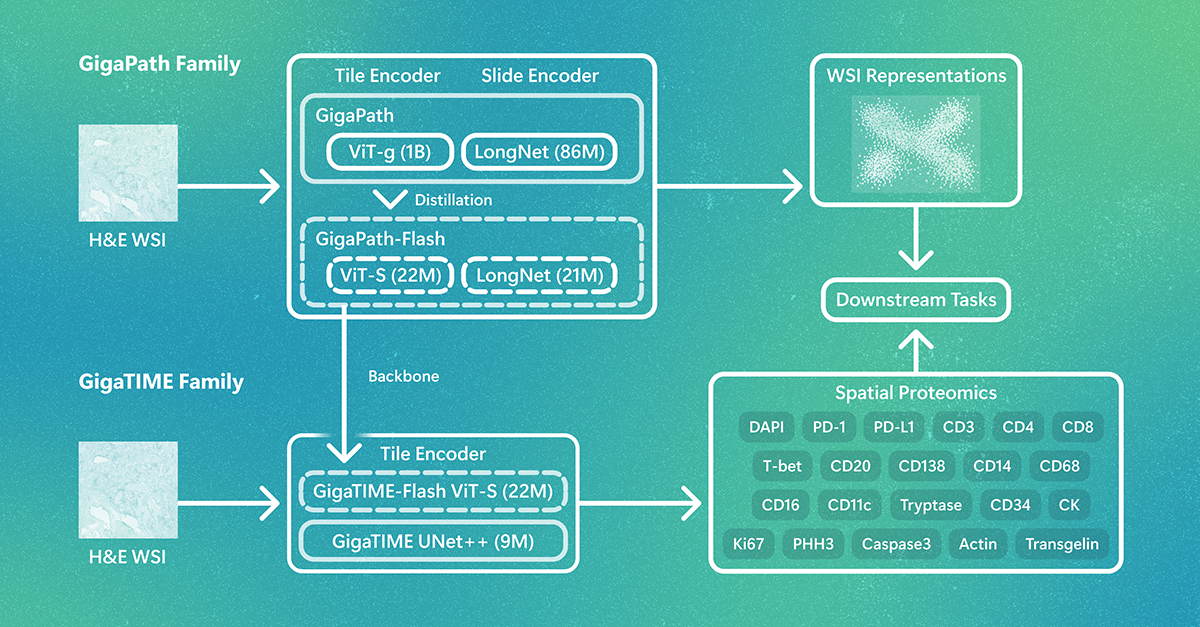
What if pathology foundation models could do more with less? GigaPath-Flash and GigaTIME-Flash cut computational demands while maintaining strong performance, opening the door to larger studies and broader exploration. The post GigaPath-Flash and GigaTIME-Flash: Toward population-scale discovery with efficient pathology foundation models appeared first on Microsoft Research.