Precision agriculture is becoming more and more of a challenge that requires the use of intelligent systems that are able to predict stress and prevent yield loss before it is too late. Traditional methods of agricultural surveillance are predominantly reactive with irrigation demands being based on thresholds or individual yield forecasts models that do not represent the intricate spatio-temporal interactions that exist between crop physiology, soil status, and environmental stresses. Besides, the majority of the current practices do not have an autonomous decision-making approach to preventive intervention which leads to inefficient use of water and slows down the response to stress. This paper suggests a cognitive UAV-assisted agro-surveillance system to predict yield vulnerability caused by crop stress and optimize adaptive irrigation with the help of spatio-temporal deep and reinforcement learning. The framework combines UAV-obtained RGB and multispectral and thermal imagery with measurements of soil sensors and meteorological data obtained with the Crop Health and Environmental Stress Dataset. A new GeoSpatio-TRiNet model is used to acquire long-range spatial relationship, time stress development, and diffusion of stresses across agricultural regions. The model predicts the vulnerability trajectories of the stress instead of the direct yield regression, and this allows early detection of yield risk. Such predictions serve to generate a cognitive environmental state of a Soft ActorCritic (SAC) reinforcement learning agent that autonomously computes zone-based irrigation behaviors to reduce the recurrence of stress at the minimum water usage cost. As shown by the results of the experiment, the proposed framework has a stress forecasting accuracy of 96.3% and performs much better than the traditional machine learning, CNN-based, and transformer-based baselines. The system also decreases the predicted yield vulnerability by 46.6 and enhances water-use efficiency by 41.1 as compared to irrigation strategies based on rules. The results confirm the usefulness of spatio-temporal intelligence with predictive control in terms of effectiveness, and the proposed framework is a scalable and sustainable solution to precision agriculture of the next generation.
S. Selvakumar, D. Venugopal· Scientific Reports· 0 citations
A controlled, replicated comparison of nine sampling strategies within a fixed Gaussian radial-basis-function (RBF) pipeline and examines when sequential acquisition is justified, finding geometry-retaining adaptive criteria improve Heat, Graetz and both four-parameter 2S-RD QoIs, whereas LHS remains effective on both two-parameter QoIs.
O. M. Shchepanchuk, M. Shcherbatyy· Journal of Applied and Numer...· 0 citations
Reach audiences
Advertise in front of researchers, engineers, and readers.
Lesion composition may offer a more informative framework than global WMH burden for understanding cerebrovascular contributions to aging and neurodegeneration, with potential implications for risk stratification, clinical interpretation, and targeted interventions.
Raúl González-Gómez, Enzo Tagliazuchi, C. G. Campo et al.· Neurology· 0 citations
The results help to clarify the biophysical interpretation of dMRI microstructural parameters by determining how strongly they are influenced by myelin content and reinforces the use of DKI and FBWM.
H. Moss, Michael A. Sugarman, Jongho Lee et al.· NMR in Biomedicine· 0 citations
Global navigation satellite systems (GNSSs) are vital for the reliable positioning of urban transportation systems. However, multipath and nonline-of-sight (NLOS) reception often introduce large measurement errors that degrade accuracy. Learning-based methods for predicting and compensating pseudorange errors have gained traction, but their performance is limited by complex error distributions. To address this challenge, we propose Diff-GNSS, a coarse-to-fine GNSS measurement (pseudorange) error estimation framework that leverages a conditional-diffusion model to capture such complex distributions. First, a Mamba-based module performs coarse estimation to provide an initial prediction with appropriate scale and trend. Then, a conditional denoising diffusion layer refines the estimate, enabling fine-grained modeling of pseudorange errors. To suppress uncontrolled generative diversity and achieve controllable synthesis, three key features related to GNSS measurement quality are used as conditions to precisely guide the reverse denoising process. We further incorporate per-satellite uncertainty modeling within the diffusion stage to assess the reliability of the predicted errors. We have collected and publicly released a real-world dataset covering various scenes. Experiments on public and self-collected datasets show that Diff-GNSS consistently outperforms state-of-the-art (SOTA) baselines across multiple metrics. To the best of our knowledge, this is the first application of diffusion models to pseudorange error estimation. The proposed diffusion-based refinement module is plug-and-play and can be readily integrated into existing networks to markedly improve estimation accuracy.
Jiaqi Zhu, Shouyi Lu, Ziyao Li et al.· IEEE Internet of Things Jour...· 0 citations
This article introduces KirchhoffNet, a novel class of neural network models inspired by the principles of analog electronic circuitry, specifically Kirchhoff’s laws. KirchhoffNet operates as an analog circuit, where the network input is represented by initial node voltages, and the output corresponds to the node voltages at a specific time. The dynamics of the node voltages are governed by learnable parameters on the edges, and the evolution of these voltages follows a system of ordinary differential equations (ODEs). Despite the absence of traditional neural network components such as convolutional layers, KirchhoffNet achieves outstanding performance across a wide range of machine-learning tasks. We further demonstrate that KirchhoffNet is capable of computing diffusion models, making it a promising candidate for accelerating modern generative AI applications. Most notably, KirchhoffNet can be implemented as a high-speed & low-power analog integrated circuit, which introduces a compelling advantage: irrespective of the number of parameters in the network, its on-chip forward calculation can always be completed within a short time. This property makes KirchhoffNet a highly attractive and scalable paradigm for implementing large-scale neural networks, opening new avenues in the realm of analog neural networks for artificial intelligence (AI).
Su Zheng, Zhengqi Gao, Fan-Keng Sun et al.· IEEE Transactions on Compute...· 0 citations
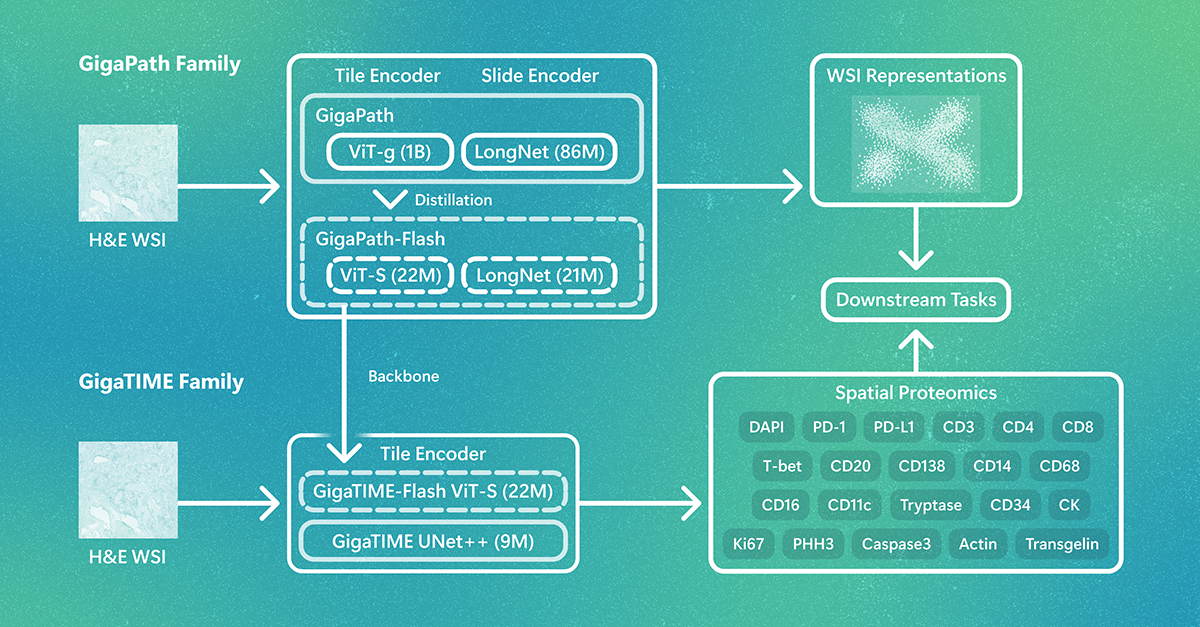
What if pathology foundation models could do more with less? GigaPath-Flash and GigaTIME-Flash cut computational demands while maintaining strong performance, opening the door to larger studies and broader exploration. The post GigaPath-Flash and GigaTIME-Flash: Toward population-scale discovery with efficient pathology foundation models appeared first on Microsoft Research.
We use cookies to run the site and, with your consent, for analytics and to show ads.
See our Cookie Policy.