ProphDR is an interpretable deep learning framework that integrates multiomics data and drug structural information using a hierarchical attention mechanism, and generates biologically interpretable attention maps that highlight key pharmacophores and resistance-related genes consistent with established mechanisms in NSCLC and BRCA.
Yundian Zeng, Qing Ye, Jike Wang et al.· Journal of Chemical Informat...· 0 citations
These findings show that reliable evaluation of LLM-generated code requires validated ground truth, protected tests, and multiple explicitly interpreted measures, and that CodeAssay provides a reproducible basis for evidence-based model evaluation in AI-augmented software development.
Shahbaz Siddeeq, Muhammad Waseem, Umar Subhan Malhi et al.· 0 citations
The first comprehensive benchmarking framework specifically designed to accommodate inter-dataset heterogeneity is presented, finding that well-designed small datasets can match or even surpass the performance of larger benchmarks, suggesting that different metrics are applicable to different datasets/testing scenarios.
Yingjuan Cheng, Qing Ye, Linlong Jiang et al.· Journal of Cheminformatics· 0 citations
Reach audiences
Advertise in front of researchers, engineers, and readers.
A novel committor learning framework grounded in the AlphaFold 3 paradigm is proposed that elucidates how ligand substituents regulate the ratio between distinct binding pathways, offering new perspectives for structure-based drug design.
Jintu Zhang, Zichang Jin, Huifeng Zhao et al.· 0 citations
The Comprehensive VS Platform with AI Engine (CVSP-AIE) for drug discovery from compound libraries integrates three AI models: KarmaDock, a fast docking model that directly updates atomic coordinates; CarsiDock, an accurate docking model that predicts protein-ligand distances and reconstructs binding poses; and RTMScore, an accurate scoring model that learns residue-atom distance distributions for affinity prediction.
Current structure-based drug design generative models often struggle to faithfully recapitulate genuine ligand-protein binding interactions. Instead, under the coupling of implicit learning architectures and biased training data, they tend to learn spurious statistical correlations. To address this, we propose EIP-Diff (Explicit Interaction-Prompted Diffusion), an architecture featuring a novel explicit interaction-prompt embedding mechanism that is better suited for real-world target-specific drug design. This architecture replaces biased implicit learning with explicit, residue-level biological guidance, thereby promoting more fine-grained geometric fidelity and more precise interaction-aware conditioning. To fully realize the capabilities of EIP-Diff and provide a reliable basis for performance evaluation, we further constructed CrystalData set, which provides higher-fidelity and less-biased structural supervision than existing data sets. This explicit architecture markedly improves distribution consistency: even when trained on the crossdocked data set, EIP-Diff achieves the highest alignment with authentic pharmacological distributions among evaluated models. Training on CrystalData set further enhances this alignment and improves 3D geometric accuracy, while retaining strong controllability, high chemical space coverage, and near-perfect uniqueness. In addition, target-based validation on KAT6A and YTHDC1 confirmed that EIP-Diff accurately recapitulates native-like binding modes. Furthermore, in a real-world drug design task against IDO1, we successfully designed a novel lead compound with nanomolar potency (IC50 = 0.31 nM). These results demonstrate that the EIP-Diff architecture can explicitly leverage experimentally derived structural data and biologically meaningful interaction information for target-specific molecular generation, thereby enabling its effective application to real-world structure-based drug design.
Huabin Du, Mingyang Wang, M. Luo et al.· Journal of the American Chem...· 0 citations
This paper introduces Caduceus, a family of MoE-enhanced foundation models built with a hierarchical pre-training paradigm to jointly integrate biological and natural language, and incorporates a multi-task instruction tuning phase, enabling robust protein parsing and natural language question answering.
Mingze Yin, Yiheng Zhu, Jialu Wu et al.· Proceedings of the 32nd ACM...· 0 citations
Post-training alignment is often shallow, eroding under fine-tuning. It remains untested as to whether constitutional midtraining interventions can produce durable alignment when cleanly isolated from post-training. We build a 394M-token constitutional corpus from Anthropic's Constitution and apply constitutional midtraining at 120B scale, where principled, values-based content is inserted into midtraining. A 2x2 design (curriculum ordering x deliberative reasoning) was used to produce four constitutionally midtrained conditions, plus a control, which were evaluated on self-generated and established benchmarks including alignment under pressure, value conflict resolution, blackmail, and emergent misalignment. All models were evaluated across three stages: post-midtraining, post-SFT, and post-benign fine-tuning. Constitutionally midtrained models outperformed the control on alignment generalization and durability, notably on blackmail: SFT instilled a blackmail propensity in all models, but constitutional midtraining blunted it, with the advantage surviving benign fine-tuning (-17.5pp). This durability did not extend to settings that required active resistance to in-context pressure or conflict, where the advantage attenuates after SFT. The presence of constitutional content at midtraining also mattered more than its structure, and constitutional midtraining incurred no capability cost, on average, at any stage (MMLU, ARC-Easy, piqa, GSM8K). A modest amount of constitutional content at midtraining could therefore yield broad, persistent alignment gains, offering a cheap, complementary addition to SFT-centered pipelines. Code, data, and models are available.
Desiree Cho, Cameron Tice, Bernie Hogan et al.· 0 citations
CHAI (Compliant Human-centered Adaptive Interaction), a novel language-driven framework for real-time modulation of a robot’s kinematics and mechanical compliance in real-world environments, introduces on-the-fly language-driven impedance (compliance) modulation along both translational and rotational directions.
Junhui Huang, Xingguang Duan, A. Bucker et al.· IEEE Robotics and Automation...· 0 citations
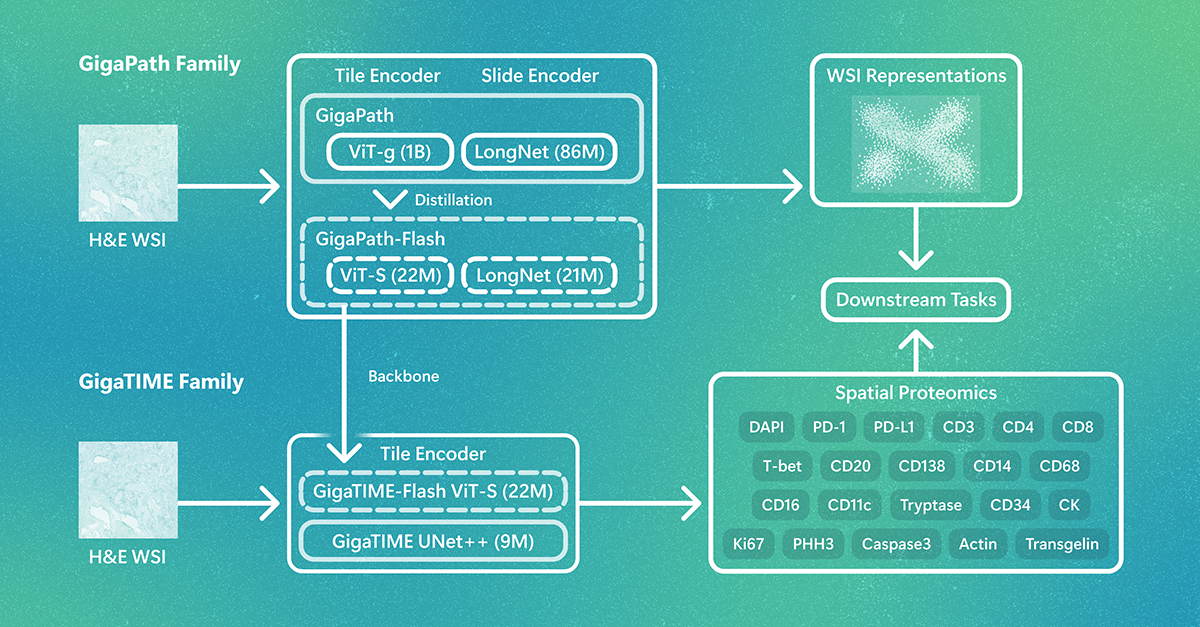
What if pathology foundation models could do more with less? GigaPath-Flash and GigaTIME-Flash cut computational demands while maintaining strong performance, opening the door to larger studies and broader exploration. The post GigaPath-Flash and GigaTIME-Flash: Toward population-scale discovery with efficient pathology foundation models appeared first on Microsoft Research.
We use cookies to run the site and, with your consent, for analytics and to show ads.
See our Cookie Policy.