Anomaly detection in smart power grids is a critical challenge due to the complexity, heterogeneity, and dynamic nature of sensor data streams. Existing one-class classification methods, particularly Subspace Support Vector Data Description (SVDD), have been extended to multimodal scenarios but often fail to fully exploit the structural dependencies across modalities, limiting their robustness in real-world applications. In this paper, we address this gap by proposing a generalized Multimodal Subspace Support Vector Data Description (MS-SVDD) model with graph-embedded regularization. The method projects data from multiple modalities into a shared low-dimensional subspace while preserving modality-specific structure through Laplacian regularizers. Our approach is evaluated on a three-modality dataset derived from smart grid event time series, using a dedicated preprocessing pipeline for constructing one-class classification training samples. The results demonstrate that our graph-embedded MS-SVDD improves robustness of event detection compared to conventional approaches, highlighting the potential of integrating graph priors with multimodal subspace learning for advancing anomaly detection in critical infrastructure. More broadly, this work contributes to the wider field of AI by illustrating how relational and structural information can be systematically embedded into one-class models, enabling robust learning under complex, high-dimensional, and multimodal conditions.
Thomas Debelle, F. Sohrab, Pekka Abrahamsson et al.· Scientific Reports· 1 citation
This paper presents MARARE, a real-time multi-agent system that transforms meeting dialogues into structured software requirements. One agent interacts with participants, while background agents extract and verify requirements collaboratively. Evaluation using the LLM-as-a-Judge method across five meetings (5–8 minutes each) shows a mean coverage of 80.0 ± 11.2 % (mean ± SD), semantic similarity of 0.86 ± 0.05, and hallucination rate of 14.3 ± 6.2 %. Preliminary results indicate performance differences across LLMs, suggesting that model choice influences coverage, consistency, and hallucination rates.
Malik Abdul Sami, Gessé Evangelista, Kai-Kristian Kemell et al.· AGENT@ICSE· 0 citations
Context: Organizations adopting Artificial Intelligence (AI) face challenges in eliciting and analyzing requirements that align with strategic objectives, especially when human oversight and iterative refinement are needed. Large Language Models (LLMs)-based Multi-agent systems provide a potential solution by supporting structured and collaborative Requirements Engineering (RE) processes for AI adoption planning.
Objective: The objective of this study is to investigate whether a multi-agent system, built on LLMs and supported by human input, can assist in requirements analysis for AI adoption. Method: We used a mixed-method approach: (i) designed and developed a multi-agent system to support the generation and prioritization of requirements for AI adoption, (ii) conducted multiple case studies with four companies to evaluate the system, and (iii) collected data through post-session questionnaires from nine participants and follow-up interviews, one per company.
Results: Questionnaire and interview findings together indicate that the system may assist in identifying relevant and goal-aligned requirements. Seven participants considered the generated requirements relevant, and six found them aligned with organizational goals. Participants noted that iterative feedback improved completeness and feasibility, often within two feedback rounds. Both data sources show that human input was essential to clarify technical details, ensure contextual accuracy, and validate prioritization results. Participants from all companies also identified usability, transparency, and scalability as areas requiring further refinement for broader organizational use.
Conclusions: LLM-based multi-agent systems can support strategic AI planning by enabling iterative refinement with human experts. Future work will include more interviews with stakeholders and adjustments to system features to improve transparency, usability, and scalability.
Malik Abdul Sami, Zheying Zhang, Muhammad Waseem et al.· e-Informatica Software Engin...· 6 citations
Large Language Models (LLMs) offer new opportunities for automated code refactoring. However, generated changes must reduce targeted quality problems without introducing new issues or altering behaviour-relevant code structures. We introduce REFINE (Refactoring with Evidence-aware Flow for Integrated ageNtic Execution), a tool-agnostic, evidence-aware multi-agent approach for generating Java file-level refactoring candidates. REFINE combines static-analysis-guided smell identification, smell-informed planning, LLM-based transformation, automated re-analysis, preservation checks, and structured reporting. We evaluate REFINE on 450 Java files from 15 open-source systems, producing 1,350 model-pass outputs using OpenAI GPT-5.5, Google Gemini 3.1 Pro Preview, and Anthropic Claude Opus 4.8. REFINE reduces detected code smells by 68.26%, 72.79%, and 68.49% across the three configurations, respectively, with the strongest reductions observed for major smells. A matched 150-file direct-prompt baseline shows that REFINE achieves a higher median code-smell reduction with smaller edits and fewer public-method removals. However, broader quality improvements are inconsistent, and preservation checks reveal residual risks, including assert/fail-call changes and public-method removal. Therefore, REFINE outputs should be treated as refactoring candidates requiring compilation, testing, dependency analysis, and human review before adoption in repository- or system-level settings.
Muhammad Waseem, Aakash Ahmad, Pekka Abrahamsson· 0 citations
Reach audiences
Advertise in front of researchers, engineers, and readers.
Sampling from discrete Markov random fields (MRFs) is a hard problem. We study amplitude-encoded i.i.d. sampling for small MRFs where $2^n$ target probabilities are precomputed classically. This removes quantum exponential speedup but allows a clean comparison against classical MCMC based on independent circuit samples ($\tau \approx 1$). Across 60 instances spanning five graph families (1k-step burn-in, 3k retained samples), the mean ESS ratios of Quantum to Single-Site Gibbs, Block Gibbs, Tuned-Block, and Parallel Tempering are $16.35$, $7.29$, $1.82$, and $1.79$, showing modern classical samplers substantially close this gap. Amortizing $O(2^n)$ preprocessing into wall-clock time, exact inverse-CDF sampling yields $17.7\text{M}$ ESS/s versus $488\text{K}$ ESS/s for the quantum sampler ($36\times$ mean rate, $153\times$ per-instance), confirming no wall-clock advantage. We characterize MCMC autocorrelation costs and benchmark amplitude-encoded state preparation at $n \in \{8,10,12\}$. An MPS scaling study ($n \le 40$) shows bond dimension $\chi=32$ achieves $F=0.721\pm0.059$ at $n=40$. Finally, a matched-budget VQC vs. MPS comparison at $n \in \{8,10,12\}$ shows VQC fidelities fall far below MPS: $(F_{\mathrm{VQC}}, F_{\mathrm{MPS}}) = (0.31, 0.99), (0.21, 0.96), (0.17, 0.88)$ at compressions $10.7\times$, $34.1\times$, and $113.8\times$.
Quantum federated learning enables collaborative model training across quantum devices without sharing raw data, and it faces the data and hardware heterogeneity inherent to noisy quantum devices. Utilizing the quantum geometric tensor is a natural remedy, yet pure-state approaches and diagonal approximations discard the correlations that encode parameter incompatibility. To address this, we extend the parameter-space geometry to the mixed states that noisy clients actually prepare. The real part of the resulting mixed-state geometric tensor is the Bures metric, which measures how fast the physical state changes under parameter variation, and the imaginary part is the mean Uhlmann curvature, which quantifies the incompatibility of estimating multiple parameters simultaneously. Accordingly, we employ the Bures metric as a local preconditioner and use the mean Uhlmann curvature to develop an achievable-precision aggregation rule that dynamically down-weights unreliable clients. Furthermore, we establish theoretical guarantees by proving a convergence theorem and a variance-dominance proposition. Empirical evaluations on a trapped-ion quantum emulator demonstrate that the proposed method maintains high accuracy across diverse device-heterogeneity conditions and outperforms standard federated averaging, whose accuracy degrades under strong noise.
Quantum DeepONet accelerates neural-operator inference by evaluating an orthogonally parameterized network on a quantum computer, reproducing in ideal simulation the accuracy of its classical counterpart at asymptotically lower inference cost. Its trunk network, however, receives query coordinates with limited spectral structure, requiring the network to learn oscillatory features through its nonlinearities. We propose Quantum SEDONet (Spectral-Embedded Deep Operator Network), which assigns each trunk coordinate a spectral basis according to its boundary condition: Fourier features for periodic coordinates and Chebyshev features for bounded, non-periodic coordinates. The basis is selected per coordinate rather than per problem, allowing both representations within a single problem. Under unary amplitude encoding, the embedding incurs no additional qubits or circuit depth when its dimension remains within the network width, while increasing the parameter count by only a few percent. Across four benchmarks, Quantum SEDONet reduces the mean relative L2 error by 54.1% for the antiderivative, 49.6% for advection, 36.0% for Burgers, and 36.2% for a mixed-boundary channel Poisson problem. Quantum and classical evaluation paths agree to within 10^-8 throughout. The channel Poisson problem simultaneously uses Fourier features in the periodic direction and Chebyshev features in the bounded direction, demonstrating coordinate-wise boundary-matched spectral embedding without additional quantum-resource cost.
Muhammad Abid, Arth Sojitra, Bipin Tiwari et al.· 0 citations
A systematic comparison of four classical machine learning architectures, support vector machines, artificial neural networks, convolutional neural networks, and long short-term memory networks against their quantum counterparts against their quantum counterparts characterize the trade-offs between classical and quantum approaches under realistic, resource-constrained conditions and provide a benchmark for future studies on actual quantum hardware.
Tariq Mahmood, Z. Abidin, Itzel Luviano Soto et al.· 0 citations
An Evaluation Agent, middleware that combines Natural Language Inference factual verification, a five-signal poison detector with relevance-weighted aggregation, and a Trust Index is proposed, which reliably blocks instruction injection of unsafe advice while contradiction and subtle semantic weakening remain hard.
Balkrishna Giri, M. Hasan, Jussi Rasku et al.· 0 citations
These findings show that reliable evaluation of LLM-generated code requires validated ground truth, protected tests, and multiple explicitly interpreted measures, and that CodeAssay provides a reproducible basis for evidence-based model evaluation in AI-augmented software development.
Shahbaz Siddeeq, Muhammad Waseem, Umar Subhan Malhi et al.· 0 citations
The first comprehensive benchmarking framework specifically designed to accommodate inter-dataset heterogeneity is presented, finding that well-designed small datasets can match or even surpass the performance of larger benchmarks, suggesting that different metrics are applicable to different datasets/testing scenarios.
Yingjuan Cheng, Qing Ye, Linlong Jiang et al.· Journal of Cheminformatics· 0 citations
Post-training alignment is often shallow, eroding under fine-tuning. It remains untested as to whether constitutional midtraining interventions can produce durable alignment when cleanly isolated from post-training. We build a 394M-token constitutional corpus from Anthropic's Constitution and apply constitutional midtraining at 120B scale, where principled, values-based content is inserted into midtraining. A 2x2 design (curriculum ordering x deliberative reasoning) was used to produce four constitutionally midtrained conditions, plus a control, which were evaluated on self-generated and established benchmarks including alignment under pressure, value conflict resolution, blackmail, and emergent misalignment. All models were evaluated across three stages: post-midtraining, post-SFT, and post-benign fine-tuning. Constitutionally midtrained models outperformed the control on alignment generalization and durability, notably on blackmail: SFT instilled a blackmail propensity in all models, but constitutional midtraining blunted it, with the advantage surviving benign fine-tuning (-17.5pp). This durability did not extend to settings that required active resistance to in-context pressure or conflict, where the advantage attenuates after SFT. The presence of constitutional content at midtraining also mattered more than its structure, and constitutional midtraining incurred no capability cost, on average, at any stage (MMLU, ARC-Easy, piqa, GSM8K). A modest amount of constitutional content at midtraining could therefore yield broad, persistent alignment gains, offering a cheap, complementary addition to SFT-centered pipelines. Code, data, and models are available.
Desiree Cho, Cameron Tice, Bernie Hogan et al.· 0 citations
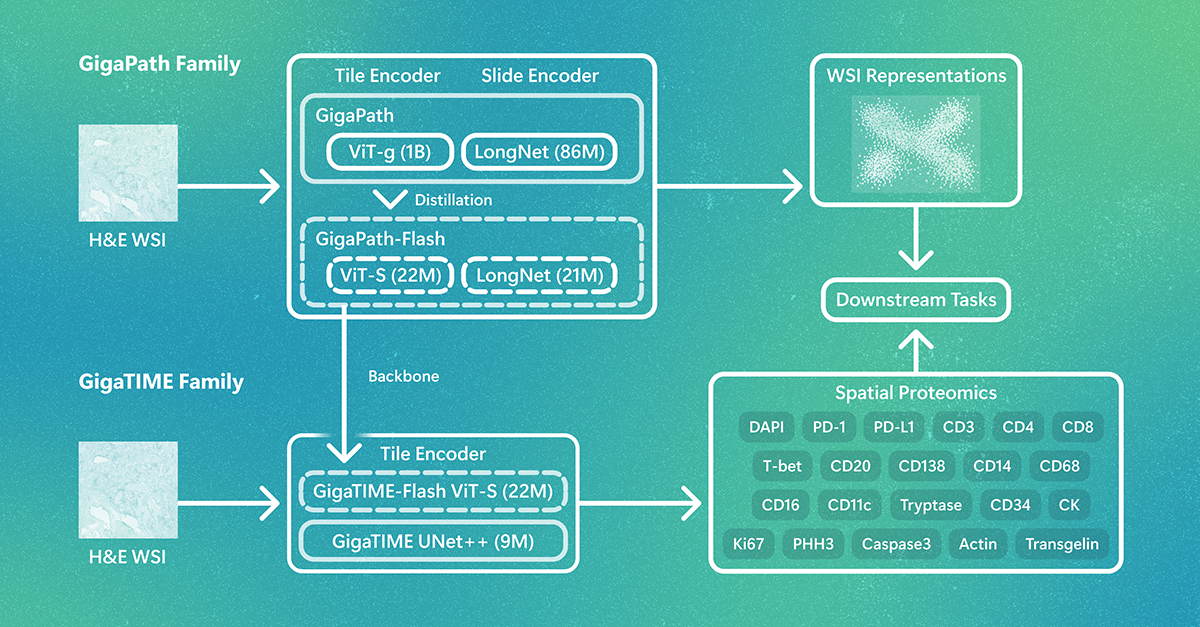
What if pathology foundation models could do more with less? GigaPath-Flash and GigaTIME-Flash cut computational demands while maintaining strong performance, opening the door to larger studies and broader exploration. The post GigaPath-Flash and GigaTIME-Flash: Toward population-scale discovery with efficient pathology foundation models appeared first on Microsoft Research.
MIT News · Artificial Intelligence· news.mit.eduAug 27, 2026
A new machine-learning framework aims to improve the success rate of computational protein design while moving away from results that reproduce sequences found in nature.