Vision-Language-Action (VLA) models are increasingly expected to not only complete robot tasks, but also follow human instructions about how those tasks should be executed. However, existing robot datasets usually pair trajectories with coarse goal-level language, leaving execution-critical details such as active arm, approach direction, and contact region unspecified. This limits steerable policy learning and robotic video understanding. We introduce FineVLA, an open framework for action-aligned fine-grained VLA supervision. The framework includes: (1) a data construction tool that unifies 972,247 trajectories across 85K tasks from 10 open-source robot datasets and builds FineVLA-Data, a human-verified dataset of 47,159 fine-grained trajectories; (2) a held-out benchmark with 500 videos, 11,631 atomic facts, and 1,030 VQA questions; (3) a robotics-specialized VLM annotator for scalable fine-grained annotation; and (4) a steerable VLA policy trained with controlled mixtures of fine-grained and raw goal-level instructions. Our experiments yield three findings. First, fine-grained supervision does not sacrifice goal-level success: FG-only improves over Raw-only by +1.4 to +8.1 success-rate points across settings. Second, fine-grained and raw instructions are complementary, following a consistent inverted-U trend peaking at FG:Raw = 1:2 to 1:1. The best mixed setting reaches 86.8%/82.5% in RoboTwin simulation and 62.7/100 in real-world dual-arm manipulation (vs. 49.9 Raw-only). Third, fine-grained supervision improves steerable control: the largest real-world gains appear on pose (+23), color (+18), and approach direction (+18)--factors where goal-level instructions provide no guidance. Overall, fine-grained language should augment goal-level instructions: specifying how to execute alongside what to achieve. Project page: https://finevla.xlang.ai/
Xintong Hu, Xuhong Huang, Jinyu Zhang et al.· 0 citations
A single egocentric image typically captures only a small portion of the floor, yet a complete metric traversability map of the surroundings would better serve applications such as indoor navigation. We introduce FlatLands, a dataset and benchmark for single-view bird's-eye view (BEV) floor completion. The dataset contains 270,575 observations from 17,656 real metric indoor scenes drawn from six existing datasets, with aligned observation, visibility, validity, and ground-truth BEV maps, and the benchmark includes both in- and out-of-distribution evaluation protocols. We compare training-free approaches, deterministic models, ensembles, and stochastic generative models. Finally, we instantiate the task as an end-to-end monocular RGB-to-floormaps pipeline. FlatLands provides a rigorous testbed for uncertainty-aware indoor mapping and generative completion for embodied navigation.
Subhransu S. Bhattacharjee, Dylan Campbell, Rahul Shome· 0 citations
This paper presents an information-gain-guided reinforcement-learning sensor-selection framework for single-vessel tracking in heterogeneous maritime sensor networks. The proposed approach is motivated by information-theoretic sensor management: instead of activating all sensors or repeatedly performing computationally expensive online expected-information-gain evaluation, a learned policy selects one tracking-relevant sensor at each decision epoch. A Bayesian sequential Monte Carlo tracker estimates the vessel state from noisy measurements and provides a belief representation for scheduling under nonlinear and non-Gaussian conditions. A Proximal Policy Optimization agent selects one of five sensors in a georeferenced simulation of the CMMI Smart Marina testbed at Ayia Napa Marina, Cyprus. The policy is trained on the testbed's actual five-sensor configuration. The agent observes belief-state, detection-history, coverage, sensor-geometry, and realized-information-gain features. The reward is defined as a realized-information-gain term gated by an observability mask. Final-test simulations compare the proposed framework with random single-sensor selection, always-on sensing using all sensors simultaneously, and the expected-information-gain sensor-selection baseline proposed in our previous work. Results show that the learned policy achieves tracking performance close to always-on sensing while activating only one sensor per decision time step and avoiding the computationally expensive online entropy search required by expected-information-gain selection. Additional zero-shot evaluation without retraining on ten moderately perturbed versions of actual layout configuration showed broadly stable tracking, with any increase in positional tracking error remaining below 1 meter across all perturbations.
Andrei Starodubov, Yaqub Aris Prabowo, Andreas Hadjipieris et al.· 0 citations
A long-standing challenge in AI is to develop agents capable of solving a wide range of physical tasks and generalizing to new, unseen tasks and environments. A popular recent approach involves training a world model from state-action trajectories and subsequently use it with a planning algorithm to solve new tasks. Planning is commonly performed in the input space, but a recent family of methods has introduced planning algorithms that optimize in the learned representation space of the world model, with the promise that abstracting irrelevant details yields more efficient planning. In this work, we characterize models from this family as JEPA-WMs and investigate the technical choices that make algorithms from this class work. We propose a comprehensive study of several key components with the objective of finding the optimal approach within the family. We conducted experiments using both simulated environments and real-world robotic data, and studied how the model architecture, the training objective, and the planning algorithm affect planning success. We combine our findings to propose a model that outperforms two established baselines, DINO-WM and V-JEPA-2-AC, in both navigation and manipulation tasks. Code, data and checkpoints are available at https://github.com/facebookresearch/jepa-wms.
Basile Terver, Tsung-Yen Yang, Jean Ponce et al.· 0 citations
Reach audiences
Advertise in front of researchers, engineers, and readers.
Autonomous robots powered by deep learning face a fundamental auditability challenge: when incidents occur, investigators cannot reconstruct why the system made specific decisions. This paper presents TRACE (Transparent Reasoning Architecture for Credible Execution), a decision framework that ensures every autonomous action can be traced back to sensor evidence through documented causal chains. The framework organizes decision-making into four auditable layers: Semantic Perception for evidence-grounded entity recognition, Belief Reasoning for probabilistic state estimation with causal graphs, Action Synthesis for constraint-aware planning with counterfactual documentation, and Execution Verification for compliance monitoring. TRACE is model-agnostic yet designed to integrate learning-based perception modules (CNNs, transformers) while preserving decision-level auditability. We evaluate the framework using three objective metrics: Evidence Traceability (sensor-to-decision linkage), Decision Reconstructability (post-hoc analysis capability), and Temporal Continuity (audit trail completeness). Experimental evaluation on warehouse robot navigation demonstrates that TRACE achieves 98.6% evidence traceability, 99.0% temporal continuity, and 98.1% decision reconstructability across 500 simulated decision cycles. Post-hoc methods like LIME provide feature attributions but lack the artifact structure needed for decision-level reconstruction. The framework addresses EU AI Act requirements for high-risk system transparency and contributes to Explainable AI for safety-critical autonomous systems.
Generating safety-critical scenarios is essential for evaluating autonomous driving systems. However, existing generators primarily focus on inducing collisions and offer limited control over where contact occurs on the target vehicle. In this paper, we study fine-grained safety-critical scenario generation, where success requires both a target collision and a specified head, rear, or side contact region. We propose CrashDiffuser, a closed-loop VLM-guided diffusion framework that decouples semantic collision reasoning from continuous trajectory synthesis through a hierarchical collision-intent interface derived from the requested target contact region. At initialization, the VLM extracts reusable scene-level context; at each replanning step, it predicts a structured action tuple describing speed change, turning behavior, and collision stage. This intent conditions a diffusion model to generate executable adversarial trajectories, while collision-guided sampling, candidate selection, and short-horizon replanning adapt generation to the target vehicle's evolving behavior. On WOMD-derived closed-loop scenarios, CrashDiffuser achieves a target-collision rate of 50.33% in a single attempt and 67.98% after three attempts, together with a contact-region control success rate of 40.05% and competitive trajectory naturalness. Component ablations further support the proposed design.
Shucheng Zhang, Yuang Zhang, Bingzhang Wang et al.· 0 citations
In trajectory planning for autonomous driving, hybrid planning architectures are often realized as a collection of disparate modules, each with its own objectives. This lack of a unifying principle can lead to inconsistencies between the initial and refined trajectory, resulting in suboptimal behavior. We address this by introducing DiffuSearch, a novel hybrid planner that uses a unified set of objectives across generation and refinement. Our model encourages all components to follow the same shared driving goals: collision avoidance, drivable area compliance, comfort, and progress. DiffuSearch employs a two-stage architecture. First, a guided diffusion model generates a scene-consistent, joint trajectory prediction, using our driving objectives as differentiable guidance functions to implicitly steer the denoising process. Second, a Monte Carlo Tree Search (MCTS) in a discretized action space performs an explicit, local refinement of this proposal, leveraging the same driving objectives as its reward function. This synergistic design leverages the diffusion model's strength in finding scene-consistent solutions combined with the explainable, constraint-aware refinement of MCTS. Experiments on nuPlan and interPlan reactive closed-loop benchmarks demonstrate that DiffuSearch achieves strong and often state-of-the-art performance, substantially reducing collisions and improving comfort, particularly in complex, interactive scenarios. Our ablation studies indicate that MCTS refinement is the main mechanism behind the gains, while sharing objectives between implicit guidance and explicit search provides further consistent improvements.
Steffen Hagedorn, Aron Distelzweig, Alexandru P. Condurache· 0 citations
Monolithic world models predict the entire next state at every step, spending capacity re-predicting the static majority of a scene and injecting error into it. We ask whether explicitly modeling change (a per-object change gate plus a residual delta head that perturbs only the objects the gate flags) is a more effective and interpretable bias for physical prediction and control. On a MuJoCo tabletop pushing benchmark scaling from 3 to 8 objects, the sparse/residual model predicts next-state poses 2.5 to 4.6 times more accurately than a dense multilayer perceptron at 8.6 to 11.1 times fewer parameters, sustains change-detection F1 of 0.80 to 0.87 where the dense baseline is degenerate, transfers across object counts with zero retraining (99.4 percent F1 retention), and reaches about 90 percent of its full-data accuracy with a quarter of the data. In autoregressive rollout it compounds far less error, hugging the no-motion floor while the dense model drifts. Finally, inside a sampling-based planner, prediction-only models fail (though a true-simulator oracle solves the task with the identical planner, confirming the planner is sound), but once featurized and trained for the states a planner visits, the sparse model begins to plan (0.23 plus or minus 0.06 success over three seeds) while the dense monolith stays at zero at every seed. Modeling what changes, rather than re-predicting the whole world, is a simple, effective bias for object-centric physical AI; code, data generators, and all checkpoints will be released upon publication.
For embodied systems, predictive agreement alone does not determine whether evidence warrants action; evidential origin matters. Repeated inference over one observation can multiply agreement without adding evidence, while source-local values do not reveal whether outputs have separately countable origins. PACT treats evidence countability as a relational variable for provenance-conserving fusion and typed action admission. A supplied provenance partition defines countable units. PACT retains coordinatewise support shared within each unit, accumulates only across units, and maps unmet release conditions to hold, confirm, or fallback. Under the stated assumptions, source-local values cannot identify countability; the coordinatewise meet is the greatest budget satisfying singleton fidelity and insertion non-amplification, with coarsening monotonicity and fixed-partition stability. Across 31,200 evaluations in 48 scene clusters, PACT attains a common-support normalized risk-coverage area (ncsAURC) of 0.0861. Excluding the constructed adversarial-consensus arm, provenance-partition aggregation reduces ncsAURC by 0.0557 relative to singleton aggregation, while the corroboration contrast vanishes. On complete-source records, native scores favor PACT, but a common posterior-peak score narrows its difference from nested Dirichlet and favors product fusion. Reassigning provenance over unchanged predictions moves evidence budgets as predicted. In offline human-robot collaboration, eightfold within-camera duplication leaves 720 typed responses per checkpoint unchanged; camera-grouped PACT admits 47 of 57 Qwen3-VL-32B reference-consistent candidates with no observed reference-inconsistent admission in 60 episodes. PACT separates computational from evidential multiplicity: agreement constitutes corroboration only when provenance permits separate accumulation.
Zekai Jin, Hanrong Zhang, Yihong Tang et al.· 0 citations
Physical human-robot interaction requires yielding transiently to contact yet recovering the commanded reference under sustained load. Finite-stiffness impedance control retains a static deflection there, while predictive alternatives typically optimize a nonlinear robot or impedance model online. Operational-space cancellation instead exposes a translational error double integrator with a fixed transition matrix and a configuration-scheduled input map, making interaction a predictive quantity rather than a property re-derived per configuration. We build on it a compact offset-free interaction-error MPC for torque-controlled manipulators: a force-domain random-walk state estimates persistent interaction and model error, and a 30-variable convex QP maps the correction through the current task inertia while constraining the applied joint torque. Conditional results establish impedance equivalence of the unconstrained passive feedback, offset-free regulation at feasible frozen configurations, and quadratic stabilizability of the scheduled backbone. In a 1kHz MuJoCo simulation of a 7-DOF Franka FR3, the estimator cuts steady-state error under a repeated 15N step from 2.77mm to 0.042mm when added to the otherwise identical 100Hz MPC. A stiffness-and-damping-calibrated impedance baseline attains 2.59mm but briefly saturates and needs 3.3x the peak positive joint power. Adding ideal measured-force cancellation to that baseline gives 1.39mm, so constant-load rejection is not unique to MPC; the sensorless controller still reaches 0.042mm in the moving task, a 65x reduction without force sensing and without the baseline's saturation or power cost. Demonstrated in simulation under a shared actuator budget, the contribution is an efficient operational-space realization complementing rather than replacing broader interaction-control architectures.
For noisy real-world environments such as those in open public spaces, spoken dialogue systems for both autonomous robots and avatars should be carefully designed to provide enhanced speech signals. These signals can be used either for speech recognition or, in the case of an avatar system, transmitted as clean speech to a remote operator. This work proposes an audio system that can be used for both these scenarios and was demonstrated as a proof-of-concept at the 2025 World Expo in Osaka. The first scenario is an attentive listening system with the android ERICA, and the second is a conversation support system with mobile Teleco robots, with one of them acting as an avatar for a remote operator. Both systems feature multi-party conversation and use a single multi-channel microphone array. We describe how our audio system not only enhances the speech of multiple speakers in a noisy environment, but provides a form of spatial audio which allows for more immersiveness in avatar-based conversational interactions.
Divesh Lala, Yogeeswaran Muthukumaran, Vincent Fernandes et al.· 0 citations
Real-world robotic assembly at sub-millimeter tolerances demands spatial precision, compliant interaction, and robustness to contact failures. We present Facet-0, a robotic foundation model that predicts and values the contact consequences of its actions. Facet-0 unifies multimodal representation learning and reinforcement learning (RL) post-training around a joint action-wrench proposal: a causal wrench history is aligned with vision-language semantics and kinematic state, and flow matching generates each action chunk together with the future wrist-wrench profile it is expected to induce. Deployment rollouts train a distributional Action-Wrench Critic to distinguish motions with similar task progress but different contact outcomes, while phase-aware rewards and contact-selective credit concentrate policy improvement on decisive interactions. To accommodate part-specific dynamics, a lightweight bounded actor reuses the frozen representation for on-robot adaptation; RL remains defined over executable Cartesian actions, while an auxiliary wrench head preserves predictive, non-commanded action-contact coupling. Trained on ManuFacet-1K, a 1,000-hour force-synchronized corpus spanning three embodiments and multiple manufacturing cells, the bounded task-adapted system reaches 82% mean success on five sub-millimeter computer-assembly tasks, compared with 15% for the strongest baseline, with 0.5 mm placement accuracy and 50 ms command latency.
Haoyuan Deng, Haichao Liu, Wenkai Guo et al.· 0 citations
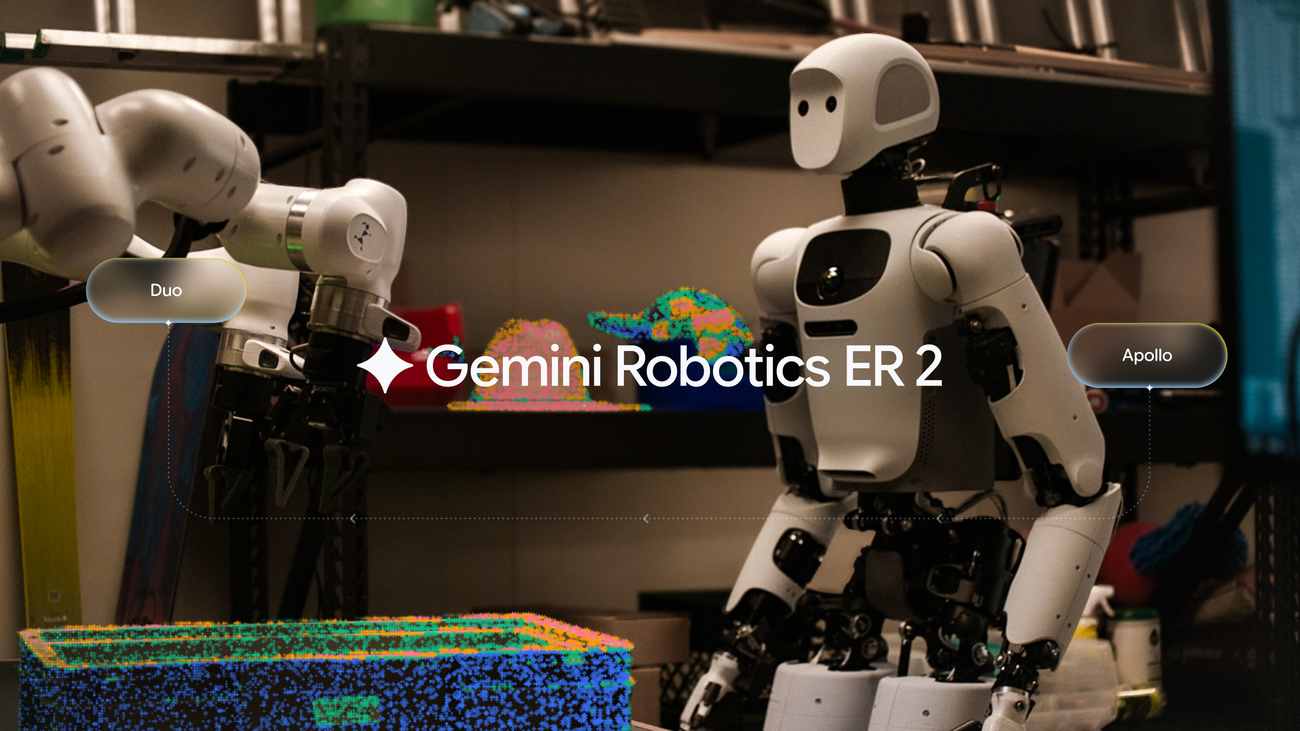
Gemini Robotics ER 2 helps robots reason, collaborate, and solve real-world tasks. It represents a step change in video understanding, tool orchestration, and multi-robot collaboration for robotic applications.
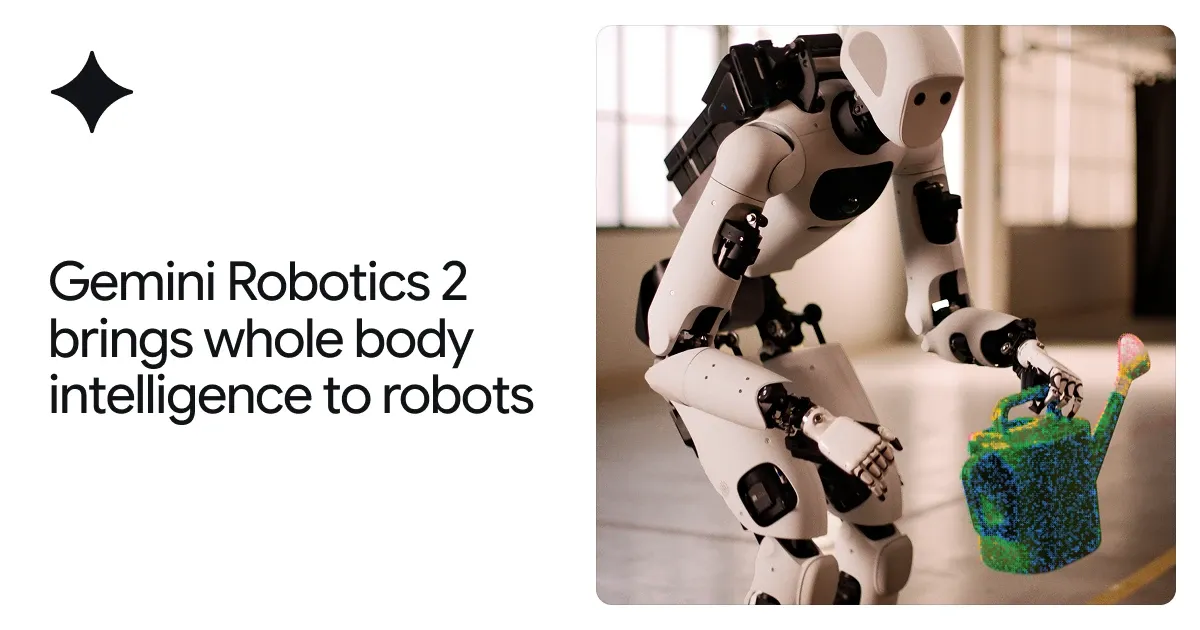
From feet to fingertips — we are teaching robots intelligent whole-body control, fine dexterity, and teamwork to complete a broad range of complex tasks.