Dexterous manipulation policies learned by imitation are typically evaluated for robustness to variation in scenes, objects, or instructions, but their performance across task execution speeds is less often examined. This leaves open how much temporal robustness a learner retains relative to the expert it imitates. We compare an expert and learner under the same task conditions, initial-condition draws, and speedup factors. We instantiate the evaluation in ParcelStow, a contact-rich task in which the robot acquires, reorients, and inserts a parcel. The demonstrations span the speedup range for the manipulation phases after parcel acquisition. A scripted expert and an Action Chunking with Transformers (ACT) policy trained from the expert's demonstrations both achieve 100 percent task success at nominal speed. Their success rates diverge within the demonstrated range: at its maximum, expert success is 84 percent and ACT success is 53 percent. Two ACT policies with different parameter initializations show similar degradation, decreasing by 34 and 48 percentage points from nominal speed to the maximum demonstrated speed, compared with 16 points for the expert. Stage-level analysis shows that 35 of ACT's 47 failures at the maximum demonstrated speed are insertion misalignments. Under the relative-motion handoff, every ACT acquisition retains the parcel through reorientation and transfer in free space, but only 64 percent complete the overall task, compared with 95 percent after expert acquisition. Across all evaluated policies and speeds, none of the 414 acquisitions without force closure completes the task. Equal nominal task success therefore does not imply preservation of expert performance across execution speeds. Code, data, and evaluation scripts are available at https://github.com/coenwerem/parcelstow.
Clinton Enwerem, John S. Baras, Calin Belta· 0 citations
In Model Predictive Control (MPC), cost-function weights shape closed-loop behavior, yet changing conditions often make fixed parametrizations suboptimal and motivate context-dependent online adaptation. Learning such policies is difficult because behavior depends implicitly on numerical MPC solutions, producing nonlinear, potentially nonsmooth, long-horizon dependencies on policy parameters. This creates a bias-variance tradeoff: Reinforcement Learning (RL) optimizes realized closed-loop return from environment samples but is sample-inefficient, whereas Gradient-Based Policy Learning (GB-PL) uses low-variance solver gradients from differentiable MPC to optimize surrogate losses on predicted trajectories but can be biased under model mismatch. We propose Solver-Gradient Guided Reinforcement Learning (SG-RL), a solver-sensitivity augmentation for RL-based online MPC cost-weight adaptation. SG-RL keeps sampled closed-loop return as the objective and uses bounded solver-derived gradients as auxiliary guidance to improve stability and sample efficiency. We instantiate SG-RL in Proximal Policy Optimization (PPO) with four modular algorithms that inject solver-gradient guidance into actor-update scaling, policy loss, advantage estimation, and value-function learning. On two full-scale autonomous racing platforms with intentional model mismatch, SG-RL reaches PPO's best closed-loop return with up to 70.6% fewer samples, outperforms GB-PL baselines by at least 54% in closed-loop return, and generalizes zero-shot to unseen environments.
Baha Zarrouki, Arslan Thobani, Jasper Hoffmann et al.· 0 citations
Autonomous flight in unknown cluttered environments is hindered by the computation-quality-memory trilemma of onboard trajectory generation. In this paper, we propose an efficient end-to-end local planner via imitation learning. A lightweight offline-primitive-based dataset collection framework is designed to produce safe and high-quality trajectory primitives in non-convex environments. A compact neural network directly maps sensory inputs to polynomial coefficients that inherently encode higher-order dynamical information. The learned policy generates smooth, empirically collision-free and dynamically feasible trajectories in real time without back-end solving. It achieves ultra-fast computation (below 1ms on a standard desktop and average 3.68ms during onboard flight), while maintaining low onboard memory requirements (less than 1.5MiB). Extensive simulation benchmarks demonstrate superiority in both planning latency and target-reaching progress quality. Zero-shot deployment in real-world experiments further validates the robust sim-to-real transfer capability of the proposed method.
Zhitao Liu, Guangtong Xu, Zihan Wang et al.· 0 citations
Multimodal Large Language Models (MLLMs) are strong perceivers of images and video. We ask how far that reach extends into acting: dropping an MLLM directly into a drone's control loop, with its entire action space declared solely in the prompt. Recent systems approach this setting but increasingly narrow the model's decision-making. We widen it back. We introduce DroneCATS-Agent, an architecture where the MLLM is a swappable component, and DroneCATS, a benchmark treating the model as the independent variable. Beyond merely flying toward a pixel, our agent entrusts the model to yaw and search, deliberate when unsure, and self-declare arrival---all without fine-tuning or function-calling schemas. Evaluating frontier and open models across four core capabilities---approaching a visible target, tracking a moving one, searching outside the initial view, and commanding a multi-drone fleet---reveals that even the simplest embodied settings are far from solved. Crucially, to identify what breaks first at the edge, our roster scales down to 2B parameters. The findings expose a stark paradox: it is not the flying that fails. Small open models often navigate into the success radius more reliably than frontier models, yet lose the episode by declaring arrival prematurely or not at all. Multi-drone commanding amplifies this divide, with small models failing by blindly copying a single coordinate across distinct views. Viewed as vision-language-action agents, the models' spatial perception holds up, but their action protocol does not. What separates a deployable edge model from a frontier model is not navigation, but the discipline to sustain a declared protocol and emit the correct terminating action. The open problem is closing this gap at onboard compute costs---yielding a fast model that plans persistently and knows exactly when it is done---and DroneCATS is built to measure that distance.
Jaewoo Park, Minyoung Lee, Sukmin Seo et al.· 0 citations
Reach audiences
Advertise in front of researchers, engineers, and readers.
Online planning under uncertainty remains a fundamental challenge for robotic systems operating in partially observable environments with high-dimensional state spaces. While sampling-based POMDP solvers enable approximate decision-making in large or continuous domains, their performance degrades as belief dimensionality increases due to the high variance inherent in Monte Carlo-based estimation. In this work, we extend the Rao-Blackwellized online POMDP (RB-POMDP) framework to improve its generalizability in high-dimensional settings through hybrid continuous-discrete belief representations. By analytically propagating uncertainty associated with marginalized state components during tree-based planning, the proposed approach reduces sampling-induced variance in value estimation. We demonstrate the effectiveness of this framework in a robotic search-and-rescue task by integrating it with FastSLAM 2.0. Experimental results show that the proposed planner achieves higher cumulative rewards using significantly fewer particles and planning simulations than purely sampling-based methods under equivalent computational budgets. These results suggest that structured high-dimensional robotic problems admitting tractable sufficient statistics can be effectively leveraged within the RB-POMDP framework for computationally feasible online decision-making.
Vision-language-action (VLA) models map visual observations and language instructions directly to robot actions, but long-horizon tasks require more than action prediction. An agent must coordinate perception, planning, execution, progress verification, and recovery as the physical state evolves. An action prediction or a model-generated skill decision does not, by itself, guarantee that the proposed operation is valid in the current state or that its outcome will be verified. We propose EmbodiedSkills, a unified framework that treats each skill decision as an execution proposal: the runtime checks its prerequisites before execution and verifies the outcome afterward. A shared executable-skill interface connects high-level skill selection, bounded low-level VLA execution, and post-action verification within a single agent loop. Because this interface remains fixed, low-level VLA policies can be replaced or adapted without changing the agent loop. The interface also records planning, execution, verification, and recovery events as structured trajectories, which provide supervision for individual components and can support optional online adaptation when interactive feedback is available. We instantiate EmbodiedSkills with Qwen3-VL and OpenPI/pi0.5 on RoboTwin 2.0 and LIBERO. Task-adapted low-level VLA policies achieve an average success rate of 86.20% across 50 RoboTwin 2.0 tasks and 97.40% across the four LIBERO suites. These results establish the execution performance of the task-adapted low-level VLA policies used in EmbodiedSkills. On four memory-dependent RMBench tasks, the same task-adapted execution approach achieves 12.5% average success. The framework provides a trainable and inspectable agent layer for turning these policies into closed-loop embodied systems.
Wei Wang, Wenqiao Zhang, Yutong Lin et al.· 0 citations
Most vision-language-action (VLA) models -- OpenVLA, $\pi_0$, RT-2, RDT-1B -- are monolithic: they emit raw motor commands or short action chunks without organizing behavior into reusable abstractions, so they degrade on long-horizon tasks and resist interpretation. Existing skill-discovery methods sidestep the core question of when two action sequences are behaviorally equivalent, either clustering contrastive embeddings or delegating the judgment to a language model uncalibrated to the robot's dynamics. We introduce REFACTOR-VLA, a wake/sleep system for learning reusable skills. Its sleep phase clusters motor-program fragments under a Behavioral-Equivalence Kernel (BEK) computed from rollouts of a learned latent world model $M_\phi$; its wake phase emits typed lambda terms over a Hindley--Milner-inspired vocabulary, consumed by a library-conditioned rectified-flow action decoder. Abstractions are admitted only if they pass Minimum Description Length and return-preservation gates. On LIBERO we report two findings. First, enlarging the world model from 188M to 430M parameters worsened performance on 4 of 4 suites, so capacity alone does not help. Second, the training objective matters far more: adding an auxiliary supervised contrastive (InfoNCE) loss during world-model warmup substantially improves sleep-phase clustering, giving Normalized Mutual Information at $n=3$ seeds of $0.462 \pm 0.021$ (object), $0.867 \pm 0.025$ (spatial), $0.915 \pm 0.013$ (goal) and $0.754 \pm 0.010$ (LIBERO-10), and beating the strongest published baseline on all 4 suites by a mean $\Delta = +0.184$. Across providers ($n=12$) the 95% bootstrap confidence interval for mean pairwise NMI is $[0.683, 0.729]$ (mean $0.705$). The sleep phase also yields the first real-LIBERO task-language library: the decoder uses 2 of 3 admitted abstractions and rewrites all 256 sampled demonstrations.
Early recognition of lane-change intention is essential for proactive decision-making in autonomous driving and advanced driver assistance systems. This paper proposes a Dual Neural-Calibrated Interacting Multiple Model (DNC-IMM) that improves adaptability to driving context while preserving the probabilistic structure and interpretability of a conventional IMM. The proposed method encodes driving-context information, including target-vehicle motion, gaps to surrounding vehicles, and relative velocities, with a neural network that calibrates both the transition-probability matrix and measurement likelihoods. The final intention is determined from the calibrated IMM mode posterior rather than from a separate direct classifier. Experiments on the highD dataset demonstrate that the proposed method reliably recognizes lane-change intentions before lane crossing and provides particularly strong performance at the earlier 2-3 s prediction horizons.
Autonomous highway overtaking demands foresighted decision-making to handle complex interactions, stochastic traffic evolution, and temporal risk accumulation. However, standard safe reinforcement learning approaches typically rely on implicit value-based risk estimations rather than explicit dynamics modeling, thereby struggling to accurately capture complex risk propagation over multi-step horizons. This limitation frequently results in behaviors that are locally safe but induce substantial latent risks in the long term. To address this, a World Model-based Risk-aware Mixture-of-Experts (WM-RMoE) framework is proposed. First, a learned latent dynamics model facilitates parallel multi-step rollouts, elevating safety assessment from the action level to the trajectory level via cumulative risk evaluation. Second, to enhance robustness under varying interaction intensities, a hierarchical gating mechanism dynamically coordinates experts across long-horizon, short-horizon, and rule-based safety modules. Furthermore, a Gaussian Mixture Model is integrated to preserve multimodal maneuvering branches, thereby mitigating the issue of behavioral mode averaging. Experimental results demonstrate that WM-RMoE significantly outperforms representative baselines in terms of safety compliance, decision stability, and generalization capability. Furthermore, benefiting from the risk-aware formulation, the proposed framework uniquely exhibits the ability to generate foresighted and semantically distinct overtaking maneuvers across diverse traffic densities.
Yongzhi Liu, Sunan Zhang, Jinchang Xu et al.· 0 citations
Long-tail autonomous driving failures are often framed as rare-object recognition errors. We argue that this view is incomplete: the decision-critical question is not only whether a model recognizes an unusual object, but whether it infers how that object changes the ego vehicle's feasible high-level actions. We formalize this problem as decision-level driving affordance prediction, where a model maps a front-view image, ego-motion history, and navigation command to a structured longitudinal--lateral meta-action. To evaluate this capability, we introduce CoLT-Drive, a 3,536-sample counterfactual long-tail benchmark that inserts rare objects into otherwise fixed driving scenes and measures whether models predict acceptable action pairs. To improve deployable small VLMs, we propose KPA, a knowledge-preserving adaptation framework that combines structured perception-to-decision prompting, SLERP-based expert merging, and RegMoE, a regime-aware LoRA mixture-of-experts module. KPA preserves the pretrained model's open-world knowledge while allocating lightweight adaptation capacity to different driving decision regimes. Experiments on an in-domain driving split and CoLT-Drive show that KPA achieves 60.8\% pair accuracy on CoLT-Drive, outperforming the pretrained Qwen3-VL-2B baseline (50.3\%) and LoRA SFT (32.4\%) while maintaining competitive in-domain accuracy. Our benchmark and code are available at https://huggingface.co/datasets/tangzx2024/CoLT-Drive and https://github.com/tangzhengxu/CoLT-Drive.
Zhengxu Tang, Guofeng Cui, Ziyu Gong et al.· 0 citations
Robotic systems are deeply embedded in both industry and everyday life, where they are expected to act with speed, precision, and reliability. Classical control and planning methods have long delivered strong guarantees, but often at the cost of computational efficiency and adaptability. More recently, learning-based approaches have shown promise in overcoming these limitations, enabling agents to leverage experience to accelerate decision-making and address previously intractable problems. In this work, we bridge these two approaches through a neuro-symbolic perspective on nonlinear motion planning. Inspired by the Thinking Fast and Slow paradigm, we introduce a dual-process architecture that combines the strengths of robust reasoning and learning. Our framework integrates state-of-the-art symbolic solvers as a ``System-2''component with experience-driven ``System-1''modules. A metacognitive controller dynamically orchestrates their interaction, selecting when to rely on fast intuition versus slower, more precise reasoning. By evaluating the framework across diverse nonlinear benchmark environments, we demonstrate that this architecture yields consistent gains in planning efficiency, accuracy, and generalization, while promoting reuse across tasks. The results suggest that tightly coupling learning with structured reasoning offers a scalable path toward more capable and adaptive robotic systems.
Jia-Yi Yan, Francesco Fabiano, Alessandro Abate· 0 citations
World models have made remarkable progress in action-conditioned future prediction for embodied agents, yet still struggle to model physically plausible interactions. Existing approaches address this limitation by constraining the generation process with external representations encoding motion, geometry, or semantics. Obtaining these spatiotemporally dense representations typically requires auxiliary estimators or manual annotations, limiting training scalability. We instead revisit the training objective and identify a supervision-allocation mismatch under the globally averaged mean squared error (MSE) denoising objective: prevalent static content dominates the optimization signal, leaving sparse dynamic-object regions critical to interaction generation disproportionately under-supervised. Motivated by this observation, we introduce IMPACT, a scalable Interaction-aware Model training framework with Prior-guided Attention Calibration and Targeting. IMPACT uses cross-attention associated with manipulated-object tokens as an internal spatiotemporal prior for action-conditioned changes. It samples candidate regions from this prior, calibrates them with detached local prediction errors to construct an interaction map, and uses the map to reweight denoising supervision, requiring neither external representations nor inference-time modifications. Extensive experiments on robot-arm and human-hand manipulation, spanning diverse control modalities and DiT backbones, show that IMPACT consistently outperforms the corresponding MSE-trained baselines, improving interaction fidelity, physical plausibility, and visual quality.
Rongze Tang, Jianjie Fang, Zhaolu Wang et al.· 0 citations
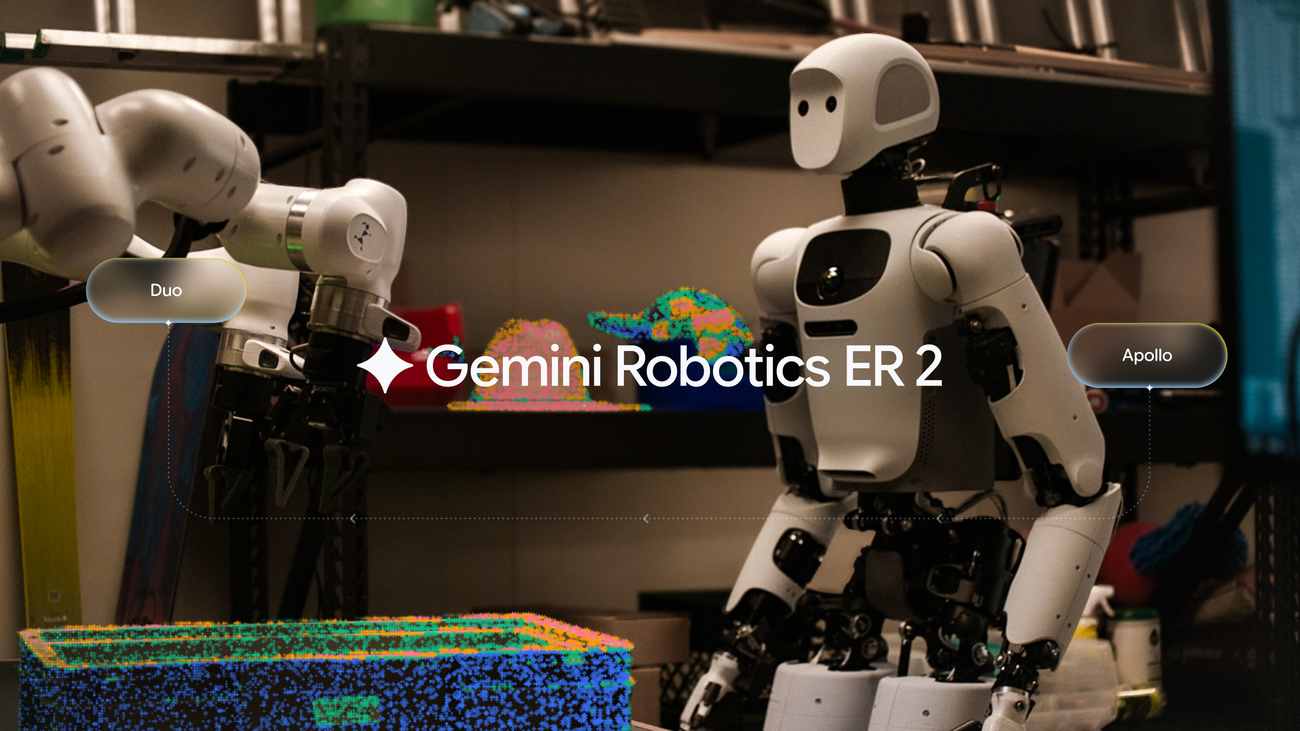
Gemini Robotics ER 2 helps robots reason, collaborate, and solve real-world tasks. It represents a step change in video understanding, tool orchestration, and multi-robot collaboration for robotic applications.
From feet to fingertips — we are teaching robots intelligent whole-body control, fine dexterity, and teamwork to complete a broad range of complex tasks.