This paper presents FAIRY, a full-stack smart-agriculture agent system developed for and deployed to an operating soybean research farm at Harbin Institute of Technology's smart-agriculture site. We develop FAIRY to execute and evaluate agentic agronomic operations on full-season spatiotemporal workflows that span ridge preparation, planting, irrigation, fertilization, pest and disease treatment, harvest, grain handling, drying, and storage. FAIRY integrates APIs and infrastructure across production-grade machinery, fixed soil and canopy sensors, multispectral and thermal drones, satellite vegetation products, a weather station, calibrated crop-process models, agronomic records, and multi-season yield histories. The system is built around the novel "everything is an event" execution paradigm, which represents spatiotemporal world evolution, remote sensing and UAV observations, sensor readings, crop-growth transitions, machinery actions, and management interventions as state-changing events in a shared farm process engine. On top of this event-driven world model, FAIRY implements a complete agentic stack: a knowledge library of atomic agronomic skills; multi-agent controller and orchestration backends; frontier- and edge-model execution; full-path trace logging; and deployment profiling on local nodes. We use FAIRY to evaluate nine state-of-the-art agent controllers across one hundred full-season soybean scenarios that preserve the operational coupling between spatial observations in a 64-ridge field, temporal decision sequences, agronomic constraints, delayed effects, and final yield. We develop an evaluation suite that combines agentic success, full-path spatiotemporal correctness, token cost, and edge-device runtime.
Ao Qu, Panagiotis Michelakis, Linyuan Han et al.· 0 citations
Physical AI models are evaluated on suites of benchmarks that differ across model reports, leaving the model-by-benchmark matrix sparse and the relationship between benchmarks unmeasured. We construct a matrix of 51 models on 12 physical AI benchmarks, selected from a registry of 51 benchmarks and 152 models by reporting density, combining scores from model cards and benchmark papers with our own evaluation runs under each benchmark's official protocol. We measure how much information the benchmarks share and show quantitative evidence of Redundancy. Redundancy affects reported rankings: collapsing the two substitute pairs into single columns moves 22 of 51 models by three or more places under an equally weighted average. We then select benchmarks greedily under a utility combining score dispersion with variance not explained by the already-selected set, and obtain a four-benchmark subset retaining 78.5\% of the utility of all 12, on which we fit a Bradley--Terry ranking. The procedure requires only benchmark-level scores with sufficient overlap and is not specific to physical AI.
Non-terrestrial networks (NTN) provide ubiquitous connectivity for embodied intelligence (EI), enabling robots in the wilderness to leverage cloud resources or report critical information to remote centers. However, the synergy is nontrivial due to the highly dynamic, resource-constrained, topology-varying, and task-oriented environment. Existing memoryless NTN protocols become inefficient, since the decisions are driven by local channel conditions and instantaneous service demands. To address these limitations, this paper proposes the memory-native NTN (Mem-NTN) paradigm that leverages long-horizon contexts for memory-augmented system optimization. To realize this paradigm shift, we establish a dual-memory architecture that distinguishes between physical memory representing the state of the world and digital memory encoding historical network experience. We develop memory acquisition, compression, valuation, update, and utilization mechanisms that facilitate cross-layer, memory-native decision-making, spanning from the physical and access layers up to the network and application layers. Experiments in satellite embodied question answering (SEQA) demonstrate that the proposed Mem-NTN consistently outperforms conventional stateless NTN and terrestrial approaches.
Chengyang Li, Yikun Wang, Jiahui He et al.· 0 citations
Robot learning and embodied agents now require simulation to serve as a shared execution substrate linking control, skills, and planning, not only as a renderer, controller testbed, or fixed task environment. Existing pipelines split these layers with "magic" actions, disconnected training environments, or forward-only renders that cannot reproduce, evaluate, and annotate the same episode. We present MagicSim, an embodied interaction infrastructure built around one deterministic batched runtime and a shared Markov decision process (MDP). From YAML-first specifications that decouple contents, placement, behavior, and agent exposure, MagicSim constructs diverse executable worlds spanning task families, interaction regimes, physics, layouts, sensors, avatars, and robot embodiments in one reset-and-step loop. A common execution interface grounds high-level commands through controllers, atomicskills, planner primitives, and asynchronous planning, realizing them as robot actions rather than simulator-side state edits. One task definition supports three capabilities: benchmark and RL evaluation, an autocollect interface that automatically turns commands into grounded trajectories, and agent/VLM-facing interaction. For automatic execution, commands flow through a Command->Skill->Planner->Robot->Record pipeline, while per-environment command, skill, planning, retry, annotation, and episode states advance independently above the shared physics tick. Successful rollouts are saved as structured multimodal trajectories aligning language supervision, action representations, visual/geometric representations, and task-level status with the executed episode. MagicSim thus unifies diverse world construction, embodied execution, task evaluation, automatic rollout generation, and interactive agent interfaces in one planner-in-the-loop runtime.
Haoran Lu, Songling Liu, Yue Chen et al.· 0 citations
Reach audiences
Advertise in front of researchers, engineers, and readers.
Robots under autonomous operation may require decisions based on evidence that is no longer visible. We study delayed-evidence tasks, where an early cue disappears before a later decision point, so visually similar observations can require different actions. In these settings, the current observation is not a sufficient state for control. We introduce TRAjectory-routed Causal Evidence (TRACE), a memory framework for visuomotor imitation policies. TRACE stores task-relevant visual and robot-state evidence, such as object identity, target choice, or route-dependent state, in a fixed-size latent memory that remains bounded over long episodes. Instead of indexing memory by raw time or manually provided task labels, TRACE uses path signatures: compact, order-sensitive features of the executed robot-state trajectory. These signatures do not store the visual cue itself; rather, they provide trajectory-conditioned keys for writing and retrieving the evidence stored when the cue was visible. When the robot later reaches an ambiguous observation, the policy conditions on TRACE memory to recover the missing context and choose the correct branch. TRACE attaches through lightweight adapters to policies, without changing the policy backbone, action head, or imitation objective. Across real-world long-horizon manipulation tasks with visually ambiguous branch points, TRACE improves branch selection and task success over alternative baselines, including short-history and recurrent memory. Project page: https://jeong-zju.github.io/trace
Zihao Li, Ranpeng Qiu, Yincong Chen et al.· 0 citations
Humanoid robots are expected to execute agile and expressive whole-body motions in real-world settings. Existing text-to-motion generation models are predominantly trained on captured human motion datasets, whose priors assume human biomechanics, actuation, mass distribution, and contact strategies. When such motions are directly retargeted to humanoid robots, the resulting trajectories may satisfy geometric constraints (e.g., joint limits and pose continuity) and appear kinematically reasonable. However, they frequently violate the physical feasibility required for real-world execution. To address these issues, we present PhyGile, a unified framework that closes the loop between robot-native motion generation and General Motion Tracking (GMT). PhyGile performs physics-prefix-guided robot-native motion generation at inference time, directly generating robot-native motions in a 262-dimensional skeletal space with physics-guided prefixes, thereby eliminating inference-time retargeting artifacts and reducing generation-execution discrepancies. Before physics-prefix adaptation, we train the GMT controller with a curriculum-based mixture-of-experts scheme, followed by post-training on unlabeled motion data to improve robustness over large-scale robot motions. During physics-prefix adaptation, the GMT controller is further fine-tuned with generated objectives under physics-derived prefixes, enabling agile and stable execution of complex motions on real robots. Extensive offline and real-robot experiments demonstrate that PhyGile expands the frontier of text-driven humanoid control, enabling stable tracking of agile, highly difficult whole-body motions that go well beyond walking and low-dynamic motions typically achieved by prior methods.
Jiacheng Bao, Haoran Yang, Yucheng Xin et al.· 0 citations
Long-horizon task planning for heterogeneous multi-robot systems is essential for deploying collaborative teams in real-world environments; yet, it remains challenging due to the large volume of perceptual information, much of which is irrelevant to task objectives and burdens planning. Traditional symbolic planners rely on manually constructed problem specifications, limiting scalability and adaptability, while recent large language model (LLM)-based approaches often suffer from hallucinations and weak grounding-i.e., poor alignment between generated plans and actual environmental objects and constraints-in object-rich settings. We present Scale-Plan, a scalable LLM-assisted framework that generates compact, task-relevant problem representations from natural language instructions. Given a PDDL domain specification, Scale-Plan constructs an action graph capturing domain structure and uses shallow LLM reasoning to guide a structured graph search that identifies a minimal subset of relevant actions and objects. By filtering irrelevant information prior to planning, Scale-Plan enables efficient decomposition, allocation, and long-horizon plan generation. We evaluate our approach on complex multi-agent tasks and introduce MAT2-THOR, a cleaned benchmark built on AI2-THOR for reliable evaluation of multi-robot planning systems. Scale-Plan outperforms pure LLM and hybrid LLM-PDDL baselines across all metrics, improving scalability and reliability. Project website: https://github.com/honda-research-institute/Scale_Plan
Piyush Gupta, Sangjae Bae, Jiachen Li et al.· 0 citations
Recent video diffusion models have achieved impressive capabilities as large-scale generative world models. However, these models often struggle with fine-grained physical consistency, exhibiting physically implausible dynamics over time. In this work, we present \textbf{Phys4D}, a pipeline for learning physics-consistent 4D world representations from video diffusion models. Phys4D adopts \textbf{a three-stage training paradigm} that progressively lifts appearance-driven video diffusion models into physics-consistent 4D world representations. We first bootstrap robust geometry and motion representations through large-scale pseudo-supervised pretraining, establishing a foundation for 4D scene modeling. We then perform physics-grounded supervised fine-tuning using simulation-generated data, enforcing temporally consistent 4D dynamics. Finally, we apply simulation-grounded reinforcement learning to correct residual physical violations that are difficult to capture through explicit supervision. To evaluate fine-grained physical consistency beyond appearance-based metrics, we introduce a set of \textbf{4D world consistency evaluation} that probe geometric coherence, motion stability, and long-horizon physical plausibility. Experimental results demonstrate that Phys4D substantially improves fine-grained spatiotemporal and physical consistency compared to appearance-driven baselines, while maintaining strong generative performance. Our project page is available at https://sensational-brioche-7657e7.netlify.app/
Haoran Lu, Shang Wu, Songling Liu et al.· 0 citations
Bridging model-based control and learned policies in long-horizon manipulation has harbored a silent disagreement: control executes specified objectives, learning amortizes that behavior into a reactive policy, yet existing protocols discard task semantics, leaving rewards hand-crafted and behavior drifting from what control verified.We introduce Semantically UNified (SUN) Programs, typed executables where geometric and contact relations are defined once and compiled into aligned Model Predictive Control (MPC) costs, satisfaction predicates, RL rewards, transition guards, and diagnostics. Our system, Kuafu, driven by large vision language systems, automatically synthesizes SUN Programs from language and scene semantics, screens feasibility via MPC, and retains semantics while training stage-conditioned policies. Across nine tasks, Kuafu achieves 82.03% macro-success, outperforming sparse-reward (35.67%) and Stage-BC (24.75%) baselines. At 8192-way scale, it generates 10.57x the successful trajectory time per hour of human teleoperation. With 500 trajectories per task, Kuafu data trains DP3 policies to 46.0% simulation success (vs. 22.4% for alternatives) and 34.7% on physical Franka and Kinova robots. These results establish that simulation-screened task semantics can effectively amortize control into robust policies, without demonstrations or manual dense rewards, unifying symbolic planning and data-driven execution.
Weiqi Wang, Zhi Li, Yudong Lei et al.· 0 citations
Embodied navigation requires agents to translate heterogeneous goals and visual observations into actions across tasks, environments, and robot embodiments. Modern vision-language models (VLMs) already encode spatial priors for visual grounding, spatial reasoning, and pointing, but these capabilities are rarely elicited directly for robot control. Existing navigation systems instead rely on task- or embodiment-specific components, fragmenting perception, reasoning, and action while offering limited generalization. Here we present LightNav-0, a compact generalist embodied navigation model that elicits the spatial intelligence of a pretrained VLM and aligns it with navigation, without task-specific prediction heads. LightNav-0 represents diverse navigation tasks through a unified token interface: dual-channel pointing expresses task-, scene-, and embodiment-agnostic spatial intent, while a residual vector-quantized action tokenizer maps this intent to precise, embodiment-specific trajectories. Together with temporally aware visual history compression, ER mid-training, supervised fine-tuning, and reinforcement learning, this formulation supports instruction following, open-vocabulary object navigation, and visual tracking within a single model. The navigation training corpus spans 2K+ scenes and 4K+ hours of embodied navigation data. LightNav-ER, the embodied-reasoning checkpoint used to initialize LightNav-0, attains the highest complete-set average across 8 embodied-reasoning benchmarks, while LightNav-0 achieves state-of-the-art monocular success rates across all 10 public navigation simulation settings. Real-world evaluations further demonstrate zero-shot generalization across robot embodiments, diverse scenes, and static and dynamic targets. These results establish compact VLMs as a unified and transferable backbone for generalist embodied navigation.
Shaoan Wang, Aocheng Luo, Fei Huang et al.· 0 citations
Direct vision-language-action policies generate continuous robot actions efficiently, but standard behavior cloning leaves two complementary gaps: their representations are not explicitly required to describe how the scene evolves over multiple time scales, and deployment trajectories of unequal quality are often reused without separating useful dynamics from undesirable behavior. We introduce \method, a direct world-action policy that combines outcome-agnostic predictive learning with outcome-aware policy improvement. \method first retains a local fixed-offset JEPA objective and adds trajectory-relative multi-horizon transition alignment at 25%, 50%, 75%, and 100% of the remaining episode. These training-only targets require the current policy representation to preserve both local physical changes and longer-range task progress, without supplying explicit future tokens to the action head. \method then trains an independent distributional value critic on cumulative deployment trajectories, computes action-chunk-aligned $N$-step advantages, and converts them into positive, negative, or null text conditions for a flow-matching actor. Thus, every valid trajectory can teach what physically happened, while the actor is deployed only under the condition associated with relatively better actions. The multi-horizon predictor and critic are removed from online execution, preserving direct action generation from the current observation, language instruction, and proprioception. \redclaim{Across the three simulation benchmarks, \method achieves the strongest overall performance while preserving the direct actor's online execution path.}
Vision-Language-Action (VLA) models demonstrate strong semantic understanding yet exhibit systematic failures during deployment. The conditions under which these failures occur, and whether they can be corrected without retraining, remain poorly understood. In this paper, we take steps toward addressing this gap. We present CorrectVLA, a framework that translates task-level natural language corrections into additive action magnitude adjustments without modifying policy weights. A human provides a single task-level correction, applied uniformly across all rollouts without per-episode intervention. In simulation, CorrectVLA recovers execution misalignment failures across both in-distribution and OOD tasks. In real-robot experiments on a UFactory xArm7 under environment shift, CorrectVLA restores near-perfect success where the base policy almost entirely breaks down, generalizing across object locations and identities. Through a taxonomy of failure modes on LIBERO-90, we find that execution misalignment failures, where the policy reaches the correct target but miscalibrates action magnitudes, represent the correctable subset, while other failure modes where semantic comprehension itself breaks down are not amenable to this approach. The approach succeeds when policies possess strategic correctness and fails when fundamental comprehension is absent, establishing a practical operational boundary for inference-time correction.
Owen Kwon, Pablo Ortega-Kral, Arthur Bucker et al.· 0 citations
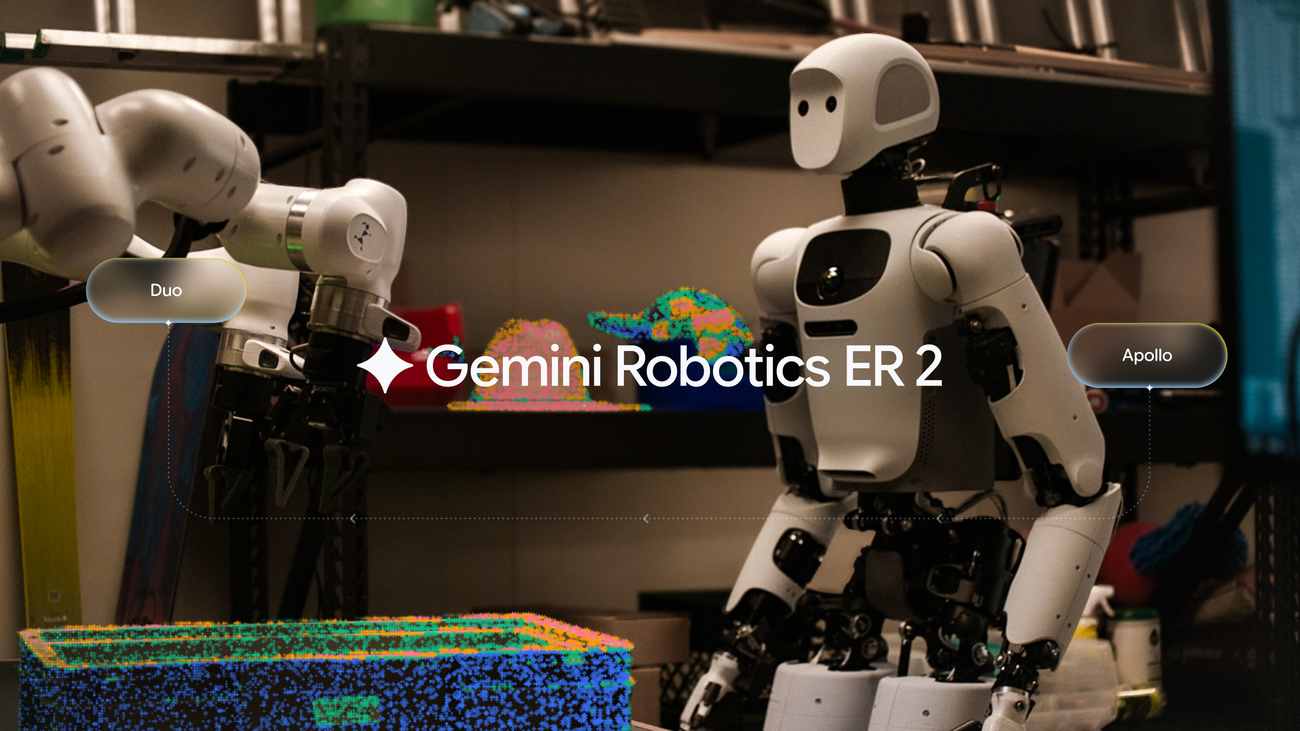
Gemini Robotics ER 2 helps robots reason, collaborate, and solve real-world tasks. It represents a step change in video understanding, tool orchestration, and multi-robot collaboration for robotic applications.
From feet to fingertips — we are teaching robots intelligent whole-body control, fine dexterity, and teamwork to complete a broad range of complex tasks.