Frozen vision-language-action (VLA) policies offer broad manipulation skills but execute open-loop action chunks without tracking task progress, so the agent cannot reliably decide whether to continue, retry, or terminate. External memory is a natural remedy, yet it can be harmful when attempted actions are treated as completed progress, turning local execution errors into persistent task-state errors. We propose Achievement-Grounded Memory (AGM), a lightweight closed-loop framework for frozen VLA policies that represents a task as a subgoal sequence with a progress pointer and advances this memory only after the current subgoal is verified by physical evidence. Proprioceptive interaction cues decide when to verify, while coherent point tracking and language-conditioned cross-view comparison, sourced from frozen foundation models through a single 2.43M-parameter verification head, decide what was achieved. AGM thereby converts open-loop execution into a closed loop of execution, verification, and progress, keeping the policy frozen without test-time large-model inference. On the RoboMME Counting benchmark, AGM reaches on PickXTimes and on BinFill, surpassing the strongest memory-augmented baseline by points on average, and the framework yields equally decisive gains on a physical robot. Reliable embodied memory thus depends more on disciplined state updates than on memory capacity.
Multi-agent systems in the real-world (e.g., drone swarms, autonomous cars, warehouse robots) must satisfy rich, temporal tasks while avoiding collisions. Signal Temporal Logic (STL) elegantly encodes such objectives, but current STL planning methods face critical limitations. State-of-the-art optimization-based approaches can handle arbitrary STL specifications but struggle with scalability, becoming computationally impractical as the number of agents grows. Learning-based methods efficiently handle a large number of agents with rapid planning times but fare poorly when deployment-time objectives differ from those used during training, and do not support planning tasks that require different specifications to be ascribed to different agents (i.e., heterogeneity) or team-level specifications requiring coordination of multiple agents. This fundamental trade-off between generalizability and scalability presents a challenge for realizing multi-agent STL planning algorithms in practice. To overcome this challenge, we introduce a new diffusion method for multi-agent planning with STL specifications. Using a differentiable approximation of STL, we integrate the STL gradient in the denoising process, making our approach generalizable to novel formulas whose predicates are placed anywhere within the goal region covered during training, while achieving the same scalability as existing learning-based methods. Our method supports heterogeneous specifications, and by using diffusion models, naturally enhances plan diversity, thereby significantly reducing safety-related violations (e.g., collisions) among agents. A detailed evaluation study justifies the utility of STL-guided diffusion-based multi-agent planners for constructing generalizable, scalable, and diverse plans. Videos and code are available at https://www.jeappen.com/diff-ma-stl/ and https://github.com/jeappen/diff-ma-stl .
Joe Eappen, Zikang Xiong, S. Iyengar et al.· 0 citations
This work introduces Semantically-Guided Exploration (SGE), a modular exploration framework for ground vehicles that integrates pixel-level semantic segmentation into sampling-based waypoint selection and receding-horizon route optimization. Unlike conventional geometric exploration methods, SGE evaluates candidate exploration goals directly in the image space using a semantic-aware utility function that accounts for terrain traversability, obstacle proximity, objects of interest, and depth-based exploration reward. Sampled waypoints are projected into 3D and ordered through a real-time Traveling Salesman Problem (TSP) formulation, enabling receding-horizon goal selection. To address real-world navigation uncertainty, the framework introduces mechanisms, including temporary taboo regions to handle navigation failures and a graph-based relocation strategy for efficient backtracking across explored areas. We evaluate SGE in standardized simulation benchmarks against state-of-the-art exploration planners and demonstrate competitive performance in volumetric coverage, while enabling semantic task biasing that cannot be achieved by purely geometric methods. The framework is further validated through real-world experiments using multiple robotic platforms in indoor campus buildings and in limestone and coal mines. Results show consistent performance and adaptability across platforms and domains.
Insect pollination is critical for global food production, yet monitoring pollinators at commercial farm scale remains a challenge. Recent advances in computer vision and deep learning have enabled detailed analysis of pollinator behaviour, but monitoring must trade-off detail against spatial coverage and human or technological resources. This paper presents the Automated Guided Robot for Insect and Crop Activity Monitoring (AGRICAM), a purpose-built robotic system designed to meet the requirements of large-scale pollination monitoring in protected cropping systems. AGRICAM operates autonomously on low-cost, easily installed track for movement along crop rows, without disrupting farm operations or insect behaviour. The platform integrates two RGB cameras, microclimate sensors, GPS and RFID modules, motion sensors, and 4G cellular network connectivity for data transmission. A web interface enables remote device configuration and scheduling. The system autonomously captures video and image data of insects' locations and local environmental conditions. These are transferred to the cloud and analysed using computer vision models to quantify pollinator visitation and spatio-temporal activity variation. We deployed the system on a commercial blueberry farm to demonstrate and test its capability. It successfully mapped insect pollination patterns across 80 m long industrial polytunnels over 30 hours. This data enabled spatial analyses of insect activity we used to confirm a uniform pollinator distribution within polytunnels, as desired by the farm management team. The data also highlighted variation of insect activity associated with time of day and microclimate. AGRICAM therefore has been shown to be a scalable, automated crop pollination monitor that can support data-driven decisions to enhance pollination management, thereby improving crop productivity and food security.
Malika Nisal Ratnayake, Adel N. Toosi, James Cook et al.· 0 citations
Reach audiences
Advertise in front of researchers, engineers, and readers.
Object detectors are typically trained under closed-set supervision, where unlabeled regions are implicitly treated as background. Under incomplete annotations, this assumption introduces objectness bias: visually valid but unlabeled objects are used as negatives, tying objectness to the annotated taxonomy rather than generic object structure. This limitation is particularly problematic for class-agnostic and open-world detection. This paper proposes Background-Free Objectness Learning (B-FOR), a dense class-agnostic detection framework that learns objectness without explicit background supervision on unlabeled regions. B-FOR formulates detection as the prediction of dense multi-scale object-center and scale fields, from which object hypotheses emerge as local spatial structures. Supervision is confined to reliable annotated regions through spatially structured soft targets, avoiding foreground-background discrimination. To support decoding from emergent local maxima, the paper further introduces displacement-aware scale fields that model object extent as a spatially varying property of the learned objectness field. Experiments on PASCAL VOC, MS-COCO, and Open Images demonstrate strong generalization to unseen categories and cross-dataset object distributions. B-FOR improves recall by more than +10 AR points over prior class-agnostic baselines. Ablation studies show that both localized objectness supervision and displacement-aware scale fields are critical for class-agnostic localization under incomplete annotations. Code available at: https://github.com/Daniaawan/B-FOR.
Dania Batool, Liliana Lo Presti, Marco La Cascia et al.· 0 citations
Vision-and-Language Navigation (VLN) requires agents to reason over accumulated observations while continuously exploring unseen regions. However, existing environment representations often struggle to jointly support explicit semantic memory and continuous exploration guidance. To address this challenge, we propose Cognitive Graph-Field Memory (CGFM), a persistent multimodal scene representation that couples explicit relational memory with continuous spatial intuition. CGFM organizes objects, spatial relations, and visual observations into a multimodal scene graph, enabling target retrieval and long-horizon reasoning across navigation tasks. When no reliable target match is identified, graph-based evidence is projected into a goal-conditioned semantic-frontier field to guide exploration toward semantically promising frontiers and regions. Building upon CGFM, we introduce CGFM-Nav, a foundation-model-based framework for lifelong multimodal navigation that integrates task-relevant subgraph selection, VLM reasoning, and verification feedback into a closed decision loop. Preliminary experiments on GOAT-Bench show that, under the same Qwen3-VL-8B backbone, CGFM-Nav improves the overall success rate from 53.2% to 63.0% and SPL from 30.0% to 39.6%, demonstrating the effectiveness of combining explicit semantic memory with semantic-guided exploration.
Yuxiang Xiao, Xibei Chen, Xin Zhou et al.· 0 citations
Video world models increasingly serve as data engines, action planners, and simulators for embodied AI, but conventional embodied world model (EWM) benchmarks lack a unified 3D-grounded protocol for establishing whether generated rollouts preserve the underlying 3D scene state or translate into executable actions. We introduce RoboPhys-3D, a 3D-grounded EWM benchmark built on RoboTwin 2.0, covering 50 manipulation tasks across four regimes, with 5,000 episodes and 25,000 multi-view ground-truth videos. A defining feature of RoboPhys-3D is that generated and ground-truth videos are processed through the same 3D reconstruction pipeline, enabling reconstruction-induced error to be distinguished from generation-induced error. The RoboPhys-3D benchmark organizes 50 complementary metrics into 18 sub-dimensions across four levels: pixel-level fidelity, 3D geometry consistency, state-level understanding, and task-level completeness. We further introduce Average Full Score, a hierarchical score averaging all 50 metrics for comprehensive evaluation, and RoboPhyscore, a compact task-aligned score averaging the metrics most strongly correlated with task success. Among the four representative video world models, Cosmos 3 achieves the highest RoboPhyscore (0.6330, 92.7% of ground truth), while state- and execution-grounded metrics reveal substantial failures that perceptual and vision-language model-based judgments fail to capture. RoboPhyscore further exhibits strong agreement with human evaluation (Pearson r = 0.9761 and Spearman \r{ho} = 0.8962), demonstrating the importance of grounded, execution-aware evaluation for EWM capability.
Tianyi Wang, Jiazhou Chen, Yiming Xu et al.· 0 citations
Long-horizon physical-world agents must reason over distant goals while grounding decisions in reliable closed-loop behavior. Today's foundation models split these capabilities: vision-language models (VLMs) infer missing information and adapt high-level plans but remain brittle and inefficient at repeated navigation grounding, while navigation foundation models (NFMs) robustly execute semantic goals but operate as bounded episodes without persistent task-level reasoning. We introduce NavMCP, an agentic scaffolding framework that couples a VLM reasoning agent with an NFM executor for long-horizon exploration. The VLM decides what evidence to seek, where to search, and when to stop, while the NFM grounds each semantic sub-goal into closed-loop navigation. Three channels structure their collaboration: intent translates evidence needs into navigation calls, observation converts rollouts into source-grounded trajectory evidence, and memory accumulates findings, negative evidence, and unresolved goals across calls. This design turns isolated navigation rollouts into persistent embodied interaction without retraining either model. On Embodied Question Answering, NavMCP achieves state-of-the-art results on HM-EQA, MT-HM3D, and EXPRESS-Bench. Under matched agent and executor backbones, it outperforms an episodic interface by 14.9 percentage points on HM-EQA. On a Unitree Go2, NavMCP reaches 78.3% success, with its margin over the strongest baseline growing from 10 to 45 points as the task horizon increases. These results demonstrate the potential of scaffolding complementary foundation models into long-horizon physical-world agents.
Zixing Lei, Gengze Zhou, Xiong-Hui Chen et al.· 0 citations
Robotic manipulation policies trained via imitation learning, such as Action Chunking with Transformers (ACT), can achieve strong performance under ideal conditions but often remain sensitive to small execution errors and distribution shifts. Correcting these failures typically requires dataset aggregation and full-policy retraining, which is computationally expensive and unsuitable for real-time deployment. In this work, we propose Online Residual Policy Adaptation (ORPA), a framework that enables immediate, feedback-driven correction of robot actions without modifying the underlying policy parameters. ORPA augments a pretrained control policy with a lightweight, feedback-conditioned module that predicts residual adjustments directly in joint space, allowing the system to adapt its behavior at runtime. We evaluate ORPA on a set of precision-sensitive manipulation tasks using the ALOHA platform, demonstrating improvements in success rate and recovery from small perturbations compared to baseline control policies and rule-based inverse kinematics corrections.
Muhammad A. Muttaqien, Tomohiro Motoda, Ryo Hanai et al.· 0 citations
Floating things invite touch. We present Feelium, a blimp-based telepresence platform that enables visual embodiment and touch interaction through its inflatable skin. Through a VR headset, a remote person inhabits the blimp, looking out of it first-person, appearing on its skin as a face or avatar, and steering it through the room. Partners in the room pat it, press a palm against it, draw on it, or lean into it; the skin senses each contact, renders it into the wearer's view in VR spaces. Touch thus provides a physical interaction channel for remote presence, turning the skin into a shared surface between remote and co-located partners.
George Xi Wang, Henghao Li, Shan Lin et al.· 0 citations
Video world models are increasingly used in robotic manipulation, yet existing benchmarks mostly evaluate them under valid, feasible, and safe instructions. We introduce RoboTrustBench, a benchmark for evaluating the trustworthiness of video world models under four scenarios: Normal, Constraint-Sensitive, Counterfactual, and Adversarial. Built from real-world DROID episodes, RoboTrustBench contains 1,207 expert-validated instruction-image pairs and a six-dimensional evaluation protocol with 13 fine-grained criteria. Evaluating seven representative video world models with human and MLLM assessment, we find that current models often generate visually coherent videos, but struggle with constraint reasoning, counterfactual grounding, physical interaction, and unsafe-instruction suppression. These results show that visual quality and surface-level instruction following are insufficient for trustworthy robotic video world modeling.
Huiqiong Li, Jiayu Wang, Zhiting Mei et al.· 0 citations
Robot imitation data are often multimodal: similar visual-language observations may be followed by different action chunks because human demonstrators act with different short-horizon intents, task phases, or recent context. Existing frame-conditioned VLA policies infer each chunk from the current observation and instruction alone, so under partial observability they may resample different intents across adjacent replanning steps, leading to inter-chunk conflict and unstable execution. We introduce IntentVLA, a history-conditioned VLA framework that encodes recent visual observations into a compact short-horizon intent representation and uses it to condition chunk generation. We further introduce AliasBench, a 12-task ambiguity-aware benchmark on RoboTwin2 with matched training data and evaluation environments that isolate short-horizon observation aliasing. Across AliasBench, SimplerEnv, LIBERO, and RoboCasa, IntentVLA improves rollout stability and outperforms strong VLA baselines
Shijie Lian, Bin Yu, Xiaopeng Lin et al.· 0 citations
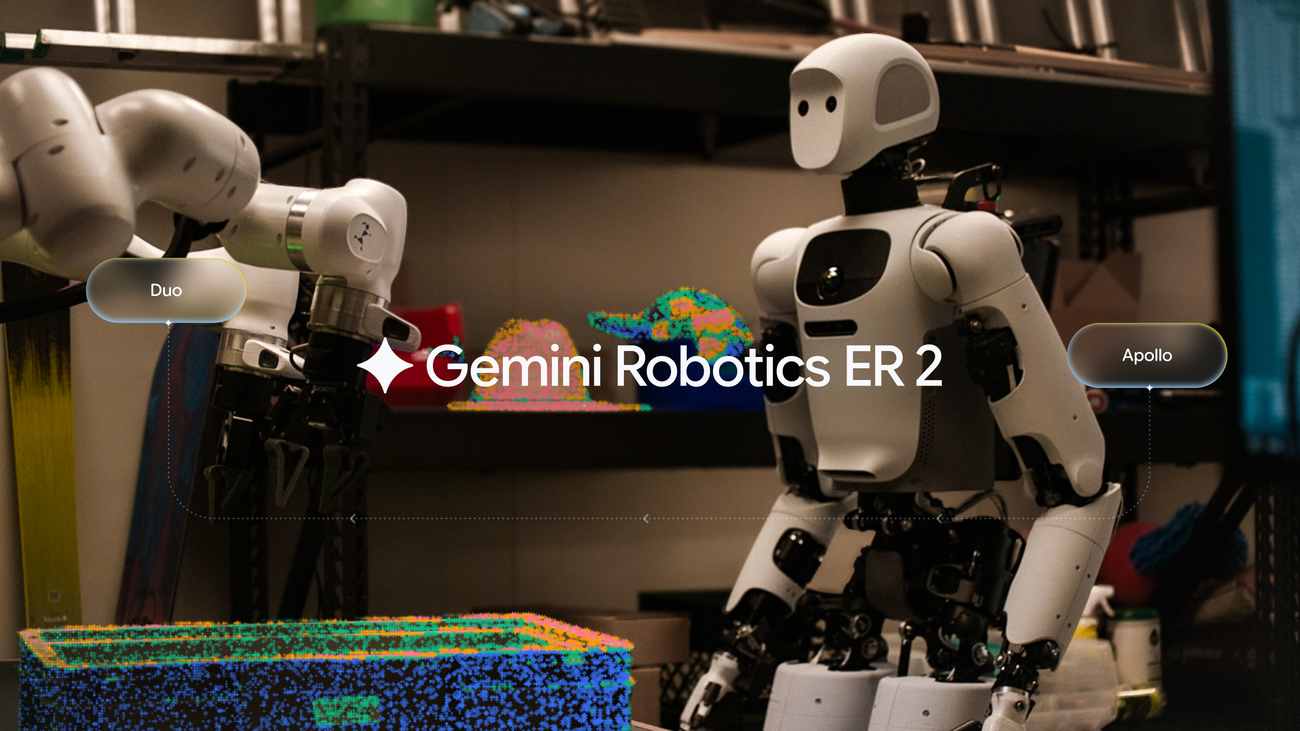
Gemini Robotics ER 2 helps robots reason, collaborate, and solve real-world tasks. It represents a step change in video understanding, tool orchestration, and multi-robot collaboration for robotic applications.
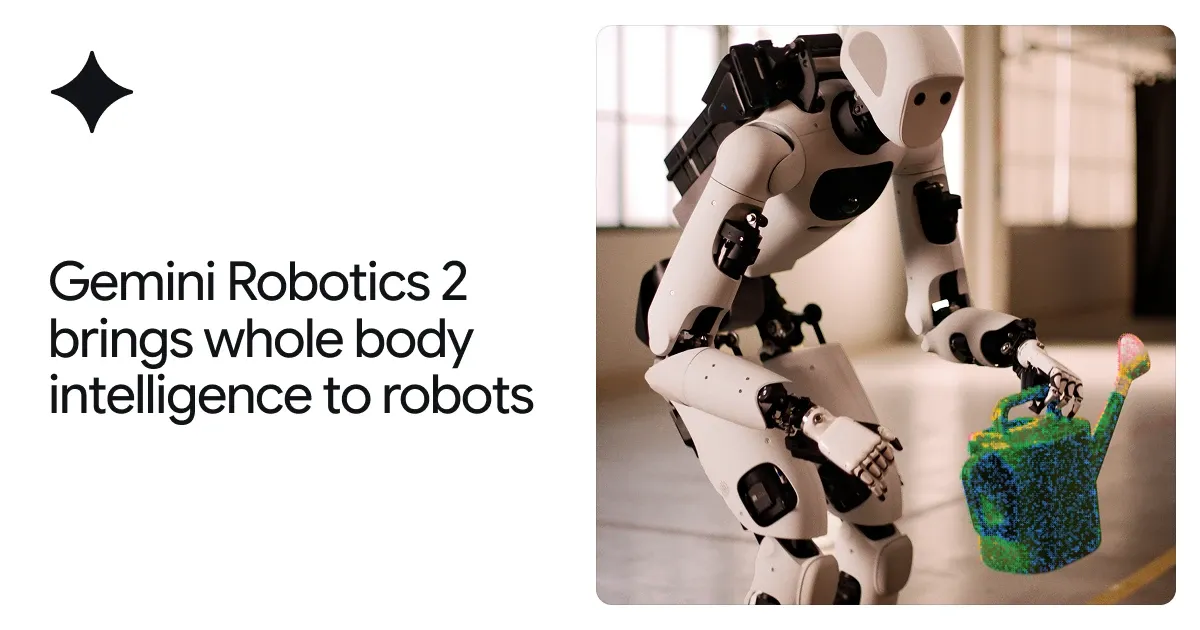
From feet to fingertips — we are teaching robots intelligent whole-body control, fine dexterity, and teamwork to complete a broad range of complex tasks.