World-Action Models (WAMs) build robot control on video-generation backbones, which jointly predict dense future visual trajectories and robot actions. We argue that video generation is an unnecessary intermediate objective for world-action modeling. For robotic manipulation, the goal of a world model is not to reproduce how the world looks at every intermediate moment, but to predict the state that the world will reach after an action is executed. The intermediate frames only describe the visual transition between physical states, which consumes substantial model capacity and computation, but do not directly specify the physical outcome that the robot action is intended to produce. In this paper, we propose DELE-w0.5, which infers robot actions from predicted future states without relying on video generation. Concretely, DELE-w0.5 infers the action sequence from its corresponding compact future latent state. The future latent state captures the action-relevant physical outcome of robot interaction and serves as an explicit bridge between world modeling and action generation. The core design principle of DELE-w0.5 is to model how the physical world changes under robot actions, rather than how its visual appearance evolves frame by frame. This formulation removes the high-dimensional visual redundancy introduced by dense video representations, and it therefore enables cheaper training and low-latency inference. Across 640 real-robot trials on four long-horizon manipulation tasks, our DELE-w0.5 achieves the best performance among all compared policies, attaining 62.5% overall full-task success and 81.3% macro ordered-stage progress. It outperforms the strongest baseline by 32.5 percentage points in full-task success and 20.1 percentage points in macro progress.
Fenghao Lei, Zhixiong Huang, Long Yang et al.· 0 citations
Learning-based separation assurance for small Unmanned Aircraft Systems (sUAS) achieves near-zero collision rates in simulation, but assumes accurate position and velocity information from Global Navigation Satellite Systems (GNSS). This assumption fails in urban environments, where multipath propagation, signal blockage, and intentional interference degrade navigation integrity. This raises a fundamental architectural question for deploying learned separation policies under GNSS degradation: should runtime safety mechanisms filter the policy's actions or its observations? This work evaluates both approaches for multi-agent sUAS separation under adversarial GNSS degradation. Both architectures first estimate a worst-case traffic state consistent with bounded observation uncertainty, then diverge: action filtering constrains policy outputs via discrete-time control barrier functions evaluated at the worst-case state, while observation filtering presents the worst-case state directly to the policy as corrected input. Experimental results show that action filtering provides negligible safety improvement, while observation filtering reduces near mid-air collisions by 90% and remains robust to the barrier function's tradeoff between separation distance and closing rate. These results suggest that, for policies with learned safety behaviors, preserving the policy's decision authority outperforms overriding its actions with hand-designed constraints.
Classical simultaneous localization and mapping (SLAM) estimates metric poses and a geometric map but does not provide an action-conditioned predictive state. Action-conditioned world models learn compact latent dynamics but ignore global metric consistency and accumulate drift under open-loop rollout. We introduce J-LAW (Joint Localization and Action-Conditioned World Modeling), a unified factor-graph formulation that connects metric pose variables, predictive latent states, and persistent latent landmarks in this letter.J-LAW represents each image as a compact predictive state and combines it with pose or motion measurements through a separately learned mapping. Its maximum a posteriori (MAP) factor graph enforces consistency between these complementary sources of information over time. Experiments on PushT and WildGS show that J-LAW's factor-graph representation can improve long-horizon latent consistency and recover more reliable predictive states under partial observations, forming a foundation for future integrated localization and planning systems.
We address robust separation assurance for small Unmanned Aircraft Systems (sUAS) under GPS degradation and spoofing via Multi-Agent Reinforcement Learning (MARL). In cooperative surveillance, each aircraft (or agent) broadcasts its GPS-derived position; when such position broadcasts are corrupted, the entire observed air traffic state becomes unreliable. We cast this state observation corruption as a zero-sum game between the agents and an adversary: with probability R, the adversary perturbs the observed state to maximally degrade each agent's safety performance. We derive a closed-form expression for this adversarial perturbation, bypassing the iterative inner optimization of adversarial training entirely and enabling linear-time evaluation in the state dimension. We show that this expression approximates the exact minimizer of the value function over the modeled uncertainty set with second-order accuracy. We further bound the safety performance gap between clean and corrupted observations, showing that it degrades at most linearly with the corruption probability under Kullback-Leibler regularization. Finally, we integrate the closed-form adversarial policy into a MARL policy gradient algorithm to obtain a robust counter-policy for the agents. In a high-density sUAS simulation, we observe near-zero collision rates under corruption levels up to 35%, outperforming a baseline policy trained without adversarial perturbations.
Alex Zongo, Filippos Fotiadis, Ufuk Topcu et al.· 0 citations
Reach audiences
Advertise in front of researchers, engineers, and readers.
Latent world models can learn representations that contain information needed for control, while the downstream controller may still rank candidate actions poorly when it relies on terminal latent distance alone. We study this failure in a fixed encoder and introduce trajectory reachability metrics (TRM), a small temporal pairwise cost trained from logged trajectories and used to rank predicted endpoints of a candidate action sequence against a goal. In the TwoRoom evaluation on 100 episodes from a high distance range, the original controller with LeWorldModel reaches 7.0% mean success. Temporal TRM trained after excluding all evaluation episodes reaches 96.7%, shuffled label controls stay at 0.0%, and TRM also improves PLDM from 32.7% to 84.0%. TopoNav, a separate pixel navigation task, shows the same link between repaired ranking and closed loop control. The selection audit with shared candidates (SASC) and rowspace interventions show that the gain comes from reweighting latent directions carrying the action decision. The XY rowspace contributes less than 1% of terminal latent MSE but carries most of the information needed for control. Coverage and boundary tests define the scope. Balanced doorway coverage restores a 0.0% coverage failure to 100.0% success, while an unseen wall orientation and contact rich PushT expose layout, dynamics, and recovery limits.
Liangyu Li, Shengzhi Wang, Libin Qiu et al.· 0 citations
Group Relative Policy Optimization (GRPO) remains the dominant critic-free approach for fine-tuning LLMs and VLMs, but its compatibility with constrained policy optimization (e.g. for safety-critical domains) has not been carefully examined. In this work, we introduce Constrained GRPO, a Lagrangian-based extension of GRPO for constrained policy optimization. We show that the standard practice of scalarizing rewards before normalization introduces a critical Lagrangian-specific failure mode: GRPO's within-group normalization makes constrained optimization highly sensitive to how multi-component learning signals are aggregated. We show that scalarizing rewards before normalization introduces shared-denominator coupling, so that changing one multiplier alters not only the emphasis on its corresponding constraint, but also the relative weighting of the reward and other constraints. We address this with a simple but crucial modification: scalarizing standardized advantages rather than rewards. This yields a better-conditioned update by addressing the coupling induced by reward scalarization, resulting in better-behaved multiplier dynamics and more stable constraint enforcement in practice. Empirically, across a controlled gridworld, a real-world autonomous driving benchmark, and a mathematical reasoning task, Constrained GRPO consistently achieves better adherence to specified constraints while maintaining or improving task performance.
Roger Girgis, Rodrigue de Schaetzen, Luke Rowe et al.· 0 citations
End-to-end autonomous driving models plan future trajectories from raw sensor input. While earlier driving benchmarks often measured deviation from the human trajectory, current benchmarks such as NAVSIM and Bench2Drive evaluate models with richer simulation-based metrics intended to capture safe and compliant driving. A high benchmark score should reflect that a model can understand the scene in front of it and act accordingly. But how much of that score specifically comes from reacting to the dynamic part of that scene? To probe this, we remove a model's camera input and replace it with memories from prior drives at the same location. The retrieved memories can provide persistent scene information, including road layout and location-conditioned regularities, but not the current traffic state. Surprisingly, memory is nearly sufficient on NAVSIM, reaching or even exceeding the performance of leading end-to-end methods without actually observing the evaluated scene. Our results suggest that a high NAVSIM score does not require a planner to react to the current traffic scene and should be treated with caution. This effect is benchmark-dependent: driving from memory causes substantially larger performance drops on Bench2Drive and RealEngine. We provide our code at https://github.com/boschresearch/MemoryDrivoR .
Christian Löwens, Thorben Funke, Alexandru Condurache· 0 citations
General embodied agents should perceive, predict, act, evaluate, and improve within a unified system. World models have shown great promise in building such agents, yet existing models typically append an action output head to a world simulator, without coupling them into a closed decision-and-learning loop for policy improvement. We present Motus2, a self-evolving general world model for dexterous manipulation. Motus2 advances world modeling through model scaling and data scaling. For model scaling, a single model with shared weights exposes three control interfaces: a policy (world-action model), a simulator (action-conditioned world model), and an evaluator (value model). The policy proposes candidate action chunks, the simulator predicts their visual consequences, and the evaluator assesses the predicted outcomes. Their coupling forms a closed decision-and-learning loop for policy improvement. This formulation uses curated expert demonstrations for action learning, while failed and suboptimal interactions provide valuable evidence for dynamics modeling and value learning. For data scaling, Motus2 progresses from large-scale monocular egocentric data to synchronized stereo egocentric data, followed by robot-domain adaptation with robot trajectories and supplementary human-robot alignment data. Motus2 further studies global-autoregressive and hybrid-memory extensions of its sliding-window context, adds tactile feedback for contact-aware control, and is instantiated on a fully biomimetic platform with stereo vision, dual arms, dual dexterous hands, and tactile sensing. Together, egocentric data scaling and closed-loop general world model scaling provide a general path toward self-evolving dexterous manipulation.
Hongzhe Bi, Zihao Zhou, Yihang Tang et al.· 0 citations
We present $\mathcal{N}_0$-Foundation, a paradigm for tactile-enabled embodied manipulation, which integrates tactile sensing hardware, large-scale multimodal data, tactile representation learning, and standardized evaluation. First, we engineer the infrastructure for scalable data collection, including a vision-based tactile sensor, a tactile Universal Manipulation Interface (UMI), and a synchronized visuo-tactile data collection system supporting both robot embodiments and UMI-based demonstrations. Leveraging this infrastructure, we construct NeoData, which contains more than 30000 hours of synchronized visual and tactile demonstrations, spanning six embodiments, 450 tasks, and billions of paired RGB and tactile frames collected through a mixture of real-robot teleoperation and UMI-based demonstrations. To facilitate open research, we further release OpenNeoData, a 5000-hour open-source subset of NeoData. The dataset addresses a central limitation of existing manipulation corpora, critical for deformable-object manipulation, precise assembly, delicate force control, and sustained surface interaction. Capitalizing on the large-scale, heterogeneous tactile measurements, we propose NeoForce, a visuo-tactile representation model that learn transferable tactile representations across different sensor designs. To enable systematic evaluation of tactile embodied models built upon our infrastructure, datasets and tactile representations, we further propose a comprehensive benchmark, which combines the real-world NeoReal suite and the simulated NeoSim suite for standardized evaluation. Experiments across both suites show that policies benefit from the physical contact state rather than from the device-specific appearance of the tactile signal. We release the dataset, the representation, and the benchmark, aiming at supporting future work on tactile-enabled embodied manipulation.
Vision-Language-Action (VLA) models, built upon Vision-Language Models (VLMs), have significantly enhanced robotic capabilities by leveraging internet-scale knowledge and multimodal reasoning. However, the intensive computational overhead of VLAs constrains on-device deployment, hindering real-time responses to environmental changes. While various acceleration techniques have been proposed, they often rely on fine-tuning or access to training datasets, which are frequently unavailable due to privacy and proprietary concerns. Moreover, although flow-matching-based VLAs have emerged as efficient alternatives to standard diffusion models, current acceleration efforts largely target VLM inference costs, failing to address the iterative ODE solving process inherent in flow matching inference. To address these limitations, we propose AdaVLA, an online, training-free adaptive framework for fast yet accurate flow-matching-based Vision-Language-Action models. We introduce a novel metric derived from the flow matching trajectory curvature to quantify action generation confidence during inference. This metric enables the dynamic reduction of inference steps and the adaptive adjustment of MLP pruning ratios through an efficiently computed importance evaluation, requiring no access to training data. Experimental results on the LIBERO benchmark using a Jetson AGX Orin device demonstrate that our method achieves $1.87\times$ and $2.24\times$ speedups for $\pi_{0.5}$ and X-VLA, respectively, with negligible degradation in success rates. Furthermore, we validate the robustness of our approach on real-world robotic tasks using SmolVLA.
Electroencephalography (EEG)-based robotic control is commonly formulated as a direct classification problem, in which electrical neural signals are mapped to a fixed set of discrete actions. However, the limited separability and high noise of EEG signals make it difficult to scale this approach to fine-grained robotic control spaces. We introduce Brain-Language-Action (BLA) models, a framework in which language conditions the interpretation of neural representations for robotic action generation. In a BLA, a small set of reliably distinguishable brain states can be dynamically associated with different actions through a language-defined control mapping, allowing a small number of neural classes to apply to a larger global action space. We develop a proof-of-concept BLA for drone control using motor-imagery EEG from the BCI Competition IV 2a dataset. The system is trained in two stages. First, we evaluate multiple candidate EEG encoder architectures using subject-specific four-class motor-imagery classification, converting 250Hz, 3.5-second, 22-channel EEG samples into five 128-dimensional brain-token embeddings. Second, these embeddings are projected into the embedding space of a pretrained large language model (LLM) and jointly fine-tuned with language instructions to autoregressively generate structured three-token drone actions. Across 840 possible language-defined mappings between four neural states and seven flight action combinations, the resulting BLA achieves 90% per-token accuracy during evaluation. These results provide an initial demonstration that language conditioning can expand the effective control range of EEG-based robotic interfaces without requiring a corresponding increase in the number of directly distinguishable neural states.
Autonomous vehicles (AVs) rely on accurate camera-LiDAR calibration for multimodal sensor fusion. In practice, calibration can drift due to vibration, temperature variation, or minor sensor displacement, motivating online calibration algorithms that detect and correct misalignment at runtime while allowing the vehicle to continue operating without a factory visit. Existing AV attacks largely assume correct calibration. We instead identify online sensor calibration as a new attack plane. A corrupted calibration update can persist across subsequent fusion operations, causing system-wide errors that propagate from perception to planning and control. We present Adversarial Calibration Attack (ACA), the first physical attack against camera-LiDAR online calibration. Using a single adversarial poster, ACA first spoofs the miscalibration detector to trigger the calibration process and then steers the calibration estimator toward an incorrect transformation. A unified optimization jointly designs the poster's geometry and texture for both objectives. We evaluate ACA across benchmark datasets, simulation, and physical experiments. On benchmark datasets such as KITTI and nuScenes, ACA induces up to 33.9 degrees mean rotational calibration error, thereby severely degrading object detection. In the CARLA simulator, the attack causes a collision when the corrupted calibration is accepted in vulnerable scenarios crafted by the attacker. On a real Husky robot, a printed adversarial poster successfully reproduces the calibration error. These results demonstrate that online calibration is a practical and safety-critical attack surface for AVs.
Liangkai Liu, Qingzhao Zhang, Kang G. Shin· 0 citations
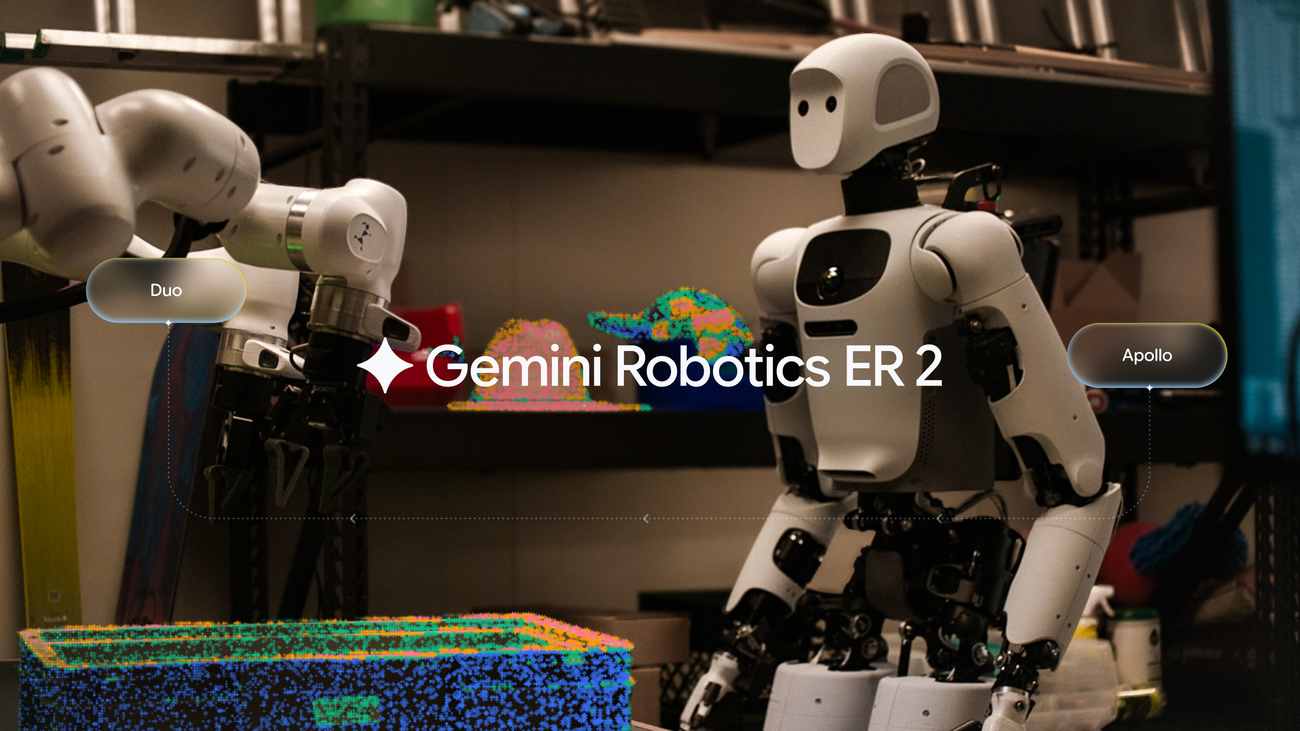
Gemini Robotics ER 2 helps robots reason, collaborate, and solve real-world tasks. It represents a step change in video understanding, tool orchestration, and multi-robot collaboration for robotic applications.
From feet to fingertips — we are teaching robots intelligent whole-body control, fine dexterity, and teamwork to complete a broad range of complex tasks.