Indoor 3D Scene Graphs (3DSGs) represent environments as multi-layer hierarchies that connect observed geometric primitives (e.g., planes) to higher-level metric-semantic concepts (e.g., rooms, floors, buildings), enabling incremental spatial reasoning for robotic perception and SLAM. However, classical high-level concept generation approaches rely on hand-crafted rules for specific concept classes, while learning-based methods require separate models for graph structure and spatial node features (e.g., centroids), which limits scalability to novel classes and more complex hierarchies. We propose a unified autoregressive diffusion-based graph generative model that jointly learns structure and features, constructing complete 3DSGs bottom-up from observed vertical planes across arbitrary hierarchy depths. Our method consistently surpasses all learning-based and random baselines across 3DSG datasets spanning synthetic scenes, real architectural floor plans, and robotic sensor data, with varying layout complexity and hierarchy depth, and surpasses a one-shot model with oracle access to the target graph size on the largest hierarchy and on real single-floor data. Finally, we propose an adaptation of the Fused Gromov--Wasserstein distance for principled graph-level evaluation of generated 3DSGs against ground truth.
J. A. Millan-Romera, Samuel Cognolato, Holger Voos et al.· 0 citations
Online learning-based control is a promising approach to control uncertain systems, where unknown components are identified during operation to improve control performance. However, resource-intensive online learning algorithms introduce non-negligible computational delays, especially when executed on systems with limited local computational resources. To mitigate this, an in-network online learning-based control structure is employed by deploying the learning-based controller on a remote computation node and connecting it via a communication channel. In this paper, control performance guarantee is first established by deriving tracking error bound for the in-network control architecture, while accounting for computational delays. The derived tracking error bound allows for diverse communication and computation strategies under a specific condition, including time-/event-triggered mechanisms. Additionally, the trade-off between communication and computation performances is shown for a given desired control performance. Furthermore, to enhance the efficiency in both communication and computation, an efficient control framework with an asynchronous event-triggered mechanism in both control and online learning is devised under the existence of computational delay. The proposed event-triggered strategy is proven to achieve the same control performance as time-triggered scenario while excluding Zeno behavior. Finally, we derive an explicit expression of the proposed event-trigger condition for exponentially stabilizable systems, and demonstrate its effectiveness through simulations.
Xiaobing Dai, Armin Lederer, Zewen Yang et al.· 0 citations
Ensuring the safe operation of multi-agent systems (MASs) under uncertain environments is crucial for cooperative robotic, where external disturbances and inaccurate dynamic models can significantly compromise performance and reliability. To address this challenge, calibrated machine learning models, particularly Gaussian process (GP) regression, are extensively employed due to their interpretable performance quantification. As the interconnected communication of MASs facilitates cooperative learning, agents are able to enhance learning performance by exchanging local GP inferences with their neighbors and aggregating the received information via distributed GP strategies. However, variations in computational power and prediction tasks among agents inevitably lead to heterogeneous computational delays and differences in query points, which are often overlooked in existing aggregation methods. To overcome these limitations, this work proposes an asynchronous cooperative learning strategy that explicitly accounts for prediction accuracy, query point variations and delay effects. Additionally, a distributed control law based on an adjoint MAS is developed to ensure the desired control performance. Simulations on unmanned surface vehicles validate the effectiveness of the proposed approach, demonstrating substantial improvements in both learning and control performance compared to the state-of-the-art approaches.
Recent machine learning research has increasingly focused on equilibrium analysis in non-cooperative games rather than solely on optimal solutions. Many such problems involve shared constraints and can be formulated as Generalized Nash Equilibrium Problems (GNEPs). For strongly monotone games, existing methods compute consensus-based variational GNEs (v-GNEs) by exchanging Lagrange multipliers. We propose a fully distributed continuous-time algorithm for shared linear equality constraints that converges without multiplier exchange and reaches any GNE, reducing communication overhead and improving privacy. Discrete-time schemes are also provided, and the method is validated on a multi-robot placement task.
Offline goal-conditioned reinforcement learning (GCRL) aims to learn policies for reaching diverse goals entirely from fixed trajectory data. Long-horizon offline GCRL remains challenging because sparse goal-reaching signals must be propagated over many steps, while execution errors cannot be corrected through additional environment interaction. Existing methods address these challenges by improving long-range value estimation or reducing the effective decision horizon through subgoals, options, and action chunks. In several hierarchical methods, however, a selected subgoal specifies where to go, while the intervening state-space path remains implicit in an endpoint-conditioned low-level policy. To address this interface, we propose PathBridger, a hierarchical offline GCRL method that explicitly connects subgoal selection to short-horizon execution. PathBridger constructs a state-space bridge toward the selected intermediate endpoint and decodes it into a short executable action chunk using an inverse dynamics model. Experiments across the evaluated OGBench tasks demonstrate strong aggregate performance, with particularly large gains on the multi-object Cube manipulation tasks. Code: https://github.com/SChoish/PathBridger
This work presents FleetScape, a Mixed Reality (MR) sandtable system that externalizes layered real-time mission, safety, and environmental data while enabling fluid transitions between manual intervention and autonomous supervision and shows that FleetScape supports situational awareness through layered spatial representations and clarifies control mode transitions.
Peisen Xu, Jérémie Garcia, Peter Cleveland et al.· 0 citations
The ethics of human-robot interaction (HRI) have been discussed extensively based on three traditional frameworks: deontology, consequentialism, and virtue ethics. We conducted a mixed within/between experiment to investigate Sparrow's proposed ethical asymmetry hypothesis in human treatment of robots. The moral permissibility of action (MPA) was manipulated as a subject grouping variable, and virtue type (prudence, justice, courage, and temperance) was controlled as a within-subjects factor. We tested moral stimuli using an online questionnaire with Perceived Moral Permissibility of Action (PMPA) and Perceived Virtue Scores (PVS) as response measures. The PVS measure was based on an adaptation of the established Questionnaire on Cardinal Virtues (QCV), while the PMPA was based on Malle et al. [39] work. We found that the MPA significantly influenced the PMPA and perceived virtue scores. The best-fitting model to describe the relationship between PMPA and PVS was cubic, which is symmetrical in nature. Our study did not confirm Sparrow's asymmetry hypothesis. The adaptation of the QCV is expected to have utility for future studies, pending additional psychometric property assessments.
Minyi Wang, Christoph Bartneck, Michael-John Turp et al.· 0 citations
The results clearly demonstrate that FlowCorrect learns from very few demonstrations and enables fast, sample-efficient, incremental, human-in-the-loop corrections of generative visuomotor policies at deployment time in real-world robotics.
Edgar Welte, Yitian Shi, R. Wolf et al.· arXiv.org· 4 citations
Creating symbolic operators by hand is one of the main bottlenecks in deploying Task and Motion Planning systems (TAMP). Recent works show that these operators can instead be learned directly from demonstration data. Existing methods, however, typically learn each action in isolation and cannot capture the recurring multi-step structure of manipulation tasks, so the search becomes intractable on long sequential tasks. A further inefficiency arises in the symbolic state: every provided predicate is evaluated at every search node, even when it never appears in any learned operator. We present a system that addresses both problems together. Its central component is the automatic generation of macro-operators, composite actions that compress a recurring sequence of individual actions into a single planning step. Our system discovers causally linked action pairs directly from the training data, where one action produces exactly the condition that the next one requires, and turns each pair into a new operator. Alongside this, our system prunes every predicate that no learned operator references, which shrinks the symbolic state evaluated at each search node. Together, these changes shorten the effective planning horizon, and the benefit they bring grows with the length of the task. Across four TAMP domains, our method reaches up to a 4.6x planning speedup compared to the baseline method, namely Learning Operators for TAMP. More importantly, it solves a long sequential task that the baseline cannot solve. Macro-operator discovery thus not only accelerates planning but, in certain domains, determines solvability in practice.
LLMs generate fluent plans for robots but routinely violate the syntactic and se8mantic constraints they must satisfy to execute, and existing remedies trade formal guarantees against plan quality: soft methods (affordance scoring, grounded decoding) give no guarantee, while symbolic planners (LLM+P) discard the LM's commonsense. We propose \textbf{Meta-Ctrl}, a constrained-decoding framework that guarantees the encoded constraints while preserving the base LM's plan quality. Meta-Ctrl introduces \emph{meta-tokens}---a compact vocabulary of grounded actions---enforcing syntax at the token level and semantics (preconditions, goals, ordering) at the action level, an exact factorization that cuts the memory of constrained decoding from over 107TB to under 2GB. With it, a small open-weight LM becomes competitive where it otherwise sits at the bottom of the leaderboard: on WAH-NL under the LoTa-Bench protocol it reaches the highest reported subgoal success rate, exceeding GPT-4's, with consistent gains across the Embodied Agent Interface. We further demonstrate it on a real tabletop robot, where every generated plan satisfies its preconditions and goals by construction. Project website: https://metactrlg.github.io
Gwen Yidou-Weng, Edward Sun, Tianyi Ma et al.· 0 citations
The benefits of integrating prior bias when considering locomotion tasks with simple hinge actuators are demonstrated and a Parameter Impact metric is introduced which showcases diminishing returns for MLPs but not for CPGs.
Kevin Godin-Dubois, Anil Yaman, Anna V. Kononova· arXiv.org· 0 citations
Experiments on simulated and real-world benchmarks demonstrate that SCALE improves state-of-the-art VLAs and outperforms existing TTS methods while maintaining single-pass efficiency.
Hyeonbeom Choi, Daechul Ahn, Youhan Lee et al.· arXiv.org· 3 citations
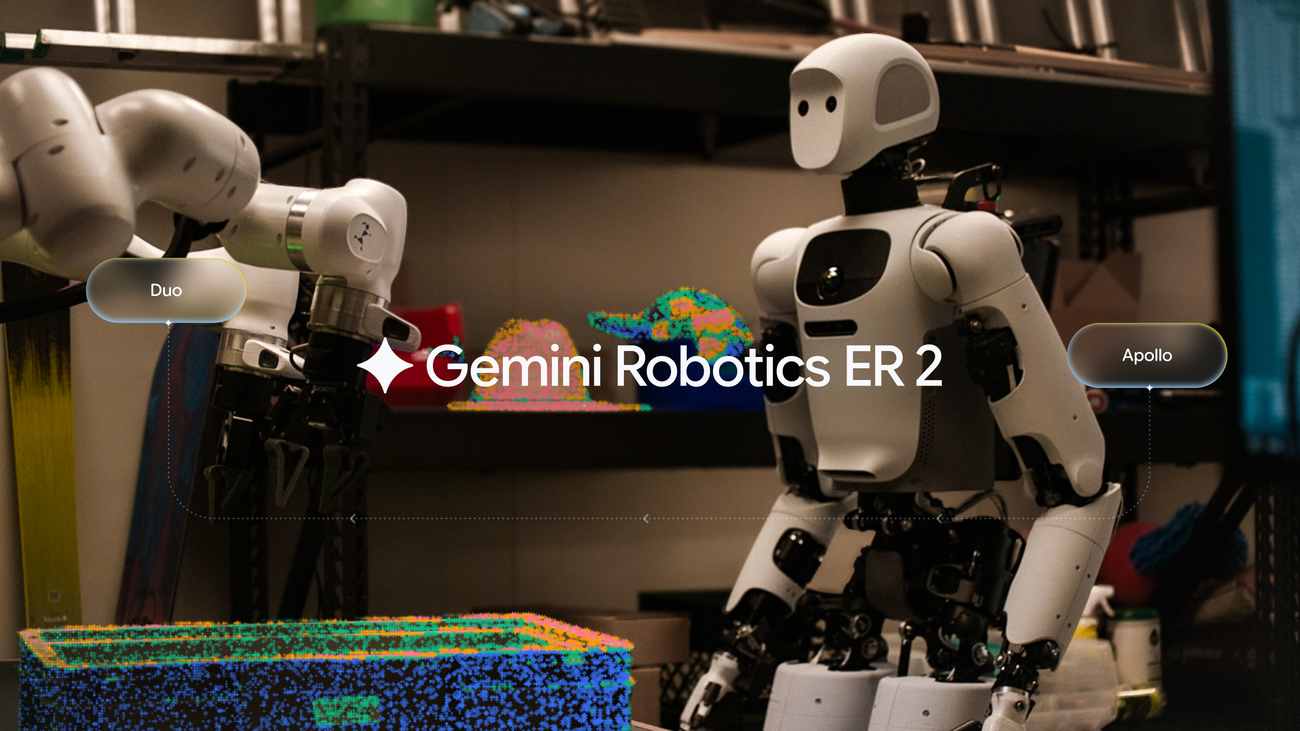
Gemini Robotics ER 2 helps robots reason, collaborate, and solve real-world tasks. It represents a step change in video understanding, tool orchestration, and multi-robot collaboration for robotic applications.
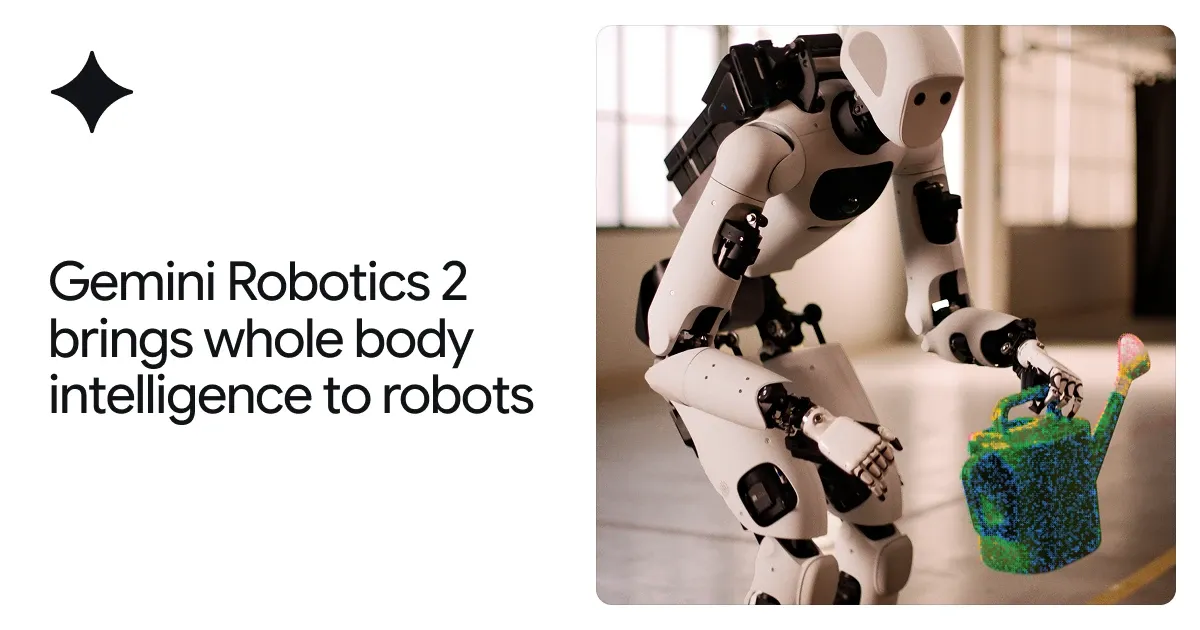
From feet to fingertips — we are teaching robots intelligent whole-body control, fine dexterity, and teamwork to complete a broad range of complex tasks.