OceanGym is introduced, the first comprehensive benchmark for ocean underwater embodied agents, designed to advance AI in one of the most demanding real-world environments, and reveals substantial gaps between state-of-the-art MLLM-driven agents and human experts.
Yida Xue, Mingjun Mao, Xiangyuan Ru et al.· 0 citations
This survey reviews representative Transformer-based autonomous driving models and organizes them by task role, sensing configuration, and architectural design and analyzes how efficiency constraints reshaping model design choices in practice affects deployability, robustness, and safety.
Tendon-driven hands are anthropomorphic, and moving the actuators off the joints is what makes a hand of this capability affordable to build. Two effects produce that saving. Routing force through a cable removes the requirement that a motor fit inside the joint it drives, so smaller and cheaper motors suffice, and one motor can drive several joints through a single cable, so fewer motors are needed. They are also harder to learn on than a direct-drive hand. The underactuated transmission that produces the saving is itself difficult to represent in a simulator, and the joints one cable drives are not independently commandable. We present Aero Hand Open, a tendon-driven anthropomorphic hand that is released simulation-ready. Three things ship with it. A simulation model reproduces the cable transmission itself. An identified actuation map connects that model to the motor commands in both directions, including the three-way coupling of the thumb. A reinforcement learning package trains policies for the hand. Together they let a policy be trained entirely in simulation and run on the hand with no fine-tuning and no state estimation. We release the mechanical design, the simulation model, the identified mapping, the training environment and the deployment stack.
Nan Wang, Mohit Yadav, Jonathan Wulff et al.· 0 citations
Industrial panel operation is knowledge-intensive and safety-critical. Beyond control recognition and action generation, execution must satisfy constraints in operation manuals and safety regulations. While foundation-model-based planners show strong semantic capability, they typically lack computable, localizable, and reproducible mechanisms for violation detection and repair. To address this, we propose PanelShield, a verifiable closed-loop safety planning framework for manual-guided industrial panel operation. The framework generates parameterized action primitive sequences from task-relevant manual evidence and applies dual formal verification with LTL and a Safety FSM to enforce cross-step temporal correctness and local transition legality. When violations occur, it outputs a structured counterexample with the earliest violating step and cause, enabling targeted repair and re-verification. We build a multi-level long-horizon planning benchmark covering three representative industrial device panels, and evaluate the framework in simulation and real-world robotic experiments. Results show that PanelShield improves complex safety-constrained task performance over foundation-model-only planning baselines while reducing the violation rate to 2.7%, with 4.1 s total latency. Real-world experiments demonstrate end-toend feasibility. Overall, PanelShield offers a verifiable approach to robotic panel operation that balances flexibility, safety, and auditability.
Gui-Peng Xin, Jia-He Xu, Chenhui Wan et al.· 0 citations
Reach audiences
Advertise in front of researchers, engineers, and readers.
Robotic industrial panel operation requires not only accurate control localization but also compliance with operating procedures, safety rules, and device-state constraints distributed across heterogeneous manuals. This study presents MaCoPlanner, a task-planning framework built on knowledge compiled from equipment manuals that converts equipment manuals into a typed intermediate representation, retrieves task- and state-relevant evidence, and uses it to support plan generation. Before actuation, candidate plans are symbolically rolled out and checked against procedural and state-transition constraints; detected violations are localized and returned for targeted repair, while unresolved plans are rejected. A separate execution interface grounds verified symbolic actions to physical controls and updates the device state. Under an independent evaluation oracle, MaCoPlanner achieves a final violation rate of 2.7%, and 26.3% of the runs in the repair analysis are rejected after exhausting the refinement budget. Compared with Raw-Manual, task success increases from 62.8% to 84.4% on Level-2 tasks and from 25.9% to 43.2% on Level-3 tasks. Experiments on a controller-panel simulator without an attached industrial load further demonstrate integrated execution feasibility under representative interaction conditions, without claiming industrial deployment readiness.
Gui-Peng Xin, Jiahe Xua, Mohammad Deghat et al.· 0 citations
A real-time semantic navigation framework for Unmanned Aerial Vehicles (UAVs) focused on improving time efficiency in the Object Goal Navigation (ObjectNav) task, using a Large Language Model that interprets user-provided natural language instructions and performs semantic reasoning over detected objects and spatial context to prioritize high-probability search regions.
Marin Maletic, Marijana Peti, T. Petrović et al.· European Conference on Mobil...· 3 citations
This work presents a training-free suction grasping system for sorting deformed aseptic beverage cartons, decoupling target identification from grasp-point selection, and compares three geometric methods: k-nearest-neighbour PCA, Sobel cross-product, and RANSAC plane fitting.
Cardiovascular risk prediction remains limited by incomplete clinical data and imaging biomarkers that reduce computed tomography (CT) to a small number of handcrafted features. We developed CARDINAL (Cardiovascular Assessment via Representation learning from Deep Imaging with Nested Anatomical Latent embeddings), a clinically grounded framework that learns compact representations from routine non-contrast cardiac CT for major adverse cardiovascular event (MACE) prediction. In 17,659 patients, CARDINAL was evaluated for 1-, 3-, 5-, and 10-year MACE prediction against American Heart Association (AHA) pooled cohort equations (PCE), AHA predicting risk of cardiovascular disease events (PREVENT), coronary artery calcium (CAC), segmentation-derived CT biomarkers, and 70-feature structural radiomics. Gains were largest at longer horizons. At 10 years, CARDINAL (joint) achieved an area under the receiver operating characteristic curve (AUROC) of 0.866 $\pm$ 0.020 and an area under the precision-recall curve (AUPRC) of 0.890 $\pm$ 0.015, compared with an AUROC of 0.826 $\pm$ 0.023 and an AUPRC of 0.826 $\pm$ 0.022 for structural radiomics, the strongest baseline. CARDINAL also achieved the highest survival concordance index (C-index), 0.753 $\pm$ 0.015, and high-versus-low risk-tertile hazard ratio, 10.78 $\pm$ 3.16, with favorable reclassification and exploratory calibration. These findings suggest that non-contrast cardiac CT contains prognostic information beyond conventional risk equations, CAC scoring, and engineered imaging biomarkers.
Roy Gabriel, Nattakorn Kittisut, Jamshid Hassanpour et al.· 0 citations
Vision-language-action models (VLAs) have shown strong promise for general-purpose robotic manipulation by mapping language instructions and vision observations directly to actions. However, most VLAs primarily condition action prediction on current observations and lack an explicit mechanism for reasoning over future task dynamics, which is particularly important for fine-grained, contact-rich manipulation. We present PHR-VLA, a framework that enables planning-horizon reasoning in VLAs through privileged latent representations of future dynamics. PHR-VLA introduces a lightweight auxiliary future head that, during training, aligns the VLA's internal representations with latent dynamics extracted from future observations. Evaluation results demonstrate that local, contact-centric, patch-level latent dynamics supervision from the wrist camera improves success rate on LIBERO from 84.1% to 88.4% and on real-world disassembly tasks from 63.3% to 82.5%. Patch-level supervision from a third-person camera also improves performance on Meta-World from 56.70% to 57.8%. These results demonstrate that privileged latent dynamics alignment provides an effective training signal for improving anticipatory reasoning in VLA policies. Project website: \href{https://davoodsz.github.io/PHR-VLA.github.io/}{https://davoodsz.github.io/PHR-VLA.github.io/}
Davood Soleymanzadeh, Kai-Di Zhang, Zhiyuan Zhang et al.· 0 citations
We investigate whether automatic speech recognition (ASR) errors in user input can lead to unsafe outputs from Embodied AI (EAI) models. We find that ASR errors can lead to harmful instructions being accepted and executed by EAI models, thereby reducing safety. We simulate ASR errors and combine them with existing safety benchmarks (SafeAgentBench and POEX) to evaluate how different errors affect embodied AI safety. We find that some of them preserve semantic structure but increase harmful ambiguity, while others weaken the model refusal behaviour and allow unsafe plans to be generated and executed. We show that in some cases automatic correction of ASR errors can reduce the risk, but this is not always effective. Overall, we show that ASR errors lead to significant safety risks for embodied AI.
The results show that explicit particle dynamics are a promising low-dimensional interface for robot video prediction, while robust language grounding and appearance delivery remain the principal open challenges.
The overall results show that editable, consolidated memory can supply remembered context for robot planning, and full MEMORA--combining editing, typed stores, and consolidation--achieves the strongest aggregate results among the evaluated memory conditions.
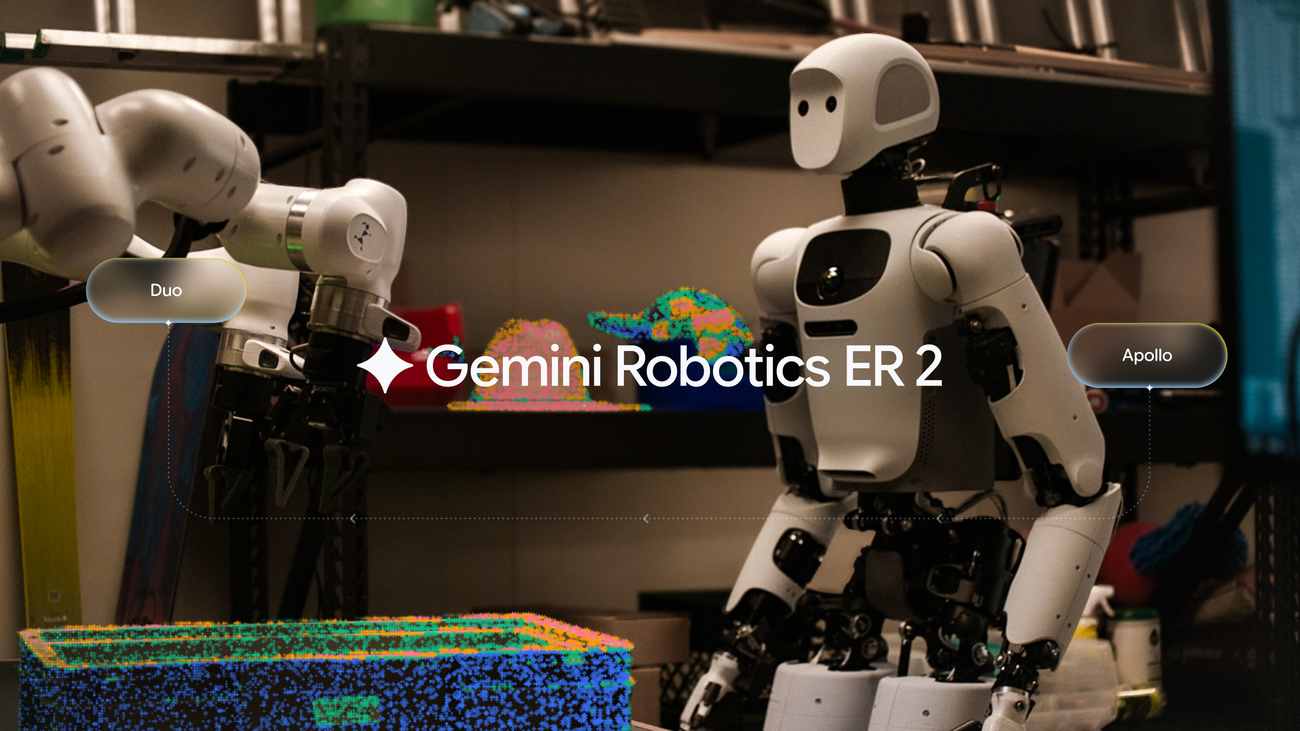
Gemini Robotics ER 2 helps robots reason, collaborate, and solve real-world tasks. It represents a step change in video understanding, tool orchestration, and multi-robot collaboration for robotic applications.
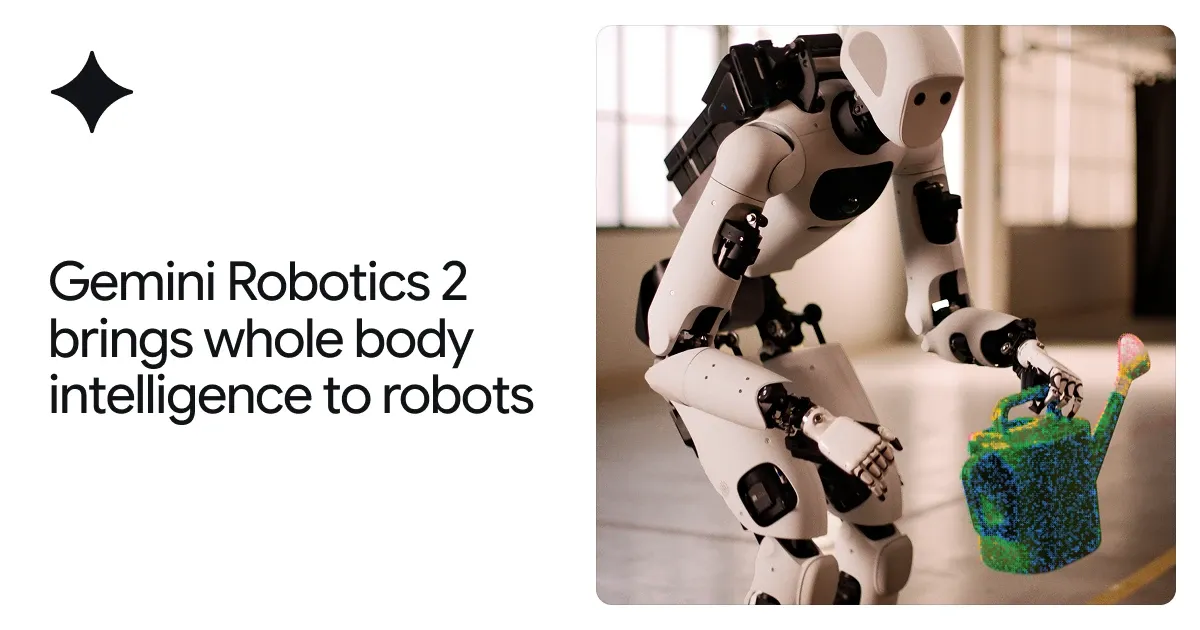
From feet to fingertips — we are teaching robots intelligent whole-body control, fine dexterity, and teamwork to complete a broad range of complex tasks.