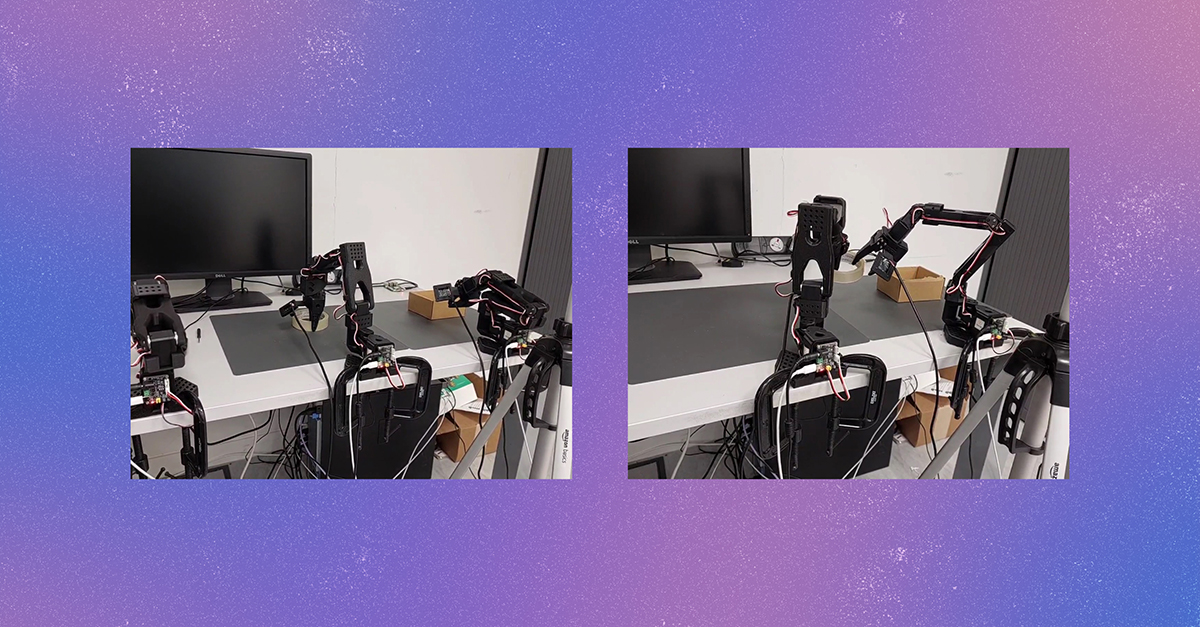
Enabling humanoid robots to perform agile and adaptive interactions has long been a core challenge in robotics. Current approaches are bottlenecked by either the scarcity of realistic interaction data or the need for meticulous, task-specific reward engineering, which limits their scalability. To narrow this gap, we pr...
Yinhuai Wang, Qihan Zhao, Yuen Fui Lau et al.· 0 citations
Generalist robot policies are trained with imitation learning and are bounded by the quality and coverage of their demonstrations. Reinforcement learning can improve and extend them, either by fine-tuning the policy weights or by training a small module to steer the input noise of a frozen generative policy. When tasks...
Bahey Tharwat, Iman Nematollahi, Marvin Alles et al.· 0 citations
SmolWAM is presented, a latent WAM that is derived from the 2B-parameter Cosmos Policy by keeping its pretrained trunk and rebuilding its inference interface: single-frame visual latents, cached text features that preserve the trunk's attention sinks, and 1,008 tokens from which actions and future visual latents are re...
Timi Owolabi, Hikmah Olawore, Frances Adelakun et al.· 0 citations
Vision-language-action (VLA) policies issue sparse targets whose arrival at the robot controller is delayed and irregular, so a reasonable predicted action can still produce abrupt motion near people. Remedies are evaluated on different streams, delays and metrics. JitterVLA replays identical commands and arrival trace...
Faith Ogunwoye, Didar Seyidov, Konstantin Gubernatorov et al.· 0 citations
Reach audiences
Advertise in front of researchers, engineers, and readers.
Pre-trained robot policies, such as Vision-Language-Action (VLA) models, provide a strong foundation for generalist robotic manipulation, but adapting them to new tasks with only a few demonstrations remains challenging. Directly fine-tuning a pre-trained policy often achieves strong in-distribution performance, yet it...
Xuhui Kang, Sung-Wook Lee, Yan Zhuang et al.· 0 citations
Modeling human reactions to spatial audio requires understanding both what is heard and where it comes from. Prior work generates motion offline from complete acoustic and spatial input sequences. Humans, however, react to sounds without knowing what they will hear next. We present Sonic-AMG, to our knowledge the first...
Autonomous landing of unmanned aerial vehicle (UAV) on unmanned surface vehicle (USV) is difficult in high sea states. Existing hierarchical landing methods often infer future USV motion only implicitly from short observation histories, which limits their ability to adapt to severe and rapidly changing sea conditions....
Stereo vision is increasingly used for robotic manipulation, with a growing body of work incorporating it into Vision-Language-Action (VLA) models. However, the scarcity of large-scale, real-world stereo datasets remains a fundamental bottleneck for scaling such policies. Recent generative monocular-to-stereo methods t...
Jason Chen, I-Chun Arthur Liu, Gaurav Sukhatme et al.· 0 citations
Embodied coding agents construct robot policies from natural-language instructions by generating executable programs and refining them from execution feedback. This refinement assumes that execution feedback reveals whether the task succeeded and, after a failure, provides sufficient evidence to guide program revision....
Jaewoo Lee, Jeongyeon Seo, Sihyun Cho et al.· 0 citations
Anticipation of vessel trajectories is an essential task when navigating at sea. This applies to both human navigators and autonomous surface vessels. Trajectory forecasting enables sub-routines such as collision avoidance to assess the situation and react accordingly in time. This paper investigates Transformer and Pe...
In maximum entropy and behavior-constrained reinforcement learning (RL), the optimal policy is given by a Boltzmann distribution. Generating samples from this distribution can be challenging, as it is often complex and multimodal. While flow policies trained with flow matching provide a powerful framework for represent...
Denis Blessing, Onur Celik, Gerhard Neumann· 0 citations
Robots deployed in realistic settings will accumulate experience across many sessions and tasks over their deployment. The robot's tasks may often require it to remember information from multiple sessions ago, making long-context robot memory important for real-world deployments. However, most robot-memory benchmarks t...
A new system identifies and corrects unreliable object descriptions stored in a robot’s memory, improving the robot’s ability to interact with its environment.
Robots are getting smarter, but how can their hardware match that growth? New Microsoft Research findings show that moving AI inference beyond the robot can improve task success, boost efficiency, and support more advanced physical AI workloads. The post Offloaded inference for real-world physical AI robotics appeared first on Microsoft Research.