Skip to content

Granularity-Adaptive Credit Assignment for Long-Horizon LLM Agent Reinforcement Learning

Sep 2026 · 1 citation · 26 references
Computer Science

TL;DR

It is argued that the right resolution is state-dependent, and GACA, a critic-free estimator whose granularity follows an uncertainty-based criticality proxy is proposed, improves task success over GRPO and GiGPO at both 1.5B and 7B scales.

Abstract

Reinforcement learning is now the standard way to train large language model agents on long-horizon tasks, where dozens of interdependent actions precede a single sparse reward. Critic-free, group-relative methods such as GRPO suit this regime, but they broadcast one trajectory-level scalar to every step and cannot say which decision drove the outcome. GiGPO recovers a step-level signal by grouping time steps that share an anchor state, yet it merges the step- and episode-level estimates under one fixed weight, spending the same resolution on a pivotal branching decision as on a routine, near-deterministic transition. We argue that the right resolution is state-dependent, and propose GACA, a critic-free estimator whose granularity follows an uncertainty-based criticality proxy. GACA scores every step by the negative log-likelihood its own rollout already records, then blends the two advantages with a per-step weight that grows with that score, so the gradient places more weight on the fine-grained signal at above-average NLL and on the episode-level signal below it. We derive an exact risk decomposition for the implemented mixture and show that sufficiently small modulation improves on fixed mixing under positive directional alignment. A separate conditional result bounds local action-value variation using expected NLL, while an error-projection analysis characterizes when mixing adds value beyond scalar uncertainty reweighting. On ALFWorld and WebShop, GACA improves task success over GRPO and GiGPO at both 1.5B and 7B scales.

View source

Similar papers

#artificial intelligence Preprint Sep 2026

SHARPO: Segment-Level Credit Assignment for Agentic Reinforcement Learning

Agentic reinforcement learning (RL) trains a large language model (LLM) to act over long, multi-step interactions. However, a single localized error can cause task failure, while trajectory-level rewards provide limited guidance for assigning credit to individual decisions. To address this limitation, we introduce Segm...

Xin-Chen Du, Zheng-Ze Zhou, Wen-Hui Zhu et al. · 0 citations
Preprint Aug 2026

AgentOPSD: Recursive Self-Distillation for Agentic Reinforcement Learning

This work proposes AgentOPSD, a critic-free, recursive method for turn-level credit assignment in agentic reinforcement learning that aggregates token-level teacher-student log-probability gaps into turn-level evidence and recursively updates a Bayesian belief state in log-odds space.

Zi-Han Wang, Zhengxi Lu, Zhiyuan Yao et al. · 7 citations · ⚡1
#artificial intelligence Preprint Sep 2026

Back to the Definition: Estimating Step-Level Advantages via Trajectory Graphs for Agentic Reinforcement Learning

A Graph-based Faithful sTep-level credit-assignment framework (GRAFT) that grafts all rollout trajectories into a trajectory graph, recovering node state-values via Bellman iteration on the graph, and assigning credit to each edge by the node value difference is proposed.

Xin-Cheng Yao, Haobo Fu, Wei-Ming Liu et al. · 0 citations
#machine learning Preprint Sep 2026

GraphHCA: Closed-Form Hindsight Credit Assignment for Long-Horizon LLM Agents

Group-based reinforcement learning (RL) has advanced large language models (LLMs) and is increasingly extending to agentic tasks, where sparse terminal rewards make step-level credit assignment essential. Existing methods assign credit from what follows an action in sampled rollouts, but do not explicitly capture its r...

Hao-Dong Zhu, Yang-Yang Ren, Chang-Bai Li et al. · 0 citations
#artificial intelligence Preprint Oct 2026

Learning Multiple Timescales for Goal-Conditioned Reinforcement Learning

Existing approaches to offline goal-conditioned reinforcement learning (GCRL) struggle with long-horizon tasks. Discounting shrinks value differences between distant states until they fall below the function approximation error, leaving the agent with no signal for ranking states. Temporal abstraction, which treats k e...

P. Dutenhefner, Dikshant Shehmar, Wagner Meira et al. · 0 citations

Related blog posts

GPT-Lab Sep 3, 2026

Adaptive AI Agents in Construction Workflows

Adaptive AI agents can help make BIM data more machine-readable by navigating IFC models, interpreting inconsistent information, and mapping it to defined standards. In this blog, Alok Rawat shares findings from a real-world pilot in construction workflows. The post Adaptive AI Agents in Construction Workflows appeared first on GPT-Lab.

GPT-Lab Aug 28, 2026

We built an AI factory for HVAC control

What does it take to trust AI-driven HVAC optimization? Our AI Model Factory combines agents, machine learning, reinforcement learning and deterministic checks in a governed workflow designed for messy, real-world building data. The post We built an AI factory for HVAC control appeared first on GPT-Lab.

Microsoft Research Blog Jul 30, 2026

EvoLib: Turning experience into evolving knowledge

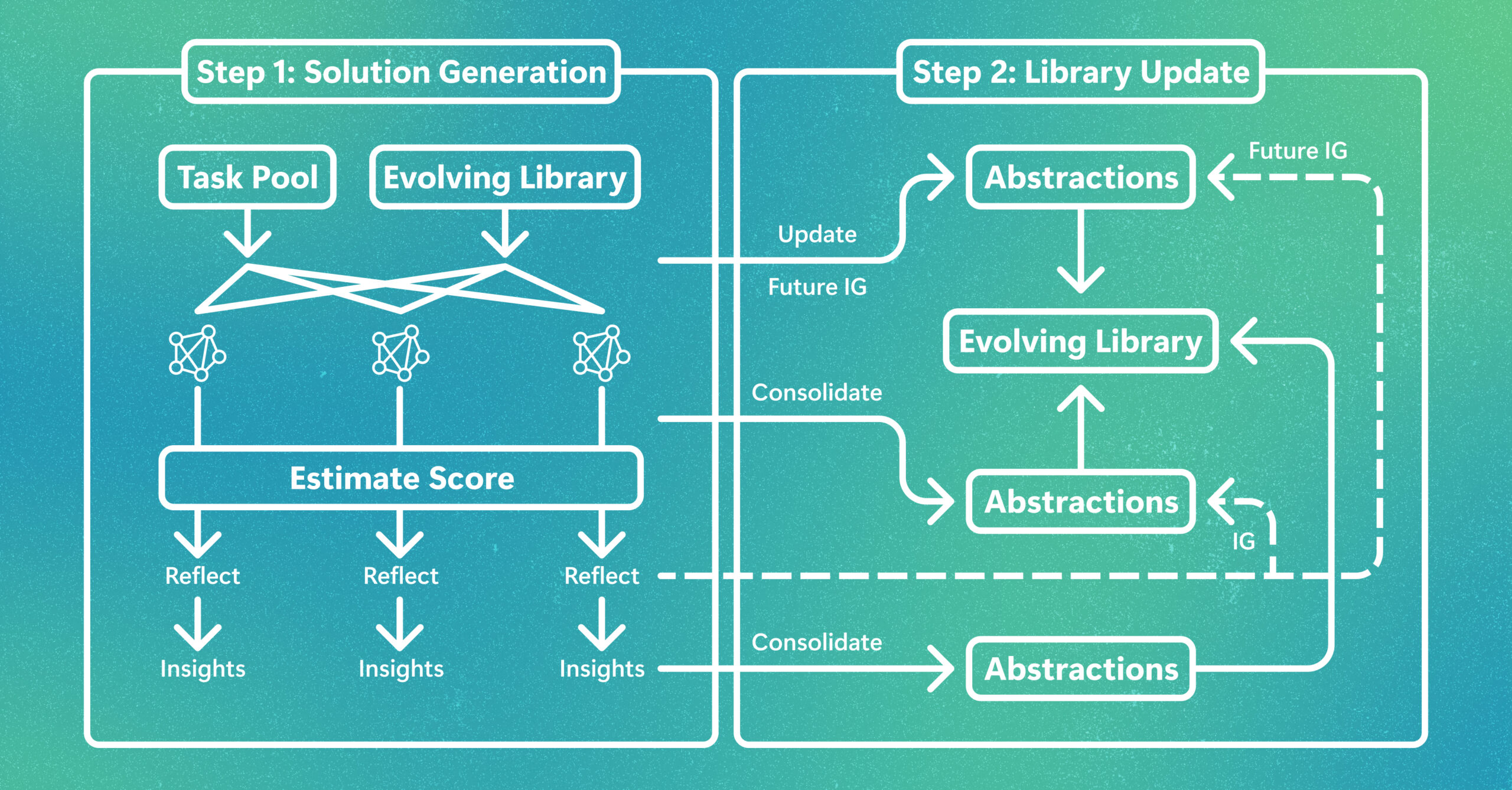
LLMs do not get smarter just by remembering more. EvoLib turns experience into evolving knowledge, taking reusable skills and insights that help models learn and adapt across tasks long after deployment. The post EvoLib: Turning experience into evolving knowledge appeared first on Microsoft Research.

We use cookies to run the site and, with your consent, for analytics and to show ads. See our Cookie Policy.