Skip to content

Do Tabular Foundation Models Still Need Feature Engineering?

Aug 2026 · 0 citations · 22 references
Computer Science

TL;DR

A controlled study across several versions of two major TFM families finds a consistent pattern: feature engineering gains are concentrated in earlier model generations and become negligible for the strongest models, suggesting that stronger TFMs depend less on explicitly engineered input representations.

Abstract

Feature engineering has long been a cornerstone of tabular machine learning. Tabular foundation models (TFMs) are pretrained on a wide range of tabular datasets and applied via in-context learning. Their rise raises a natural question: does manual feature construction still matter as these models become more capable? To answer this, we perform a controlled study across several versions of two major TFM families, testing a wide range of existing feature engineering techniques on benchmark datasets from TabArena. We find a consistent pattern: feature engineering gains are concentrated in earlier model generations and become negligible for the strongest models. These results suggest that stronger TFMs depend less on explicitly engineered input representations. In a complementary experiment, however, adding in-context information from related datasets still improves performance. Our findings indicate a shift in the source of performance gains for stronger TFMs: re-representing existing inputs becomes less effective, while providing additional task-relevant context remains beneficial.

View source

Similar papers

Architecture Alignment With Sparse Priors in Tabular Foundation Models

Together, these results support architecture-prior alignment: preserving an addressable feature axis provides an inductive bias for task-adaptive relevance inference for task-adaptive relevance inference.

Tian-Qi Zhao, Tian-Yi Zhuang, Shuo Duan et al. · 0 citations
#machine learning Preprint Oct 2026

RelICL: Training-free Relational Learning with Tabular Foundation Models

Tabular foundation models achieve state-of-the-art performance on single-table tasks without any training. Recent work suggests that they are also well-suited for relational learning via deep feature synthesis (DFS), which flattens a relational schema into a single table by adding aggregates of the other tables'columns...

Simon Forbat, Rainer Gemulla · 0 citations
#artificial intelligence Preprint Sep 2026

From Synthetic Priors to Model Behavior: Structural Coverage in Tabular Foundation Models

This work recovers or reconstructs the synthetic data generators of four TFMs and compares their generated tasks with datasets from two widely used tabular benchmarks, finding substantial differences across synthetic pretraining priors.

He Zhao, Ryan Thompson, Daniel M. Steinberg et al. · 2 citations
#machine learning Preprint Aug 2026

Understanding the Surprising Generalization Properties of Tabular Foundation Models

A task-centric, retrieval-based perspective is offered for how TFMs generalize: it is believed that tabular in-context generalization is largely retrieval-based, and good models are those that learn to identify relevant examples in the provided context and aggregate them well.

Nour Shaheen, Junwei Ma, Alex Labach et al. · 3 citations
#artificial intelligence Preprint Oct 2026

TICDA: Tabular In-Context Data Attribution

Tabular foundation models (TFMs) achieve strong predictive performance by conditioning on labeled demonstrations provided in context, without any parameter update. Yet how individual demonstrations shape a given prediction remains poorly understood. This gap matters in practice: the context is often assembled from what...

Yacine Benihaddadene, Milan Bhan, Eliot Dugelay et al. · 0 citations
Preprint Aug 2026

EXAONE Tabular 1.0 : Technical Report

These results establish EXAONE Tabular as a state-of-the-art compact tabular foundation model family, combining strong predictive performance across classification, point regression, and probabilistic regression with an efficient model design.

M. Eo, Min-Kook Suh, Hye-Seung Cho et al. · 12 citations · ⚡3

Related blog posts

MIT News · Artificial Intelligence Nov 17, 2026

Learning the language of machine learning

By studying the computational foundations of language learning, Associate Professor Jacob Andreas builds intelligent systems that can communicate effectively with humans.

Microsoft Research Blog Nov 16, 2026

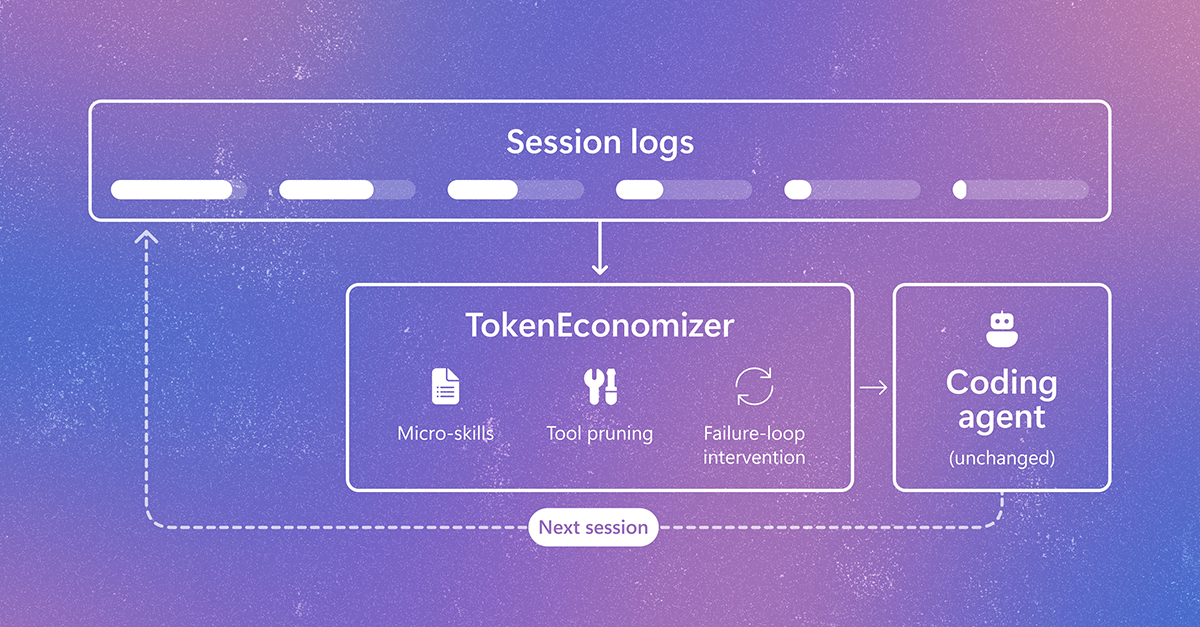
TokenEconomizer: Learning from Experience to Make AI Coding Agents More Efficient

AI coding agents are increasingly help developers fix bugs and build features largely on their own, but every interaction with their models consumes tokens. In each session, an agent sends instructions, tool descriptions, and session history to its model. Most efforts to reduce this cost focus on individual tasks. Yet developers return to the same […] The post TokenEconomizer: Learning from Experience to Make AI Coding Agents More Efficient appeared first on Microsoft Research.

We use cookies to run the site and, with your consent, for analytics and to show ads. See our Cookie Policy.