A learning-to-rank framework for selecting efficient contraction plans before executing them and supporting Learning to Rank as a practical way to reduce contraction-plan search, while showing that performance remains partly backend dependent.

Abstract
Classical simulation remains essential for developing and validating quantum algorithms, but its cost grows rapidly with circuit size. Tensor-network contraction can reduce this cost by exploiting circuit structure, although its efficiency depends strongly on the chosen contraction plan. On GPUs, plans with similar theoretical complexity may perform very differently because execution also depends on parallelism, reduction structure, memory traffic, and contraction geometry. We present a learning-to-rank framework for selecting efficient contraction plans before executing them. Each plan is represented by structural features derived directly from its sequence of pairwise contractions, and gradient-boosted rankers are trained from GPU measurements using listwise and pairwise objectives. We evaluate the resulting models on diverse circuit families, using separate in-distribution and circuit-family-shift test sets, and compare them with random and MinFill-based baselines. The learned rankers generally identify better plans, with the listwise model providing the strongest overall decision quality. We also study backend shift by comparing empirical plan orderings on two GPU architectures and evaluating the source-trained models on the second device without retraining. The rankings remain substantially, though not perfectly, stable across GPUs, and the models retain useful decision quality. These results support Learning to Rank as a practical way to reduce contraction-plan search, while showing that performance remains partly backend dependent.
Quantum computing is a promising way to study problems that are difficult for classical methods, but current quantum hardware still faces limits in scale, noise, and fidelity. Running quantum algorithms on physical machines can also be costly. Quantum circuit simulators therefore remain important because they let resea...
A systematic analysis of expressivity and trainability of Pauli Correlation Encoding and a multistage continuation framework that gradually transforms a smooth relaxed objective into a sharper objective that more closely approximates the target discrete problem are proposed.
Riku Usuki, Don Arai, Ken N. Okada et al.· 0 citations
In quantum machine learning, training a quantum model requires each sample to be prepared as a quantum state by a loading circuit that must be re-executed for every shot at every training step. The total burden therefore scales with both the number of samples and the cost of preparation. Existing approaches reduce the...
Selecting an effective encoding quantum circuit is a key challenge in quantum kernel methods because different feature maps can lead to different performance. Conventional methods require constructing and evaluating every circuit for each new dataset, making it computationally expensive. We present Qmes, an open-source...
D. Tung, Quoc Chuong Nguyen, Hai Tuan Vu et al.· 0 citations
Automated construction of variational quantum circuits remains a major bottleneck in quantum chemistry, largely because adaptive VQE methods repeatedly screen large operator pools using quantum-gradient criteria. For a canonical Hartree--Fock reference and normalized double-excitation generators, the initial ADAPT gr...
Li Hao, Chao-Qun Ji, Meng-Bo Fu· Quantum Science and Technolo...· 0 citations
Simulating a continuous-time quantum walk (CTQW) on a graph in the circuit model of quantum computing requires decomposing its Hamiltonian into terms that can be Trotterized into hardware-native gates. We consider two such decompositions: the standard Pauli decomposition and the recently introduced matching decompositi...
A weeklong summer workshop brought higher education faculty to campus to explore how AI and machine learning materials can be adapted for their classrooms.
MIT News · Artificial Intelligence· news.mit.eduAug 27, 2026
A new machine-learning framework aims to improve the success rate of computational protein design while moving away from results that reproduce sequences found in nature.
Microsoft Research Blog· microsoft.comAug 20, 2026
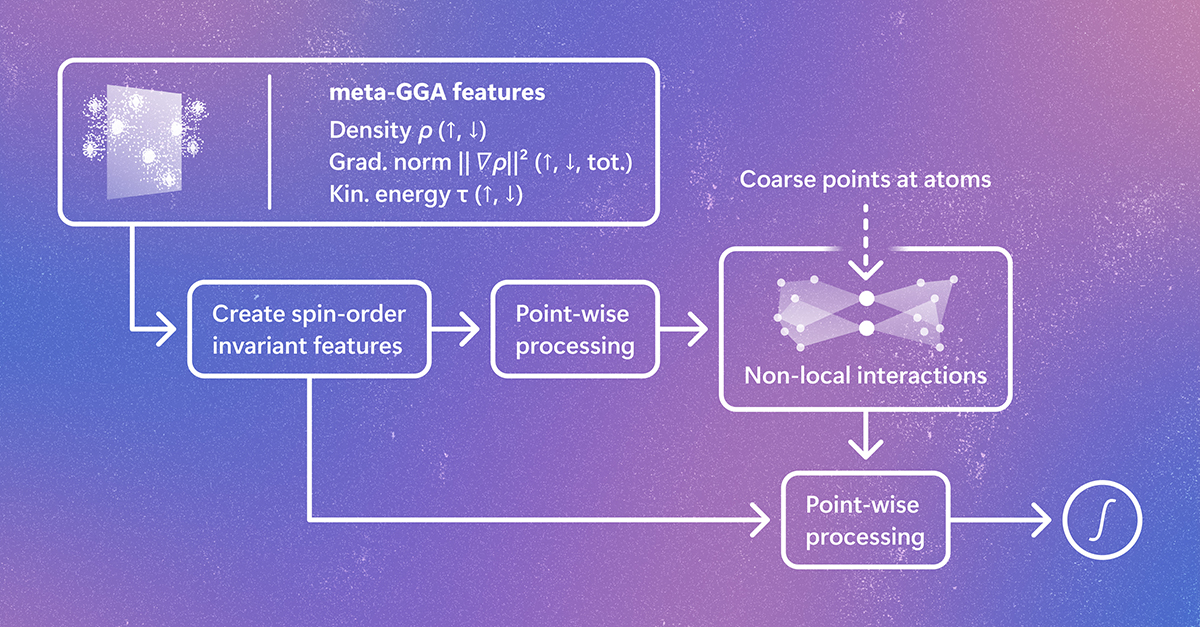
Skala 1.1, the updated deep-learning exchange-correlation functional from Microsoft Research, provides greater accuracy, expanded accessibility across the computational chemistry ecosystem, and a living benchmark to track computational performance. The post Broadening access to Skala creates a faster path to predictive DFT appeared first on Microsoft Research.
We use cookies to run the site and, with your consent, for analytics and to show ads.
See our Cookie Policy.