Sep 2026· International journal of pattern recognition and artificial intelligence· 0 citations
Authorship Attribution and ProfilingTopic Modeling
TL;DR
FedRAT is proposed, a privacy-preserving federated framework that couples paired paraphrase consistency, generator-family auxiliary supervision, differentially private client updates, and loss-dependent aggregation within a unified detection setting.
Abstract
With the widespread use of large language models, distinguishing human-written text from LLM-generated text has become increasingly important for content authenticity, academic integrity, and digital forensics. However, existing detectors remain vulnerable to paraphrase attacks, domain shift, and privacy restrictions that prevent institutions from sharing raw text data. To address these challenges, this paper proposes FedRAT, a privacy-preserving federated framework that couples paired paraphrase consistency, generator-family auxiliary supervision, differentially private client updates, and loss-dependent aggregation within a unified detection setting. FedRAT jointly learns binary AI-text detection and weak attribution to a predefined generator family through a shared encoder. Experiments on multi-domain and multi-generator benchmarks show that FedRAT consistently outperforms local training, standard federated learning, paraphrase-augmented federated learning, and representative detection baselines under clean and paraphrased settings. The ablation results evaluate attribution learning, paraphrase consistency, risk-aware aggregation, and differential privacy, while Expected Calibration Error and Brier Score provide diagnostic measures of confidence quality. The results support FedRAT as an empirically evaluated integration for privacy-constrained LLM-generated text detection and coarse generator-family attribution under the tested rewriting conditions.

Cloud-based Large Language Model (LLM) inference services typically require users to submit plain-text inputs, thereby posing severe privacy risks. Existing privacy-preserving paradigms are mostly task-specific and often necessitate pervasive modifications to the entire server-side model. This reliance introduces subst...
Wentao Zhong, Yu-Ting Li, Di-Cong Yu et al.· IEEE Transactions on Informa...· 0 citations
Client-Resolved Generation (CRG), a genera- tion interface that separates server-side generation from the lexical realization of input-derived content, is introduced, which provides a practical interface for privacy-sensitive cloud LLMs by reducing plaintext exposure across both input and output pathways while preserv-...
Jeongho Yoon, Chanhee Park, Yong-Chan Chun et al.· 0 citations
Conformal Privacy Auditing is introduced, a distribution-free calibration framework that provides a statistical certificate of re-identification risk for each released document against LLM-empowered adversaries and enables audits of open-source models and proprietary API models in a unified framework.
Shuo Huang, G. Haffari, Xing-Liang Yuan et al.· 0 citations
Natural-language datasets support many downstream applications and research studies, but releasing text can reveal sensitive global properties of the underlying data source, such as the proportion of records associated with a particular gender, diagnosis, or political stance. Existing work has largely focused on proper...
The Dynamic Relational Unlearning Framework (DRUF) is proposed which comprises a Relational Decoupling Unlearning (RDU) module and a dynamic set update mechanism that suppresses the leakage of high-risk field pairs while preserving KIE performance.
Bei-Ning Xu, Hairui Wang, Jiaxin Wang et al.· 0 citations
CoVeil is proposed, a defense mechanism which dynamically optimizes transmitted signals to suppress leakage during decoding time while preserving the collaborative quality, and consistently improves the privacy-utility trade-off over existing baselines by reducing data leakage.
Ke-Jia Zhang, Tianyuan Zou, Zi-Xuan Gu et al.· 0 citations
What does it take to trust AI-driven HVAC optimization? Our AI Model Factory combines agents, machine learning, reinforcement learning and deterministic checks in a governed workflow designed for messy, real-world building data. The post We built an AI factory for HVAC control appeared first on GPT-Lab.
MIT News · Artificial Intelligence· news.mit.eduAug 18, 2026
A new method for surgically removing training examples from a model reveals that as datasets grow, the link between what a model learns and what it produces dissolves.
Microsoft Research Blog· microsoft.comJul 30, 2026
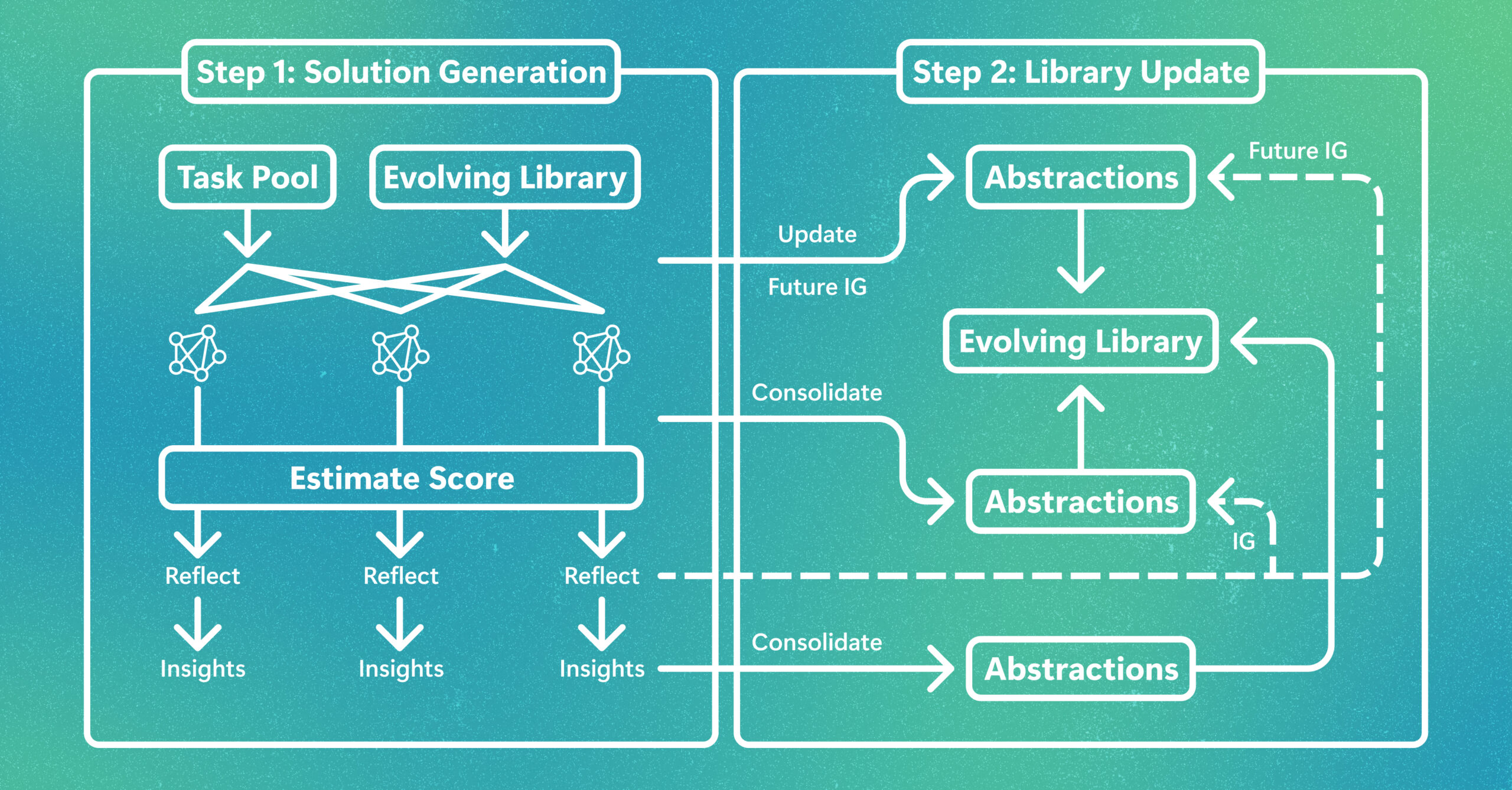
LLMs do not get smarter just by remembering more. EvoLib turns experience into evolving knowledge, taking reusable skills and insights that help models learn and adapt across tasks long after deployment. The post EvoLib: Turning experience into evolving knowledge appeared first on Microsoft Research.
MIT News · Artificial Intelligence· news.mit.eduMay 20, 2026