Skip to content

Luck Is Not Skill: When Do Paired Rollouts Help Group-Relative RL of LLM Agents?

Sep 2026 · arXiv.org · Vol abs/2609.24144 · 0 citations · 27 references
Computer Science

TL;DR

Pairing removes the between-schedule component of reward-contrast variance, but need not reduce gradient variance, and finite-sample measurements support the variance mechanism without establishing a general learning-speed benefit.

Abstract

Group-relative reinforcement learning compares rollouts of the same prompt, but independent environment noise can obscure these comparisons. We study paired rollouts, which share an event-keyed noise schedule within each group while preserving each rollout's marginal distribution. Pairing removes the between-schedule component of reward-contrast variance, but need not reduce gradient variance. For one-sided grader noise, we derive an exact condition for reduction and give a counterexample in which reward contrasts improve while gradient variance increases. A controlled study trains a 2B tool-use agent under tool faults and grader flips, with three seeds per design. The protocol was registered with a disclosed, previously completed pilot. Under tool faults, pairing improves final noisy-test success by +5.1 percentage points on average, with all three seed differences positive, but misses the registered learning-curve criterion. The criterion is also missed under grader flips: the validation-AUC difference is +0.003 (95% interval [-0.029, +0.033]). A gradient probe on eight distinct checkpoints from two fault-trained trajectories finds lower mean-centered covariance traces under both noise types: 21 to 30% for grader flips and 40 to 63% for tool faults. These finite-sample measurements support the variance mechanism without establishing a general learning-speed benefit. The results distinguish improving reward comparisons, reducing estimator variance, and improving learning.


View source

Similar papers

Preprint Oct 2026

Measure First, Then Allocate: Calibrated Rollout Budgets for MCP Agents in Reinforcement Learning

Training tool-using language models requires costly interaction, yet identical rewards within a rollout group provide no group-relative learning signal. We use reward disagreement to guide harness evaluation and the allocation of rollouts for policy training in Model Context Protocol (MCP) environments. We first introd...

Hieu Tran, Zonghai Yao, Sunjae Kwon et al. · 0 citations

Learning Beyond What You Sample: Off-Policy-Aware Cross-Model Trajectory Exchange for RLVR

GRAFT (Gated Replacement of Answer-Failed groups with peer Trajectories), an off-policy-aware framework that replaces all-fail groups with informative peer groups and transfers both successful and unsuccessful peer responses with peer-computed advantages, while controlling cross-model mismatch through sequence-level co...

Doohyuk Jang, Y. Park, Gyouk Chu et al. · 0 citations

Where the Model Changes Its Mind: Hindsight-Divergence Localization for Efficient Reinforcement Learning with Verifiable Rewards

Group-relative methods for reinforcement learning with verifiable rewards (RLVR) learn from differences in rollout outcomes. Independently sampling complete trajectories is costly and does not explicitly explore the decision space at critical positions. Feedback on a completed trajectory can reveal which earlier choice...

Fan-Chao Chen, Heng-Yu Fu, S. Venkataraman et al. · 0 citations
#artificial intelligence Preprint Oct 2026

Hindsight-Privileged RLVR: Single-Rollout Token Credit Without Group Sampling

Reinforcement learning with verifiable rewards (RLVR) trains language models from checked task outcomes, but assigning a terminal reward to individual reasoning tokens or actions remains difficult. Group-relative methods such as Group Relative Policy Optimization (GRPO) sample several attempts per prompt, but lose thei...

Wei Chen, Yu-Bing Wu, Zhou-Shi Xu et al. · 0 citations
Preprint Oct 2026

Is it RL or Data? A Controlled Comparison of GRPO and Rejection-Sampling Fine-Tuning

Bauer et al. (2026) showed that in low-data reinforcement learning with verifiable rewards, training GRPO on mixed-difficulty prompts gives up to 5x the sample efficiency of easy-only prompts. They did not test whether this benefit is specific to GRPO, or whether another post-training method given the same data would o...

Lakshya Chaudhry · 0 citations
#artificial intelligence Preprint Oct 2026

PEARL: Process-Experience Aware Reinforcement Learning for Multi-Turn Agents

Terminal rewards make multi-turn agents trainable without step-level annotations, but group-relative advantages provide little guidance about which intermediate decisions to adjust. Failed trajectories also contain reasonable actions, while unfavorable decision patterns can recur as training proceeds. We introduce PEAR...

Jie Yang, Mian-Qiu Huang, Yi-Wei Zhao et al. · 0 citations

Related blog posts

MIT News · Artificial Intelligence Nov 17, 2026

Learning the language of machine learning

By studying the computational foundations of language learning, Associate Professor Jacob Andreas builds intelligent systems that can communicate effectively with humans.

Microsoft Research Blog Nov 16, 2026

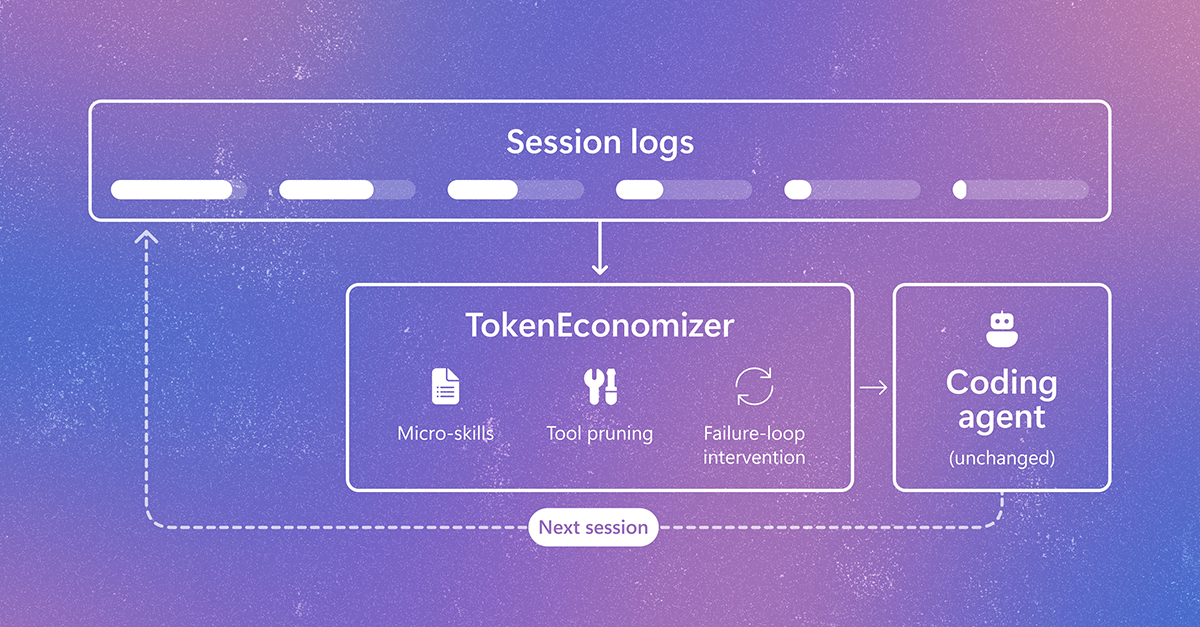
TokenEconomizer: Learning from Experience to Make AI Coding Agents More Efficient

AI coding agents are increasingly help developers fix bugs and build features largely on their own, but every interaction with their models consumes tokens. In each session, an agent sends instructions, tool descriptions, and session history to its model. Most efforts to reduce this cost focus on individual tasks. Yet developers return to the same […] The post TokenEconomizer: Learning from Experience to Make AI Coding Agents More Efficient appeared first on Microsoft Research.

We use cookies to run the site and, with your consent, for analytics and to show ads. See our Cookie Policy.