Skip to content

Underwater C3-JEPA: An Object-Centric Cross-View World Model for ROV Salvage

Sep 2026 · 0 citations · 58 references
Computer Science

TL;DR

Underwater C-JEPA (cross-view, control-conditioned, context-extended, context-extended), an object-centric multi-view predictive world model for near-field heavy-load underwater ROV salvage is presented.

Abstract

We present Underwater C$^{3}$-JEPA (cross-view, control-conditioned, context-extended), an object-centric multi-view predictive world model for near-field heavy-load underwater ROV salvage. Without contact sensors, it predicts in latent space how the task-object state evolves through contact interaction and under the hydrodynamic lag of the vehicle, from synchronized multi-view RGB observations and vehicle control signals. C$^{3}$-JEPA encodes multi-camera observations into task-object and context tokens, fuses cross-camera evidence through held-out-view attention, and directly predicts future states conditioned on control. Weak binding anchors the target and gripper at low annotation cost, while SIGReg sharpens the geometric representation. Experiments show that the learned representation transfers substantially more task-relevant information to downstream probes than a reconstruction-free latent baseline, while keeping the predictor lightweight. The resulting predictive interface supports model-predictive-control (MPC) candidate evaluation and imagined-rollout behavior-agent training. Validation on real underwater video shows the same architecture recovering a withheld camera's object state and staying ahead of persistence, so the recipe transfers beyond simulation.

View source

Similar papers

Conference Sep 2026

UCD-Where2comm: ground-prior-guided communication-efficient collaborative 3D object detection for multi-UAV swarms

Multi-UAV collaborative perception enlarges the observation field and reduces occlusion by sharing complementary observations, but deployment is constrained by wireless bandwidth and by the difficulty of mapping camera features from different UAV heights, viewing angles, and baselines into a consistent 3D space. This p...

Lin-Lin Liu, Xin Liu, Jing-Ru Wang · 0 citations
Sep 2026

RoGSW4RLD: Feed-Forward 4D Gaussian Lifting for Robot World Model Rollouts

RoGSW4RLD is introduced, a feed-forward framework that lifts synchronized multi-camera rollouts into a unified, time-queryable metric 4D Gaussian field and directly reconstructs the visual future generated by existing world models.

Jin Hyun Kim, Min Young Kim, Soohwan Song et al. · 0 citations
Preprint Aug 2026

Contact-Aided Factor-Graph Localization for Underwater Sampling

Accurate state estimation for autonomous underwater vehicles performing close-range seafloor sampling remains challenging. In low-altitude operation, down-looking cameras over featureless planar seabeds produce scale ambiguity, lateral degeneracy, and inconsistent feature tracking. Meanwhile, inertial-Doppler Velocity...

Michele Grimaldi, Yosaku Maeda, H. Kakami et al. · 0 citations
Preprint Oct 2026

FUSEye: Training-Light Fisheye Detection with Overlapping Views and Zero-Initialized Adapters

Fisheye cameras give mobile robots a single-sensor, low-cost view of their surroundings, yet the COCO-pretrained detectors that practitioners routinely reuse fail on them: strong radial distortion warps local image structure, while boundary compression shrinks objects to near-invisible sizes. Full fine-tuning closes mu...

Wen-Ya Su, Kai Luo, Di Wen et al. · 0 citations
Sep 2026

AMB3R-SLAM: Kilometer-scale SLAM with Hierarchical Backend

AMB3R-SLAM achieves strong camera tracking performance across 9 datasets, reducing the absolute trajectory error of previous state-of-the-art methods on VBR and Oxford Spires by over 70%.

Hengyi Wang, Lourdes Agapito · 1 citation · ⚡1
Preprint Oct 2026

F$^2$ SLAM: Turning Feed-Forward Geometry into Persistent Factors for SLAM

Feed-forward 3D models provide strong multi-view geometric priors, while on- line simultaneous localization and mapping (SLAM) relies mainly on local mea- surements and can accumulate drift over long sequences. Existing attempts to combine the two typically treat feed-forward predictions as an external geomet- ric stat...

Zhi-Song Xu, Fan Zhu, J. Qian et al. · 0 citations

Related blog posts

MIT News · Artificial Intelligence Nov 13, 2026

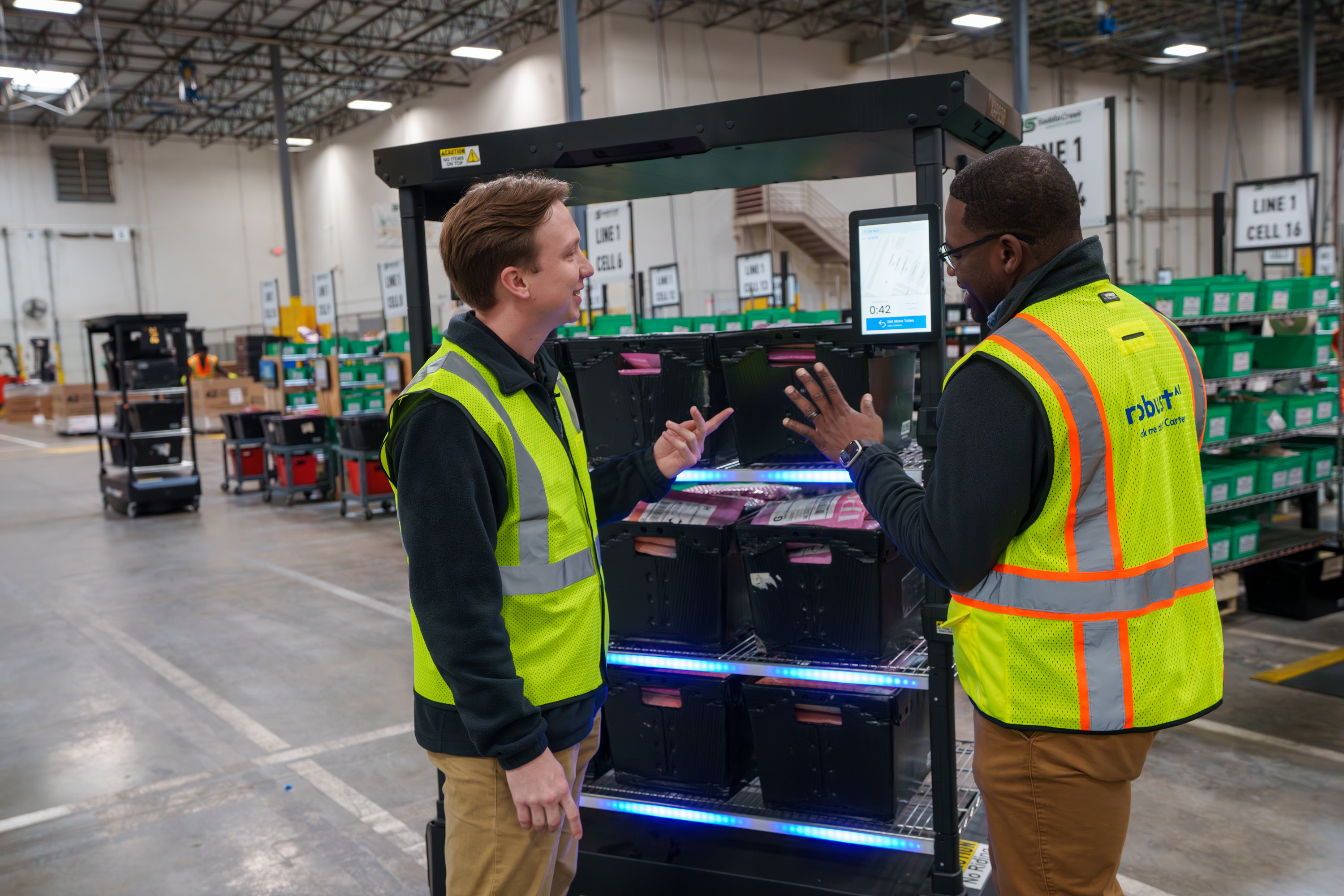
Helping robots fit into the human workplace

Founded by Anthony Jules ’92, SM ’92 and Professor Emeritus Rodney Brooks, Robust AI’s robots are designed to collaborate with humans in factories and warehouses.

We use cookies to run the site and, with your consent, for analytics and to show ads. See our Cookie Policy.