Oct 2026· IEEE Transactions on Emerging Topics in Computational Intelligence· Vol 10, pp. 3699-3714· 0 citations· 43 references
Abstract
Federated learning (FL) enables collaborative model training without centralized data sharing, yet its practical deployment is often hindered by slow convergence and excessive communication overhead, particularly under non-Independent and non-Identically Distributed (non-IID) data distributions. To address these challenges, this paper proposes Federated Fractional Order Gradient Descent with Adaptive Momentum (FedFOGDAM), a novel client-side optimization framework that integrates fractional-order gradients with adaptive momentum and bias correction to accelerate convergence and reduce the number of communication rounds (CRs) required for model convergence. By leveraging the memory effect of fractional-order calculus, FedFOGDAM stabilizes local updates and mitigates client drift, while adaptive momentum enhances update consistency across heterogeneous clients. We provide a rigorous convergence analysis under non-convex objectives, demonstrating improved convergence behavior compared to conventional integer-order optimizers. Extensive experiments on benchmark datasets under both IID and non-IID settings show that FedFOGDAM consistently achieves communication-efficient convergence and competitive accuracy.
Experimental results on heterogeneous MNIST and CIFAR-10 settings show that QEF-GT-AdamW consistently improves robustness and convergence performance over representative DecL baselines while achieving favorable accuracy-communication trade-offs under limited wireless resources.
Thieu Van Nguyen, T. Nguyen, Ons Aouedi et al.· 0 citations
This paper proposes a robust decentralized personalized federated learning method R-DPFL, that enables clients to reduce the impact of Byzantine attacks via robust neighborhood direction estimation and history-based update trend prediction, rather than purely aggregating client models as in the existing work. In R-DPFL...
: Personalized federated learning (PFL) aims to address the insufficient adaptability of a single global model caused by Non-IID data. It improves client-specific performance by learning customized models for different clients. However, existing PFL methods based on similarity modeling often struggle to balance persona...
Decentralized federated learning paradigms are increasingly adopted to support scalable and privacy-preserving training across distributed edge systems. However, existing approaches exhibit significant performance variability under realistic system conditions, including statistical heterogeneity, resource constraints,...
Sergey Dubrovskiy, Abdulsalam Yassine· 2026 4th International Confe...· 0 citations
Estimation error provably converges to zero as training progresses and HaFedHo surpasses state-of-the-art methods, including SCAFFOLD, MimeLite, and FedDyn, in both test accuracy and communication efficiency.
Jian-Rong Lu, Bang-Wei Li, Zhuo-Ya Gu et al.· Proceedings of the Thirty-Fi...· 0 citations
FedPGT, a progressive gradient transmission scheme for VFL over time-varying channels, where vehicles progressively transmit high-magnitude gradient entries in response to instantaneous channel conditions is proposed, establishing a convergence bound that characterizes the impact of transmitted gradient entries and rev...
Jin-Tao Yan, Tan Chen, Yuxuan Sun et al.· arXiv.org· 0 citations
Related blog posts
Microsoft Research Blog· microsoft.comNov 16, 2026
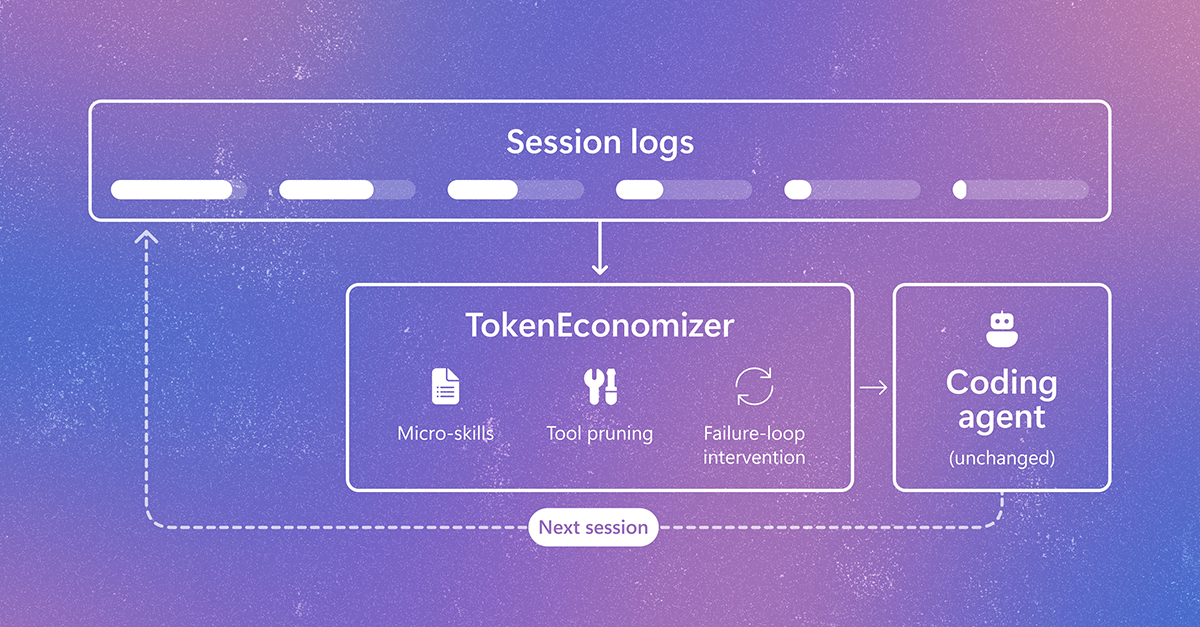
AI coding agents are increasingly help developers fix bugs and build features largely on their own, but every interaction with their models consumes tokens. In each session, an agent sends instructions, tool descriptions, and session history to its model. Most efforts to reduce this cost focus on individual tasks. Yet developers return to the same […] The post TokenEconomizer: Learning from Experience to Make AI Coding Agents More Efficient appeared first on Microsoft Research.
MIT News · Artificial Intelligence· news.mit.eduNov 9, 2026
A machine-learning approach called CheMeleon provides a practical way to develop new drugs or other molecules with much less detailed, expensive experimentation.
We use cookies to run the site and, with your consent, for analytics and to show ads.
See our Cookie Policy.