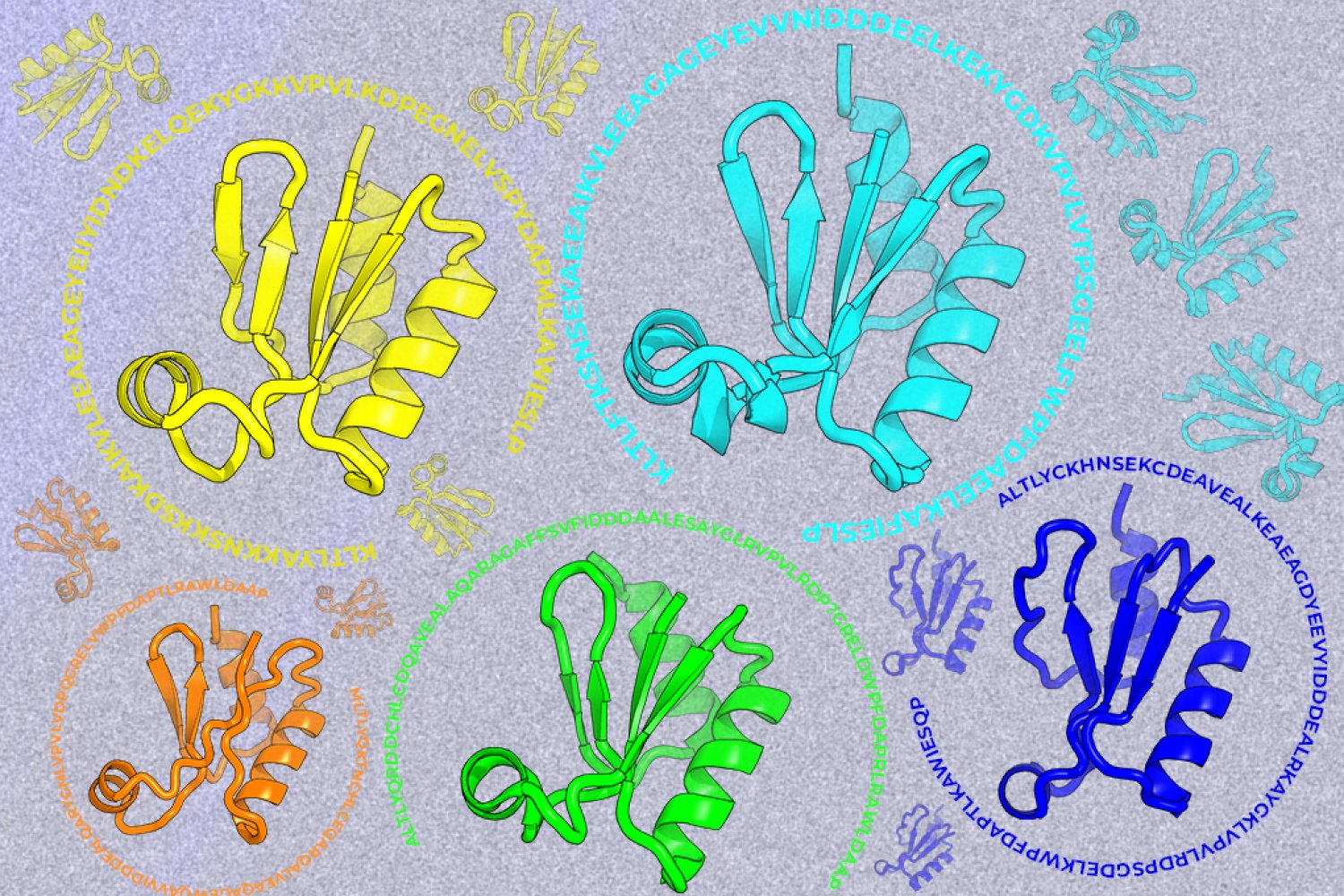
A coarse-grained, structure-based model is developed and applied to investigate how temperature and electrostatic screening control this fold switch in XCL1, showing that productive dimerization tends to occur when both chains are at least partially unfolded and that formation of the final alternate dimer may proceed via an intermediate state characterized by a partially formed dimer interface.
Abstract
Metamorphic proteins challenge the classical view of protein folding by reversibly interconverting between two distinct, stable native structures. XCL1 (lymphotactin) is a prototypical example, transitioning between a monomeric mixed- α / β chemokine fold and an alternate all- β fold that forms a stable dimer. Here we develop and apply a coarse-grained, structure-based model to investigate how temperature and electrostatic screening control this fold switch. By tuning the relative interaction strength of native contacts in the two folds, we show that the model qualitatively reproduces the experimentally observed temperature dependence of XCL1 fold populations, including an increasing alternate-fold population with increasing temperature. We introduce a sequence-dependent treatment of salt effects, which reveals a strong sensitivity of the fold equilibrium to salt concentration and yields a temperature-salt phase diagram with a broad coexistence region. Focusing on conditions near coexistence, kinetic simulations of the chemokine-to-alternate fold transition show that productive dimerization tends to occur when both chains are at least partially unfolded, and that formation of the final alternate dimer may proceed via an intermediate state characterized by a partially formed dimer interface. Finally, we use the model to examine how charge patterning in ancestral variants of XCL1 modulates the population balance between the two folds.

The results demonstrate that path-metadynamics enables the calculation of rate constants, the localization of transition states, and the mapping of the free energy along a transition path described on a high-dimensional space.
This work employs MD simulations and the path-metadynamics method to elucidate the dissociation/formation mechanism of the complex GCN4 leucine zipper between the native state (N) and the denatured state (D).
Abiotic foldamers that switch between distinct, well-defined geometries are rare. Here, we report a structurally simple series of oligomers with alternating ortho-phenylene and 2,3-pyrazinylene repeat units. Deconvolution of variable-temperature 1H NMR spectra, with the help of ab initio chemical shift predictions, sho...
Ying Liao, Vipul Batra, G. P. Devkota et al.· Chemistry· 0 citations
This work stabilizes the crucial half-bound intermediate of a cooperative dimer in the enzyme chorismate mutase by chemically linking one NMR-visible subunit to one that cannot bind ligand, letting us watch each subunit independently.
P. J. Sapienza, T. Mileur, M. S. Khan et al.· bioRxiv· 0 citations
Protein folding is a process in which the linear amino acid chain is transformed into a stable three-dimensional native structure which enables the protein to carry out its function. In several neurodegenerative diseases, including Alzheimer's disease (amyloid-β) and Huntington's disease (huntingtin), a pathological me...
Yi-Yuan Xie· Theoretical and Natural Scie...· 0 citations
High hydrostatic pressure provides a unique and sensitive perturbation to protein structure, enabling direct measurement of volume changes associated with folding, misfolding, and assembly. Because pressure perturbs noncovalent forces while preserving covalent integrity, it reveals conformational intermediates that o...
J. L. Silva, G. C. de Andrade, M. A. Marques et al.· ACS Applied Polymer Material...· 0 citations
Related blog posts
MIT News · Artificial Intelligence· news.mit.eduNov 9, 2026
A new machine-learning framework aims to improve the success rate of computational protein design while moving away from results that reproduce sequences found in nature.