A unified theory for RE(S) is developed that covers the full spectrum of S, and can be interpreted as a stage-wise optimization process, where each stage takes $S$ gradient steps for minimizing the Kullback-Leibler distance to a fixed reward-weighted rollout distribution.
Abstract
We study the learning dynamics of fine-tuning a policy model on self-generated and reward-weighted data, with particular focus on a generalized version of REINFORCE -- referred to as RE(S) -- that updates the rollout distribution once every $S \ge 1$ gradient steps. Prior work in bandits and reinforcement learning has developed rich theory for policy gradient methods, and on-policy sampling (i.e., a small $S$, ideally $1$) is often viewed as crucial to their success; yet in prominent application like post-training large language models, reward-guided self-training has proved to be effective even when the rollout distribution is updated infrequently, but theoretical understanding remains limited for the convergence properties of these off-policy methods. To bridge these gaps, we develop a unified theory for RE(S) that covers the full spectrum of $S \ge 1$: it can be interpreted as a stage-wise optimization process, where each stage takes $S$ gradient steps for minimizing the Kullback-Leibler distance to a fixed reward-weighted rollout distribution. For multi-arm bandits with softmax policies, our in-depth analysis and numerical experiments reveal three key findings: (1) for any fixed $S$, RE(S) enjoys global convergence to the optimal policy as the number of rollout distribution updates $B = \lfloor T / S \rfloor \rightarrow \infty$, where $T$ denotes the number of gradient steps; (2) we prove tight two-sided bounds showing that the suboptimality gap of RE(S) achieves an asymptotic $\Theta(1 / T)$ convergence rate, while $S$ only affects the length of a burn-in phase; (3) when initialized at a weak policy with a small optimal-action probability, RE(1) gets trapped around suboptimal policies for a long period, whereas RE(S) with a suitable $S$ avoids the detour and achieves significantly faster convergence to the global optimum, highlighting the benefits of off-policyness in this case.

On-policy learning has been argued to reduce catastrophic forgetting, produce sparser parameter updates, and improve generalisation. However, existing comparisons between supervised fine-tuning and reinforcement learning vary many factors simultaneously, making the contribution of rollout policy difficult to isolate. W...
Julianna Piskorz, Antonin Berthon, M. van der Schaar· 0 citations
This work introduces Minimal Intervention Reinforcement Learning (MInTRL), which expands the exploration frontier through sparse, local interventions in otherwise on-policy rollouts, and establishes minimal intervention as an effective paradigm for enhancing on-policy RL.
Ming-Yu Chen, Ye-Fan Tao, Gerald Friedland et al.· 0 citations
Reinforcement Learning with Verifiable Rewards (RLVR) methods such as GRPO rely on successful self-generated trajectories, but finite rollout budgets can produce all-fail groups with no reward-based policy-gradient signal. While additional rollouts improve the chance of success at higher cost, successful trajectories m...
Doohyuk Jang, Y. Park, Gyouk Chu et al.· 0 citations
It is shown that this loop can sustain a lower-return policy even when representation fitting is globally optimal on data selected by the agent, which then uses the resulting returns to guide its next choices.
Reinforcement learning (RL) has become a standard tool for post-training language models on reasoning tasks, where the policy is updated by reward feedback while exploring the space of responses. Despite its empirical success, theoretical understanding of RL post-training remains limited, in particular of why on-policy...
ELBO-based reinforcement learning offers a sampler-agnostic approach to fine-tuning flow matching models with reward feedback. Timestep weighting in ELBO-based RL has large impact on performance, and it also provides a unified view (as we show in this work) to understand prediction losses heuristically chosen in prior...
Qin-Wei Ma, Jing-Zhe Shi, Si-Min Fan et al.· 0 citations
Adaptive AI agents can help make BIM data more machine-readable by navigating IFC models, interpreting inconsistent information, and mapping it to defined standards. In this blog, Alok Rawat shares findings from a real-world pilot in construction workflows. The post Adaptive AI Agents in Construction Workflows appeared first on GPT-Lab.
What does it take to trust AI-driven HVAC optimization? Our AI Model Factory combines agents, machine learning, reinforcement learning and deterministic checks in a governed workflow designed for messy, real-world building data. The post We built an AI factory for HVAC control appeared first on GPT-Lab.
MIT News · Artificial Intelligence· news.mit.eduAug 18, 2026
A new method for surgically removing training examples from a model reveals that as datasets grow, the link between what a model learns and what it produces dissolves.
Microsoft Research Blog· microsoft.comJul 30, 2026
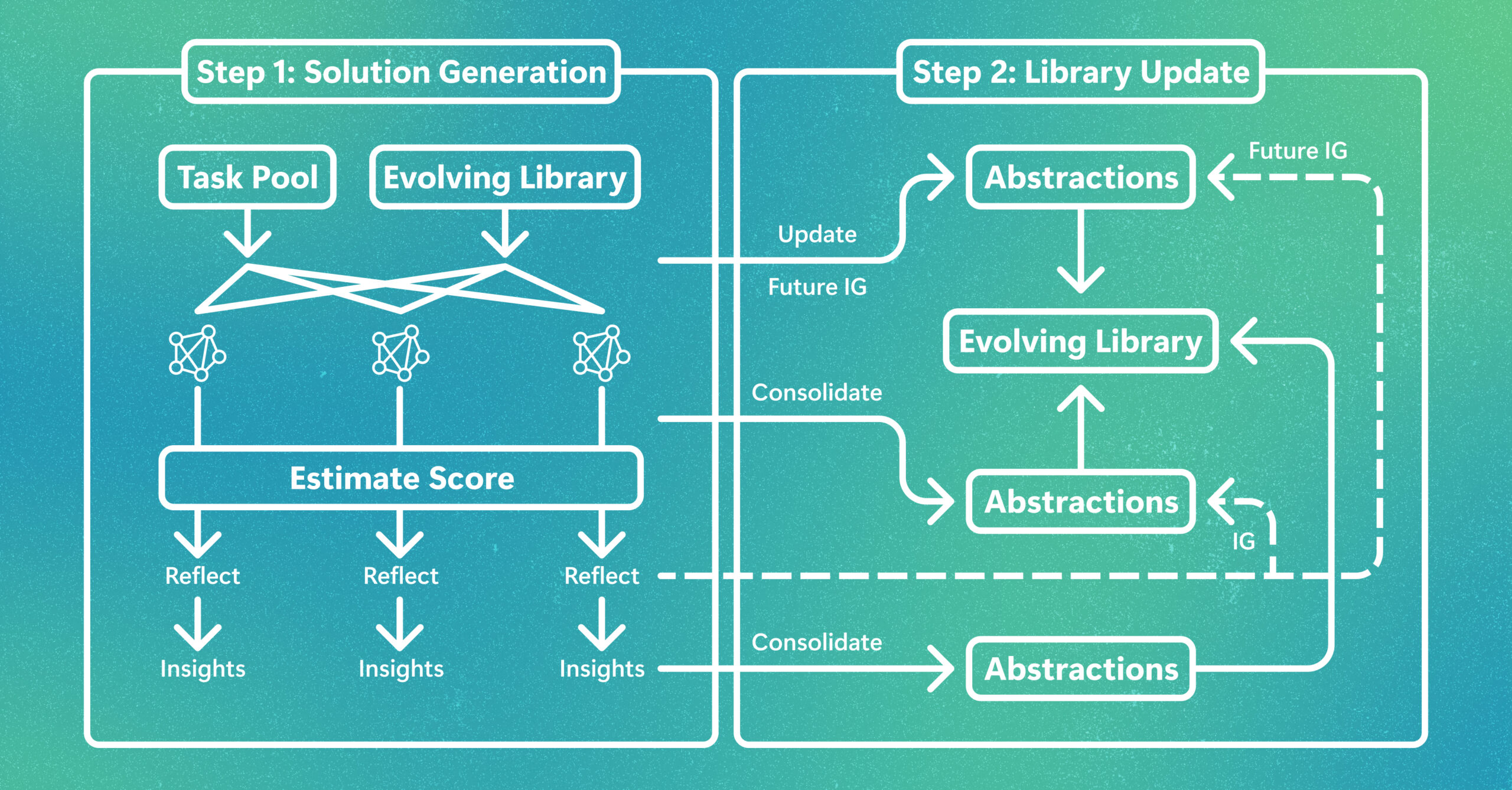
LLMs do not get smarter just by remembering more. EvoLib turns experience into evolving knowledge, taking reusable skills and insights that help models learn and adapt across tasks long after deployment. The post EvoLib: Turning experience into evolving knowledge appeared first on Microsoft Research.
We use cookies to run the site and, with your consent, for analytics and to show ads.
See our Cookie Policy.